A Day in the Life: Conducting Research on the Ethics of Regenerative Medicine
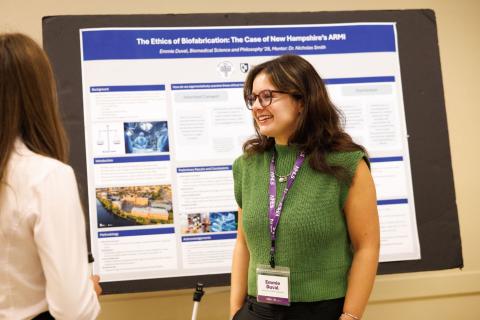
Last summer, I had the privilege of working on a normative bioethical analysis project through a Summer Undergraduate Research Fellowship (SURF) from the Hamel Center for Undergraduate Research. My work centered around creating an ethical framework for biofabrication (the manufacturing of replacement organs and tissues), which entailed heavy reading of bioethical literature, synthesis of several different existing frameworks, and writing my own opinions as to how these abstract theories ought to be applied to the tangible and ever-growing field of regenerative medicine. In other words, my project addressed how manufacturing organs can be conducted in an ethical way that benefits patients as much as possible, while acknowledging that the existing transplant system is also strained.
This research was conducted remotely, which means my days were filled with deep focus wherever I could find it. I wasn’t entirely familiar with how liberal arts research was conducted until this summer. However, with help from my advisor, Dr. Nick Smith, and other awesome mentors like Dr. Laure Barillas and Dr. Elizabeth Mellyn, I really grew as a learner, thinker, and budding philosopher. Dr. Smith and I emailed frequently and discussed the project in person when I presented my work to a group of high school philosophy students he was teaching last summer. Dr. Barillas and Dr. Mellyn reviewed my work, providing guidance that was vital to my progress. Each mentor challenged me and helped me refine my ethical arguments during the bioethical research process. Working with such excellent philosophers and researchers was a highlight of my research experience.
To give a general idea of how I organized my time conducting this work, here is what a typical day looked like for me as a full-time summer researcher.
5:45 a.m.
Wake up and get my body moving. To prepare for the more sedentary lifestyle that reading and writing calls for, I found it was important to move first thing in the morning to ensure I was ready for the day ahead.
7:00 a.m.
Eat a hearty breakfast, set up or drive to my workstation for the day, and caffeinate. It is important to fuel my brain with enough calories to think clearly while also positioning myself for success. I found several quiet workspaces that optimized my ability to think and produce good quality work.
8:00 a.m.
Settle into my workstation and begin dictating (through voice to text) my goals, expectations, and thoughts for the day. I would then organize my thoughts into a to-do list and a new idea list. This centered my work session and ensured that all the reading, writing, and revising I would do that day had purpose. It is easy to go off into rabbit holes doing research without a clear goal. I found this to be the easiest way to remain on track with my work.
8:30 a.m.
Begin completing my list of action items, which is the brunt of my work. These items can range from “revise section on informed consent” to “read critique of commodification” to “add relevant case study to distributive justice section.” While reading, I highlighted key elements of the work and summarized key takeaways in my research notebook. When writing, I tend to read aloud my work and refine for tone and clarity, incorporating any new ideas as seamlessly as possible.
10:30 a.m.
When I get stuck in a rut, I gravitate towards engaging with further philosophical theory in many different media forms. I experienced instances of writer's block, unable to figure out how to best argue for the importance of accessibility in organ distribution, for example. To continue the progression of the work, I scoured the internet for case studies in which patients lacked the resources necessary to receive the treatment they needed. This exposure to the real-world implications of bioethical tensions was usually enough to propel my argument forward, and many of these “writing brain breaks” led to discovering case studies that were incorporated into my manuscript.
11:30 a.m.
Continue revising and tackling the to-do list, if it is not yet finished.
12:30 p.m.
At this point in the day, I would usually turn off my computer for a few hours. The sun was shining and it was important to allow myself time to think about the ethical framework I was employing between writing sessions, preferably outside. Usually, my best ideas were discovered in the space between work sessions, when all the information I was trying to incorporate had time to digest, settle, and take form.
6:00 p.m.
I reread any changes I made earlier in the day, dictate my evening to-do list, and work methodically through it, as I had earlier. Revisions to work from the morning session were also usually conducted at this time.
10:00 p.m.
After writing and editing for another few hours (totaling seven per day), I close my laptop and try to get some sleep. There is always tomorrow to rinse and repeat, and my best work is done on a good night’s rest.
Reflections and Next Steps
Early findings suggested marginal improvements in the ethics of biofabrication compared with traditional models of organ donations in some fields, but not all. There are new ethical foci that must be mitigated in biofabrication, specifically: prioritizing equitable access with such advanced and likely expensive technology; ensuring that proposed biological enhancements to biofabricated organs are approached with great caution (if at all); and preserving patient autonomy and prioritizing well-being even while trying to advance technology with such incredible biological and financial potential.
Full-time remote research was both challenging and rewarding. It required an immense amount of discipline and deep focus to maintain productivity outside of a traditional lab or office setting. I learned how to manage my time effectively while diving deep into complex philosophical questions. This research is ongoing, and I will present my summer work at more than one research conference and at least one symposium throughout the next year.
I am so grateful for the generosity of the donors to the UNH Hamel Center for providing the funds to make work like this possible. The doors opened by this work are truly special, and I could not have asked for a better support system and program to back this passion.

