


















Access Restricted to NH Agricultural Experiment Station Facilities
For safety reasons due to the COVID-19 pandemic, access to our NHAES farms and greenhouses has been temporarily restricted to employees and essential research staff only.

UNH Today is produced for the UNH community and for friends of UNH.
The stories are written by the staff of UNH Marketing.
Email us: unhtoday.editor@unh.edu.
Manage Your Subscription Contact Us

For safety reasons due to the COVID-19 pandemic, access to our NHAES farms and greenhouses has been temporarily restricted to employees and essential research staff only.
University of New Hampshire (UNH) researchers have launched a new study that will evaluate plants from three cold-hardy hydrangea species for cut flower and landscape use.
The next major eastern spruce budworm outbreak likely will hit Northeastern United States forests over the next few years, putting more than 11.4 million acres of forest and 94.8 million metric tons of stored carbon in spruce and balsam fir at risk. While salvaging these trees for energy or lumber increases carbon dioxide emissions in the short-term, New Hampshire Agricultural Experiment Station researchers have found that certain forest management practices result in long-term benefits that can balance these short-term setbacks.
A two-year study into cover crops at UNH allowed scientists to determine not just the average values for each cover crop but also the consistency of each cover crop’s performance.
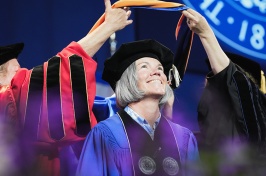
Serita Frey, professor of soil microbial ecology at the University of New Hampshire and a researcher with the New Hampshire Agricultural Experiment Station, has been named a fellow by the Ecological Society of America.
Tim Marquis graduated with his bachelor’s degree in biomedical science from the UNH College of Life Sciences and Agriculture in 2015, and will complete medical school at the University of Connecticut this May. While he was an undergraduate, he conducted research at the New Hampshire Agricultural Experiment Station with Dr. Stacia Sower, professor emerita of molecular, cellular, and biomedical sciences, discovering a novel pituitary cell type in the lamprey. He credits his work with her and her mentorship with providing him the personal and professional qualities necessary for him to perform high-quality research in a world-class environment. As he fininishes medical school during the COVID-19 pandemic and prepares to start his residency at Yale, we asked him what the last few months have been like. Here is what he told us.
Wood-fired heaters create local jobs. Can they fight climate change, too?
Wilfred Wollheim, associate professor of natural resources and the environment, presents “Are Rivers the Livers of Watersheds? River Network Capacity to Remove Nutrient Pollution,” at the 2020 Farm, Forest, and Garden Expo.
As the world continues to focus on responding to the COVID-19 pandemic, New Hampshire should not let its guard down about additional diseases of potential importance to the state and nation. Pathologists and personnel at the New Hampshire Veterinary Diagnostic Laboratory at UNH continue to safeguard animal and public health by delivering essential services to the state and region.
The Fairchild Dairy Teaching and Research Center and the Organic Dairy Research Farm, both facilities of the NH Agricultural Experiment Station at the University of New Hampshire, have been awarded 2019 Quality Milk Awards from the nationally recognized nonprofit dairy farmers cooperative Dairy One. Less than one quarter of Dairy One’s member herds received the designation in 2019.