Environmental Sciences: Earth Systems, B.S. - CEPS, UNH

Undergraduate

Environmental Sciences: Earth Systems

Explore an in-depth study of the biological, chemical, and physical processes that shape our natural environment.
Degree
Bachelor of Science
Location
Durham, NH
Courses
25*
Credit
128 hrs.*
Full-time
4 yrs.
Part-time
Varies
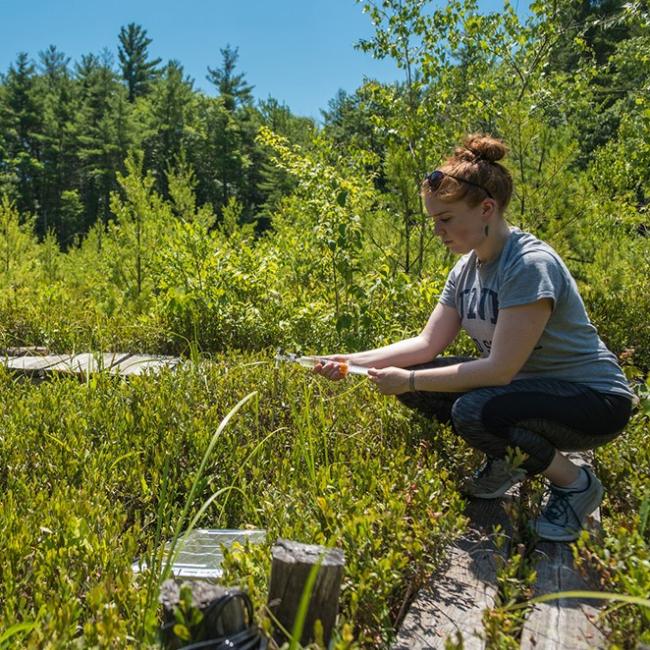
Female student crouching in a field collecting a sample with a needle

Earth Sciences

The Environmental Sciences degree with a Earth Systems focus offers an in-depth study of the biological, chemical, and physical processes that shape our natural environment. 

Situated near the Great Bay Estuary and the White Mountains, the program provides abundant opportunities for fieldwork, hands-on learning, and research at local, national, and international levels. Guided by expert faculty, you will gain the knowledge and skills to pursue advanced research or launch a career in a wide range of growing environmental fields.

*Number of courses and course credit hours may vary, please reach out to your academic advisor for exact requirements.

Earth Sciences Department

UNH student looking at a computer screen

Innovation scholars

The only first-year research and innovation program of its type in the region!

The Innovation Scholars program, open to all CEPS majors, offers students an exceptional launch to their college experience. Through multiple interdisciplinary cohorts and hands-on research in world-class facilities, students build confidence, gain real experience, and open doors to paid research, internships, and future graduate study. It’s a proven program that helps students shape their future from day one.

Contact Cards

Undergraduate Coordinator
Associate Professor
James Hall, Room 230, Durham, NH 03824
(603) 862-4119

What is the Earth Systems option in Environmental Sciences?

Majoring in Environmental Science at UNH with an option in Earth Systems will provide you with a deep understanding of the complex interactions within the Earth systems that both shape our modern environment and provide critical resources for society. The Earth Systems option emphasizes hydrological processes, geochemical cycling, and the interplay between these complex natural systems and society. This major is ideal for those seeking studies that emphasize using a strong foundation in mathematics and the physical and biological sciences to address environmental challenges in a sustainable manner. This major positions students for work in the environmental and geosciences industry, energy and climate technology sectors, teaching at the secondary level, state and federal environmental agencies, and graduate studies in the Earth and environmental sciences.

Why study Earth systems at UNH?

UNH is a recognized leader in environmental sciences research related to the Earth systems. Students benefit from the significant depth and breadth of faculty expertise in the areas of hydrology, water resources, stream processes, climate change, biogeochemistry, and environmental chemistry. The location of UNH, on the Great Bay Estuary and close to both the White Mountains and the Gulf of Maine, provides an ideal backdrop for hands-on learning opportunities for all environmental science students. Students have multiple opportunities to immerse themselves in research experiences in the field and in state-of-the-art laboratories and computer centers. The increasing need for environmental protection, climate adaptation and technologies, and land and water resource management are projected to spur demand for broadly trained environmental scientists.

Potential Careers

  • Environmental consultant
  • Environmental toxicologist
  • Geospatial scientist
  • Hydrographer
  • Hydrologist
  • Physical scientist
  • Resource manager
  • Science journalist
  • Secondary school teacher

Curriculum & Requirements

01
Program Description
Open icon icon to open the summary

The College of Engineering and Physical Sciences (CEPS) and the College of Life Science and Agriculture (COLSA) jointly offer a Bachelor of Science degree in environmental sciences. Environmental sciences, an interdisciplinary field, focuses on the interaction of biological, chemical, and physical processes that shape our natural environment. Students graduating with a degree in environmental sciences will have an understanding of these interacting processes, the ability to communicate effectively with both scientific and lay audiences, competency in field methods appropriate for entry-level environmental science positions, competency in the use and application of Geographic Information Systems (GIS), a basic understanding of environmental policy, and the ability to contribute to multidisciplinary teams. The University of New Hampshire is a recognized leader in environmental sciences research, and the environmental sciences program capitalizes on faculty expertise in this area. The full-time faculty members comprising this program have major teaching and research emphases in the areas of biogeochemical cycling, environmental chemistry, ecosystem science, geospatial science, global change, hydrology, plant ecology, soil science, and water resource management. 

Employment opportunities include environmental consulting firms, educational facilities (e.g., science centers), environmental monitoring laboratories (e.g., water treatment plants; the Environmental Protection Agency), government agencies (e.g., the U.S. Geological Survey, Bureau of Land Management, Natural Resource Conservation Service), university and government research laboratories, and nongovernment environmental organizations. The environmental sciences program also constitutes an excellent preparation for graduate programs in several areas relating to the environment. Students should consult with their adviser early if their goals include further study.

The Program has 3 options, and specific course requirements for the major vary by option. The Earth Systems option is managed by the Department of Earth Sciences in CEPS, and the Ecosystems and Soils and Watersheds options are both managed by the Department of Natural Resources and the Environment in COLSA. The Earth Systems option provides students with a solid grounding in quantitative reasoning, with an emphasis on geochemical, hydrologic, and geospatial systems.

02
Degree Plan
Open icon icon to open the summary

Sample Degree Plan

This sample degree plan serves as a general guide; students collaborate with their academic advisor to develop a personalized degree plan to meet their academic goals and program requirements.

Plan of Study Grid
First Year
FallCredits
ESCI 400
or NR 400
First-year Experience
or Professional Perspectives in Natural Resources
1
NR 403 Introduction to Environmental Science 4
MATH 425 Calculus I 4
CHEM 403 General Chemistry I 4
ENGL 401 First-Year Writing (or pass placement test) 4
 Credits17
Spring
ESCI 409
or ESCI 402
Geology and the Environment
or Earth History
4
MATH 426 Calculus II 4
CHEM 404 General Chemistry II 4
Inquiry Discovery Course 1 4
 Credits16
Second Year
Fall
ESCI 534 Techniques in Environmental Sciences 3
PHYS 407 General Physics I 4
Intro-level Environmental Science elective 4
Discovery Course 1 4
 Credits15
Spring
BIOL 411
or BIOL 412
Introductory Biology: Molecular and Cellular
or Introductory Biology: Evolution, Biodiversity and Ecology
4
ESCI 512 Principles of Mineralogy 4
PHYS 408 General Physics II 4
Discovery Course 1 4
 Credits16
Third Year
Fall
ESCI 777 GIS for Earth & Environmental Sciences 4
NR 602 Natural Resources and Environmental Policy 4
ESCI 561 Landscape Evolution 4
Discovery Course 1 4
 Credits16
Spring
BIOL 528
or MATH 644
Applied Biostatistics I
or Statistics for Engineers and Scientists
4
ESCI 654
or ESCI 642
Fate and Transport in the Environment
or Biogeosciences in the Earth System
4
ESCI 690 Capstone & Professional Development 1
Science Elective 2 4
Discovery Course 1 4
 Credits17
Fourth Year
Fall
ESCI 705
or ESCI 741
Principles of Hydrology
or Geochemistry
4
Quantative Methods Elective 4
Free Elective 2 4
Discovery Course 1 4
 Credits16
Spring
ESCI 710
or ESCI 745
Groundwater Hydrology
or Isotope Geochemistry
4
Science Elective 2 4
Free Elective 4
Senior Capstone 4
 Credits16
 Total Credits129
1

One course must be taken in each of the remaining Disciplinary Groups of the University Discovery Program (Environment Technology & Society; Historical Perspectives; World Culture; Fine & Performing Arts; Social Science; Humanities).

2

Three technical electives must be approved in consultation with departmental advisor.

All students must take four writing intensive courses, including ENGL 401 First-Year Writing, a course in the major, and a course at the 600/700 level.

03
Requirements for the Program
Open icon icon to open the summary

Degree Requirements

Minimum Credit Requirement: 128 credits
Minimum Residency Requirement: 32 credits must be taken at UNH
Minimum GPA: 2.0 required for conferral*
Core Curriculum Required: Discovery & Writing Program Requirements
Foreign Language Requirement: No

All Major, Option and Elective Requirements as indicated.
*Major GPA requirements as indicated.

Major Requirements

In addition to the Discovery Program and University writing requirements, all students complete introductory courses, and foundation courses that include introductions to biology, physics, chemistry, geology, calculus, and statistics. Students must complete additional courses for the Earth Systems option, including at least four courses at the 700-level.

Required Courses
Foundation
MATH 425Calculus I4
MATH 426Calculus II4
CHEM 403
CHEM 404
General Chemistry I
and General Chemistry II
4-8
or CHEM 405 Chemical Principles for Engineers
PHYS 407General Physics I4
PHYS 408General Physics II4
MATH 644Statistics for Engineers and Scientists4
or BIOL 528 Applied Biostatistics I
BIOL 411Introductory Biology: Molecular and Cellular4
or BIOL 412 Introductory Biology: Evolution, Biodiversity and Ecology
Intro
ESCI 400First-year Experience1
or NR 400 Professional Perspectives in Natural Resources
NR 403Introduction to Environmental Science4
Select one introductory level elective from the following:4
ESCI 405
Global Environmental Change
ESCI 420
Our Solar System
ESCI 501
Introduction to Oceanography
ESCI 514
Introduction to Climate
NR 504
Freshwater Resources
CEE 520
Environmental Pollution and Protection: A Global Context
GEOG 473
Elements of Weather
Earth Systems
ESCI 401Dynamic Earth4
or ESCI 402 Earth History
or ESCI 409 Geology and the Environment
ESCI 561Landscape Evolution4
ESCI 512Principles of Mineralogy4
or NR 501 Studio Soils
ESCI 642Biogeosciences in the Earth System3-4
or ESCI 654 Fate and Transport in the Environment
NR 602Natural Resources and Environmental Policy4
or NR 507 Introduction to our Energy System and Sustainable Energy
Hydrology Elective
ESCI 705Principles of Hydrology4
or ESCI 710 Groundwater Hydrology
Geochemistry Elective
ESCI 741Geochemistry4
or ESCI 745 Isotope Geochemistry
or ESCI 747 Aqueous Geochemistry
Methods
ESCI 534Techniques in Environmental Sciences3
NR 658Introduction to Geographic Information Systems4
or ESCI 777 GIS for Earth & Environmental Sciences
Select one quantitative methods elective from the following:4
ESCI 633
Sea Level Rise and Fall
ESCI 654
Fate and Transport in the Environment
ESCI 701
Quantitative Methods in Earth Sciences
ESCI 734
Global Geophysics
ESCI 764
Spectral Analysis of Geophysical Time Series Data
CS 410P
Introduction to Scientific Programming/Python
CS 457
Introduction to Data Science and Analytics
MATH 527
Differential Equations with Linear Algebra
MATH 528
Multidimensional Calculus
MATH 645
Linear Algebra for Applications
MATH 739
Applied Regression Analysis
MATH 740
Design of Experiments I
Math/Science Electives
Select two approved science electives determined in consultation with departmental advisor.8
The following should be considered: additional courses in Earth Sciences, Mathematics, Chemistry, and Physics; Computer Science, Engineering, the Biological Sciences, or Natural Resources and the Environment.
Professional Development
ESCI 690Capstone & Professional Development1
Capstone Experience*
Total Credits84-89


For further information about the Earth systems option, students may contact earth.sciences@unh.edu.

Some students enroll in the EcoQuest program (a study abroad opportunity in New Zealand), which satisfies the policy requirement, and capstone requirement if taken senior year.

*Capstone Experience

A capstone experience is required of all undergraduate Earth sciences majors during their senior year. All capstone experiences at UNH must meet one or more of the following criteria:

  1. The capstone synthesizes and applies disciplinary knowledge and skills.
  2. The capstone fosters reflection on undergraduate learning and experience.
  3. The capstone demonstrates emerging professional competencies.
  4. The capstone applies, analyzes, and/or interprets research or data or artistic expression.
  5. The capstone explores areas of interest based on the integration of prior learning.

Suggested ways of meeting the capstone requirement in the Department of Earth Sciences include approved INCO 790 Advanced Research Experience, ESCI 795 Topics, ESCI 796 Topics, ESCI 799 Senior Thesis, URA/SURF/IROP projects, internships, environmental/geologic field camps, REU programs, or Earth Sciences education and outreach activities designed according to the above criteria. Capstone experiences must be equivalent to a minimum of 2 academic credits. Students should work closely with their faculty advisors to define the most appropriate capstone experience for their Earth Sciences degree program, although the capstone mentor can be someone other than their primary faculty advisor. All capstone experiences must be approved and certified by the faculty advisor and the capstone mentor. Presentation of projects or experiences developed for the capstone is encouraged at the annual UNH Undergraduate Research Conference or other appropriate venue.

04
Student Learning Outcomes
Open icon icon to open the summary

Program Learning Outcomes

Students will be able to:
  • Recognize and understand common Earth and environmental materials, processes, dynamics, and cycles.
  • Demonstrate a broad understanding of Earth-ocean-atmosphere systems, with an emphasis on interactions among physical, chemical, and biological processes that shape our natural environment and impact society.
  • Perform calculations and apply computational methods to process and evaluate a range of quantitative Earth, environmental, geochemical, and hydrologic data.
  • Become proficient in basic Earth and the environmental science laboratory and field techniques.
  • Summarize, analyze, evaluate, and explain/present student-generated scientific data and the primary Earth and environmental sciences literature.
  • Effectively communicate results of scientific inquiries orally, visually, and in writing.

Explore Program Details

01
Capstone Experience
Open icon icon to open the summary

A key requirement of the Discovery Program is the completion of one senior capstone experience, to be supervised and approved within the major.

Earth Sciences & Environmental Sciences Capstone Agreement Form

Earth Sciences & Environmental Sciences Capstone Evaluation Form

02
Resume
Open icon icon to open the summary
03
Forms
Open icon icon to open the summary

Departmental Petition for Program Variance - Petition for major requirement

Registrar Forms - including Petition for Variance in Academic Policy (Petition for University and/or Discovery requirement)

04
Advanced Degrees
Open icon icon to open the summary

Those interested in the Environmental Sciences: Earth Systems option major may also be interested in the following advanced degrees. Students in the program also have the opportunity to participate in the UNH accelerated master’s program.


Earth & Environmental Science Ph.D.

Earth Sciences M.S.

Earth Sciences: Geochemical Systems M.S.

Earth Sciences: Geology M.S.

Earth Sciences: Ocean Mapping M.S.

Hydrology M.S.

Oceanography M.S.

Oceanography Ph.D.