Click below to get more information about UNH graduate programs
Request Information Form
Request Information Form

Earth Sciences
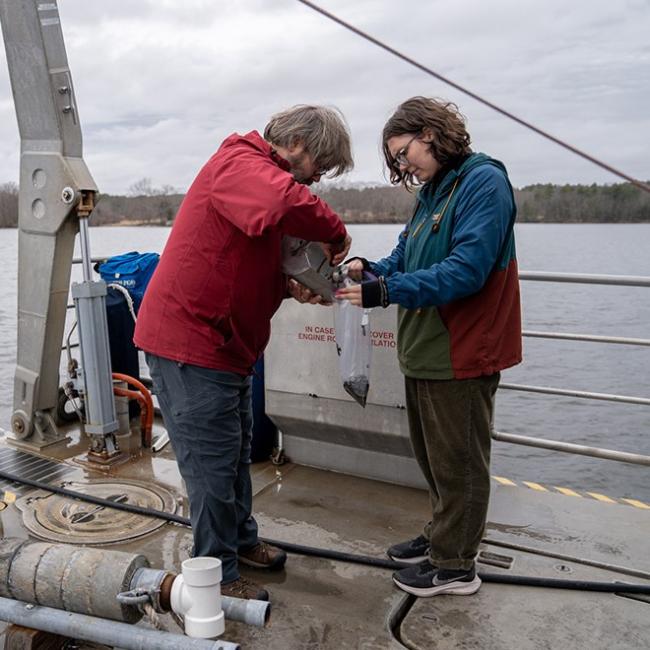
The Oceanography Master's program at UNH offers comprehensive training in physical, biological, chemical, and geological marine science. Here you'll be able to research coastal processes, ocean acidification, and climate change alongside expert faculty.
With access to world-class facilities and diverse research opportunities, this program prepares you for careers in marine science, government, and consulting.
*Number of courses and course credit hours may vary, please reach out to your academic advisor for exact requirements.
Key Links
Contact Cards
Are you interested in the environment around you, and does a job or career in marine science appeal to you? Do your interests lie in the aquatic realm, specifically the marine system that includes oceans, estuaries and the atmosphere? Then you’re in luck! Students in the oceanography graduate program are trained in the broad sub disciplines (physical, biological, chemical and geological oceanography) and in their specialty field, and conduct research in topics including – but not limited to – coastal and estuarine processes, sedimentation and transport, ocean modeling, ocean acidification, marine biogeochemical cycles, climate change, ocean mapping, paleoceanography and climatology, primary productivity and microbial ecology of marine systems.
Oceanography students at UNH can choose from a variety of research projects leading to post-graduate employment opportunities. Our faculty span the major disciplines of oceanography. Marine facilities at UNH include the Jackson Estuarine Laboratory, Coastal Marine Facility (and vessels), Shoals Marine Lab on Appledore Island, and a variety of research space in the Chase Ocean Engineering Laboratory, Ocean Processes Analysis Laboratory, Earth Sciences and Biological Sciences Departments, and the Center for Coastal and Ocean Mapping, a Joint Hydrographic Center with NOAA. Our graduates are well-suited to jobs that require knowledge of coastal and ocean processes, field data collection analysis, at-sea experience, modeling and laboratory techniques.
The Oceanography (OCE) graduate program has a diverse set of faculty, staff, and students who examine ocean processes in broad fields of physical, biological, chemical, and geological oceanography and geophysics. Basic and applied research of an experimental, numerical, and analytical nature is conducted in oceanic settings that range from shallow nearshore and estuarine waters to the deep ocean and span all ocean basins on earth including the Arctic.
OCE offers programs leading to M.S. and Ph.D. degrees. These interdisciplinary programs prepare students for professional careers in ocean-relate fields. In addition, students can also pursue an ocean mapping option within the Department of Earth Sciences and carried out within the Center for Coastal and Ocean Mapping.
The oceanography graduate program within the Department of Earth Sciences and the School of Marine Science and Ocean Engineering (SMSOE) is enhanced by the ocean engineering and marine biology graduate programs, and by other departments and institutes at UNH, including the civil and mechanical engineering and biology departments; the Institute for the Study of Earth, Oceans, and Space (EOS); the Center for Coastal and Ocean Mapping (CCOM); and the Ocean Processes Laboratory (OPAL). Other related programs include the N.H. Sea Grant Program, the Center for Collaborative Science, and the Atlantic Marine Aquaculture Center, Coastal Response Research Center (CRRC), Northeast Consortium (NEC), and the Piscataqua Region Estuaries Partnership (PREP). Oceanographic laboratories at UNH include the Shoals Marine Laboratory (SML) on Appledore Island, the Coastal Marine Laboratory (CML) in Newcastle, the Jackson Estuarine Laboratory (JEL) at Adams Point on the Great Bay, and the Chase Ocean Engineering Laboratory (COEL) on the main UNH campus. Additional laboratories for the oceanography faculty are located on campus in James, Morse, Rudman, and Spaulding Halls. The SMSOE operates a marine support facility and two UNH research vessels moored in Portsmouth Harbor at the UNH pier, the R/V Gulf Challenger and the R/V Gulf Surveyor, as well as a number of small boats. The SMSOE also supports the UNH Diving Program and oversees a shared use Instrumentation Pool for student and faculty use.
Applicants should have completed an undergraduate major related to one of the oceanography disciplines, including biology, chemistry, engineering, geology, physics, or mathematics, or an appropriate array of science and engineering courses within their major field. Applicants are expected to have completed one year each of calculus and chemistry and two semesters of physics and/or biology. It is not necessary to have had previous coursework in oceanography. Students still working to strengthen a particular component of their foundational coursework may be admitted provided they are prepared to complete courses, in addition to their graduate degree requirements, as needed.
Students must complete a minimum of 30 credits for the thesis option or 34 credits for the non-thesis option.
| Code | Title | Credits |
|---|---|---|
| Required Courses | ||
| ESCI 997 | Seminar in Earth Sciences | 1 |
| ESCI 998 | Proposal Development | 1 |
| Select two courses from the following: | 6-8 | |
BIOL 855 | Biological Oceanography | |
ESCI 852 | Chemical Oceanography | |
ESCI 858 | Introduction to Physical Oceanography | |
ESCI 859 | Geological Oceanography | |
| Thesis/Non-Thesis Option | ||
| Select one of the following options: | 6 or 2 | |
| Thesis Option: | ||
OCE 899 | Master's Thesis (acceptable to the thesis-examining committee and must pass a thesis defense) | |
| Non-Thesis Option: | ||
ESCI 898 | Directed Research | |
or OCE 898 | Directed Research | |
| Other Relevant Graduate Courses | ||
| Select from the following courses: | 16-22 | |
BIOL 828 | Marine Bioacoustics | |
BIOL 873 | Physiology of Fishes | |
ESCI 801 | Quantitative Methods in Earth Sciences | |
ESCI 820 | Ocean Measurements Lab | |
ESCI 834 | Global Geophysics | |
ESCI 841 | Geochemistry | |
ESCI 845 | Isotope Geochemistry | |
ESCI 847 | Aqueous Geochemistry | |
ESCI 849 | Ocean Biogeochemistry | |
ESCI 854 | Sedimentology | |
ESCI 856 | Geotectonics | |
ESCI 860 | Paleoceanography | |
ESCI 862 | Glacial Geology | |
ESCI 864 | Spectral Analysis of Geophysical Time Series Data | |
ESCI 865 | Paleoclimatology | |
ESCI 871 | Positioning for Ocean Mapping | |
ESCI 874 | Integrated Seabed Mapping Systems | |
ESCI 875 | Advanced Topics in Ocean Mapping | |
ESCI 896 | Topics (Nearshore Processes) | |
ESCI 972 | Hydrographic Field Course | |
ESCI 973 | Seafloor Characterization | |
ESCI 995 | Advanced Topics (Geophysical Fluid Dynamics) | |
ESCI 996 | Advanced Topics (Ocean Modeling) | |
ESCI 996 | Advanced Topics (Nearshore Hydrodynamics) | |
IAM 940 | Asymptotic and Perturbation Methods | |
MARI 895 | Special Topics (Crafting Ocean Stories) | |
MARI 995 | Special Topics (Marine Biogeochemistry Lab) | |
MATH 835 | Statistical Methods for Research | |
MATH 839 | Applied Regression Analysis | |
MATH 845 | Foundations of Applied Mathematics I | |
MATH 853 | Introduction to Numerical Methods | |
ME 807 | Analytical Fluid Dynamics | |
ME 812 | Waves in Fluids | |
ME 817 | Marine Robotics and Applications | |
ME 895 | Special Topics (Transport and Mixing in the Environment) | |
NR 844 | Biogeochemistry | |
OE 820 | Design of Recirculating Aquaculture Systems | |
OE 853 | Ocean Hydrodynamics | |
OE 854 | Ocean Waves and Tides | |
OE 857 | Coastal Engineering and Processes | |
OE 858 | Design of Ocean Structures | |
OE 865 | Underwater Acoustics | |
OE 965 | Advanced Underwater Acoustics | |
OE 995 | Graduate Special Topics (Coastal Sediment Transport) | |
OE 995 | Graduate Special Topics (Wave Energy) | |
OE 995 | Graduate Special Topics (Dynamics of Air-Sea Interactions) | |
ZOOL 810 | Sharks and Bony Fishes | |
| Total Credits | 30-34 | |
Accelerated Master’s programs offer qualified University of New Hampshire undergraduate students the opportunity to begin graduate coursework in select graduate programs while completing a bachelor’s degree. Accelerated master's programs are designed to provide students with an efficient and cost-effective pathway to earn both a bachelor's and master's degree or graduate certificate, enhancing career opportunities and long-term earning potential.
*Some exceptions apply.
*Some exceptions apply.
This graduate degree program is approved to be taken on an accelerated basis in articulation with the following undergraduate program(s):
| Code | Title | Credits |
|---|---|---|
| Earth Sciences (B.S.) | ||
| Environmental Sciences: Earth Systems Option (B.S.) | ||
| Earth and Environmental Sciences (B.A.) | ||
| Students select from the following approved 800-level courses that can be completed in the undergraduate senior year for dual credit: | ||
| ESCI 801 | Quantitative Methods in Earth Sciences | 4 |
| ESCI 805 | Principles of Hydrology | 4 |
| ESCI 810 | Groundwater Hydrology | 4 |
| ESCI 815 | Hydrologic Data Analysis | 4 |
| ESCI 820 | Ocean Measurements Lab | 4 |
| ESCI 826 | Igneous and Metamorphic Petrology | 4 |
| ESCI 834 | Global Geophysics | 4 |
| ESCI 841 | Geochemistry | 4 |
| ESCI 845 | Isotope Geochemistry | 4 |
| ESCI 847 | Aqueous Geochemistry | 4 |
| ESCI 849 | Ocean Biogeochemistry | 3 |
| ESCI 852 | Chemical Oceanography | 3 |
| ESCI 854 | Sedimentology | 4 |
| ESCI 856 | Geotectonics | 3 |
| ESCI 858 | Introduction to Physical Oceanography | 3 |
| ESCI 859 | Geological Oceanography | 4 |
| ESCI 860 | Paleoceanography | 3 |
| ESCI 862 | Glacial Geology | 4 |
| ESCI 864 | Spectral Analysis of Geophysical Time Series Data | 4 |
| ESCI 865 | Paleoclimatology | 3 |
| ESCI 877 | GIS for Earth & Environmental Sciences | 4 |
| ESCI 878 | Remote Sensing Earth & Environmental Sciences | 4 |
| ESCI 895 | Topics | 1-4 |
| ESCI 896 | Topics | 1-4 |
| BIOL 855 | Biological Oceanography | 3 |
Program Learning Outcomes
Students graduating with a M.S. in Oceanography should achieve the following learning outcomes:Applications must be completed by the following deadlines in order to be reviewed for admission:
Application fee: $65
Administered by: Durham
New England Regional: VT
Accelerated Masters: Yes (for more details see the accelerated masters information page)
Students claiming in-state residency must also submit a Proof of Residence Form. This form is not required to complete your application, but you will need to submit it after you are offered admission, or you will not be able to register for classes.
If you attended UNH or Granite State College (GSC) after September 1, 1991, and have indicated so on your online application, we will retrieve your transcript internally; this includes UNH-Durham, UNH-Manchester, UNH Non-Degree work and GSC.
If you did not attend UNH, or attended prior to September 1, 1991, then you must upload a copy (PDF) of your transcript in the application form. International transcripts must be translated into English.
If admitted, you must then request an official transcript be sent directly to our office from the Registrar's Office of each college/university attended. We accept transcripts both electronically and in hard copy:
Transcripts from all previous post-secondary institutions must be submitted and applicants must disclose any previous academic or disciplinary sanctions that resulted in their temporary or permanent separation from a previous post-secondary institution. If it is found that previous academic or disciplinary separations were not disclosed, applicants may face denial and admitted students may face dismissal from their academic program.
Recommendation letters submitted by relatives or friends, as well as letters older than one year, will not be accepted.
Prepare a brief but careful statement regarding:
All applicants are encouraged to contact programs directly to discuss program-specific application questions.
Prospective international students are required to submit TOEFL, IELTS, or equivalent examination scores. English Language Exams may be waived if English is your first language. If you wish to request a waiver, then please visit our Test Scores webpage for more information.
An applicant to the M.S. program is expected to have completed one year of calculus and at least four semesters of college chemistry, physics, and/or biology; and to have an undergraduate degree or equivalent in geology, chemistry, physics, mathematics, engineering, or the biological sciences. Students lacking some background in a particular area may be admitted provided they are prepared to complete courses, without graduate credit, in which they may be deficient. The program of study a student wishes to follow and the student's undergraduate major determine the level of preparation necessary. The preparation of each student is determined before the beginning of the first semester in residence in order to plan the course of study. Each entering student is assigned an academic adviser to assist in planning a program of study.
Admission decisions will be based on:
