Effects of Proprioceptive Neuromuscular Facilitation (PNF) Stretching on Muscular Force Production and Range of Motion in Males and Females
Proprioceptive Neuromuscular Facilitation (PNF) is a form of stretching that is used in a variety of settings, such as athletic training and physical therapy, to increase flexibility and help with recovery from injury. PNF combines stretching and muscle contraction to manipulate proprioceptors, which are specific sensors in the muscle that prevent stretching, thereby allowing muscles to lengthen and range of motion (ROM) to increase. However, there is a tradeoff, as lengthening muscles could decrease muscle force production and impair athletic performance. The objective of our study, funded with a Summer Undergraduate Research Fellowship (SURF), was to determine if this lengthening of the muscle fibers via PNF stretching is beneficial to flexibility and detrimental to force production. Understanding these effects could aid clinicians and athletic trainers by determining the acute impacts of PNF stretching on their patients and clients.
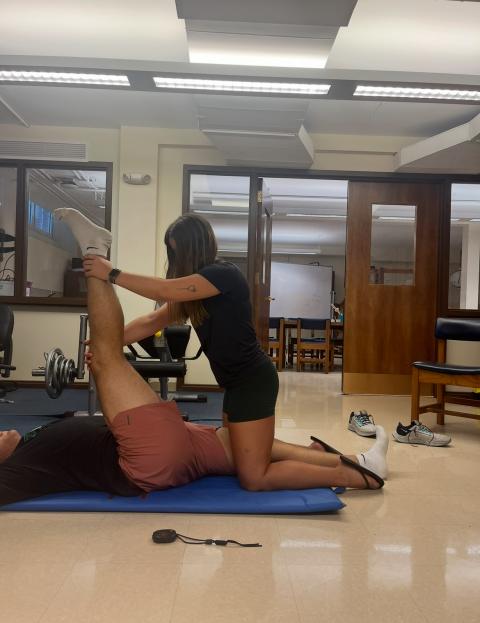
Sage Coellner conducting hold-relax PNF stretching on the hamstring muscle of a participant.
We hypothesized that PNF stretching would increase range of motion and decrease muscle force production in male and female college students. It was also hypothesized that PNF stretching would elicit a greater response in females due to their intrinsically greater range of motion and flexibility. Since males and females have different body composition and anatomy that influences flexibility, it was important for this study to compare the response of PNF stretching on males and females. Currently, in most of the exercise science literature, there is a lack of female participants in studies, which contributes to a gap in knowledge on how males and females react to different processes. Most of the current research on PNF stretching assesses the overall population without distinguishing results between males and females or does not include females in the data at all. Therefore, it was important to us to include females and create a study design that allowed for direct comparison.
PNF Stretching Protocol and Data Collection
This study was conducted on sixteen college-aged individuals (eight males and eight females, aged 18-25 years) at the Robert Kertzer Exercise Physiology Lab in New Hampshire Hall. After obtaining IRB approval, we recruited participants through word of mouth around the UNH Durham campus. Participants were excluded from the study if they had any lower body orthopedic injuries or had participated in PNF stretching of the lower body in the past six months. Participation consisted of three visits to the lab, each lasting one hour.
The first visit was the familiarization visit, where informed consent and body anthropometrics (height, weight, and body fat percentage) were obtained for each participant. We then measured their range of motion and muscular force. Range of motion measurements were obtained using a goniometer on the dominant leg to measure the joint angles formed when we moved the hip and knee through full flexion and extension. This was done passively by having one researcher move the participant’s leg while the other researcher measured the angle of the joint.
We measured knee extension range of motion by having the participant lie on their back, while the researcher held the leg above the knee and moved the lower leg slightly upwards. Hip flexion range of motion was also measured with the participant on their back, holding their leg straight at the knee as we moved it upwards towards the head as far as possible. Knee flexion was measured with the participants lying on their stomach and propped up on their forearms, and we bent their leg at the knee with the lower leg moving towards the glutes. Hip extension range of motion was also measured with the participant lying on their stomach and propped up on their forearms; while holding their leg straight at the knee, we lifted it off the table until a point of resistance.
Muscular force of the dominant leg was assessed on the Cybex Humac Norm dynamometer by instructing the participant to flex and extend their knee at slow and fast speeds (0, 60, 180, and 300 ̊·s-1) to evaluate peak force production in the quadriceps and hamstring muscles. Participants performed three knee extensions and flexion movements at each speed, and we recorded the peak force production of each contraction.
The next two visits were a randomized order of either PNF stretching or seated control session. At each visit, we measured the participant’s range of motion and muscular force production before and immediately after the stretching intervention, as well as thirty minutes post intervention. The PNF intervention consisted of a researcher conducting four repetitions of stretching the hamstring muscles of the participant’s dominant leg for thirty seconds and resting for thirty seconds. We used the hold-relax hamstring PNF stretch, where the participants laid on their back, and we lifted their dominant leg up, and pushed the leg towards the participant’s head until they reported slight discomfort and that stretch was held for ten seconds. The participant then contracted their hamstring muscles to resist a force the researcher provided for another ten seconds. The participant’s leg was passively stretched again by pushing it towards the participant’s head for ten more seconds. During the control visit, the intervention consisted of participants sitting quietly for two minutes instead of stretching.
After recording the range of motion and force production measurements, the data was entered into Excel and then imported to a statistical software program where a repeated measures analysis of variance (ANOVA) test was conducted comparing the range of motion and force production in males and females.
Summary of Findings
When we evaluated the effects of acute PNF stretching of the hamstrings on range of motion in the hip and knee joints, and muscular force production in the knee flexor and extensor muscles in males and females, we found no significant effects in any of the variables. Not surprisingly, males had higher force production during knee flexion and extension than females in each condition at each speed. Females did have significantly higher resting hip flexion and knee flexion range of motion compared to males. These findings related to strength and flexibility differences between males and females aligns with previous literature in the field, but these differences did not result in differences in the physiological responses to PNF stretching. While we did not find that females responded more to PNF stretching than males, future research could alter different variables such as time spent stretching to further investigate the effects of PNF stretching on males and females.
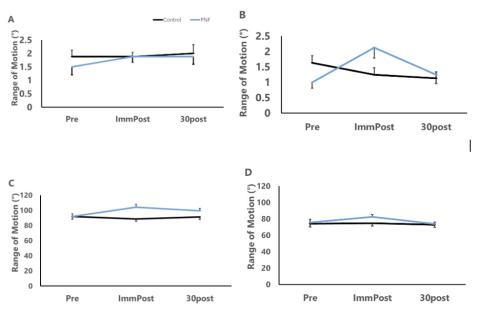
Figure 1 (click to enlarge): Graphs of significant changes in hip flexion (HF) and knee extension (KE) ROM in college males and females after PNF stretching, means ± SEE. A: KE in females. B: KE in males. C: HF in females. D: HF in males.
When assessing the overall response of all participants to PNF stretching, we found that hip flexion and knee extension range of motion increased compared to the control results. On average, hip flexion improved immediately after stretching from 84±17° to 93±17° but then decreased to 87±17° thirty minutes post stretching. Knee extension range of motion increased immediately after stretching from 1.3±1.0° to 2.0±1.1° and decreased to 1.6±1.2° thirty minutes post stretching. This indicates that the benefits of stretching to increase range of motion are short-lived as the measurements return to resting values within 30 minutes. We also found that PNF stretching did not significantly decrease muscle force production compared to the control. This was partially consistent with our original hypothesis. While PNF stretching did not cause an acute change in muscle force production or a different response in males compared to females, we did find that PNF stretching increased acute range of motion.
Moving Forward
We recently had the opportunity to share these findings with other professionals and students in the field of exercise science at the New England Chapter of the American College of Sports Medicine conference, an experience that furthered our communication and critical thinking skills. This study will also serve as the basis of our senior theses for the Hamel Honors and Scholars College and will be presented at UNH’s Undergraduate Research Conference (URC) and CHHS Grimes Award Competition in spring 2026.
Overall, our undergraduate research experience at UNH has broadened our knowledge of a wide range of topics, while successfully setting us up for our futures after graduation. We developed clinical skills, like conducting range of motion measurements, operating a dynamometer, and obtaining informed consent, which remain relevant in our current coursework as well as in our post-graduate plans. Working with human subjects and with a lab team of other students and a faculty member also helped us further our interpersonal and collaborative skills. We had the opportunity to experience a professional lab setting, where we could practice our communication, teamwork, adaptability, and problem solving. As we both are interested in pursuing a graduate degree in physical therapy, this experience helped us become well-rounded, qualified candidates for programs and serves as a culmination of our academic careers at UNH.
We would like to thank our faculty mentor, Dr. Summer Cook, for her support throughout this research experience. Our project would not have been possible without her expertise or guidance through the research process. Additionally, we would like to thank the Hamel Center for Undergraduate Research for our Summer Undergraduate Research Fellowship, which was made possible through the generosity of Mr. Dana Hamel and the Patricia M. Flowers ’45 Scholarship Fund.
Author and Mentor Bios
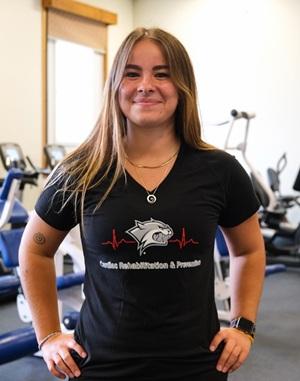
| Sage Coellner is an exercise science major from Mashpee, Massachusetts who will graduate from the University of New Hampshire in September 2026. In addition to her involvement with undergraduate research, Sage is an active member of the Association of Exercise Science Students. |

| Jenna Hamelin is an exercise science major from Nashua, New Hampshire who will graduate from the University of New Hampshire in September 2026. In addition to her involvement with undergraduate research, Jenna is the president of the Association of Exercise Science Students, as well as the vice president of the UNH chapter of the Chi Omega sorority. |
Summer Cook is an associate professor in the Department of Kinesiology at the University of New Hampshire, where she has been since 2009. Her research focuses on aging, athletic performance, neuromuscular function, and resistance training, particularly blood flow restricted resistance training.
Copyright © 2025, Sage Coellner and Jenna Hamelin


