UNH Today

True To Form

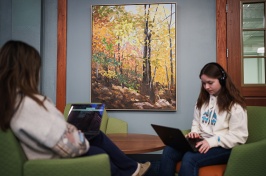
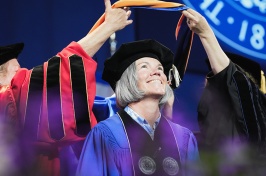
When Virginia Walsh ’21 recently went to get some of her paintings framed for an upcoming exhibition, the art store employee couldn’t help but notice the skill in her landscapes – and passion. It seemed clear that Walsh’s post-graduation plans would be oriented around art. “Why are you going into the military?” the framer asked.

Space Bound

A team of UNH Manchester students is one of five selected by NASA to send their experiment on soil bacteria mutation to the International Space Station.

What COVID-19 Can Teach Us: Violence and Marginalization

The disproportionate impact of the pandemic on certain populations has highlighted numerous disparities and injustices in our society. On the surface, a disease does not discriminate. However, it's not hard to see that some groups may find it more difficult to take health precautions, are less likely to be tested, and will not receive the same quality of treatment if they do end up with COVID-19.

Top Performers

A team of UNH engineering students was recently selected as a finalist in the prestigious U.S. Department of Energy Solar Decathlon® 2021 Design Challenge.  The competition challenges student teams to design highly efficient and innovative buildings powered by renewable energy and aims to equip the next generation of the building workforce with the skills and passion to create future-ready buildings.

Welcome, Admitted Students

UNH Manchester invites accepted students to our Virtual Admitted Student Event Series. From March 29 to April 13, explore virtual programs designed specifically for new admits, including sessions on paying for college, career exploration, academic overviews with faculty and more.

Randomness, not Environmental Selection, Key to Altering Bacteria in Arctic

In the Northeast, heat waves, heavy downpours, and sea level rise pose growing challenges. Infrastructure, agriculture, fisheries, and ecosystems will be increasingly compromised, according to NASA. Such climatic outcomes at lower latitudes could be, in part, affected by changes to microbial communities in the Arctic, where the thawing of permafrost changes how microbes contribute to global greenhouse gas production. To further understand and predict the implications of a thawing Arctic, scientists with the University of New Hampshire's College of Life Sciences and Agriculture have focused on identifying ecological factors that play key roles in affecting changes to microbial communities.