This policy brief provides an overview of hospital market concentration in New Hampshire. It begins by describing how the degree of market concentration is measured by a metric called a Herfindahl-Hirschman Index (HHI) and how it is applied to local hospital markets. The policy brief then provides estimates of this HHI measure for New Hampshire’s hospital markets by examining the variation within New Hampshire and how the degree of market concentration within New Hampshire’s local markets has changed over time. It concludes by comparing the levels and trends of New Hampshire’s hospital market concentration to surrounding states and the U.S. overall.
Measuring Market Concentration with the Herfindahl-Hirschman Index
Analysts at the Federal Trade Commission (FTC) and U.S. Department of Justice (DOJ) generally use a metric called a Herfindahl-Hirschman index (HHI) to measure the degree of market concentration based on firm-level market shares and, in turn, gauge whether a given market for goods or services is adequately competitive for consumers. The HHI is calculated as the sum of the squared market shares across competitors in a market. (An HHI can thus be calculated to measure market concentration for any type of product market and not just the hospital sector.)
HHI values range from 0, when there are infinite number of small competitors, to 10,000, representing a monopoly where one firm controls the entire market. An example of a geographic market with five firms, each with 20% market share, would have an HHI of 2,000. A “five to four” merger (leading to one firm having 40% market share) would have an HHI of 2,800. The US DOJ and FTC’s updated guidelines view competitive markets as having HHIs less than 1,000; moderately concentrated markets as having HHIs between 1,000 and 1,800; and concentrated markets as having HHIs over 1,800 (link).i
To construct HHI measures for hospital market concentration, one must define an appropriate geographic area to represent a local market for hospital services, and one must estimate each hospital system’s market share within that local market; individual hospitals that are part of multi-hospital ownership system would have a combined market share within a given geographic market. We use the U.S. National Center for Health Statistics’ (NCHS) “Health Service Area” (HSA) to define geographic markets for hospitals; NCHS’s HSAs are groupings of counties that represent the market for routine hospitalizations, thereby capturing the natural boundaries of local hospital markets.ii
We use data from the American Hospital Association’s (AHA) Annual Survey to construct hospital market shares. We examine the subset of the AHA’s hospitals that are general medical/surgical community hospitals (i.e., federal hospitals and specialty hospitals are each excluded). We use the hospital’s annual number of admissions to calculate market shares, and any hospitals that are part of a multi-hospital system have their combined market share calculated based on the sum of admissions for that system within the HSA market.
Hospital Market Concentration within New Hampshire
Figure #1 is a map of the hospital markets in and around New Hampshire. Specifically, it includes the six HSAs with at least one county in New Hampshire and the additional ten HSAs adjacent to these six New Hampshire HSAs. Among the six New Hampshire HSAs, only one is entirely within New Hampshire’s state border; one HSA includes a county in Maine, three HSAs include counties in Vermont, and one HSA includes a county in Massachusetts. (Among these ten adjacent HSAs shown in this map, two are within Maine, three are within Massachusetts, three are within Vermont, one spans Massachusetts and New York, and one spans Vermont and New York.)
Figure #1:
Hospital Market Concentration Measures for New Hampshire Region's Health Service Areas
Herfindahl-Hirschman Indices (000s)
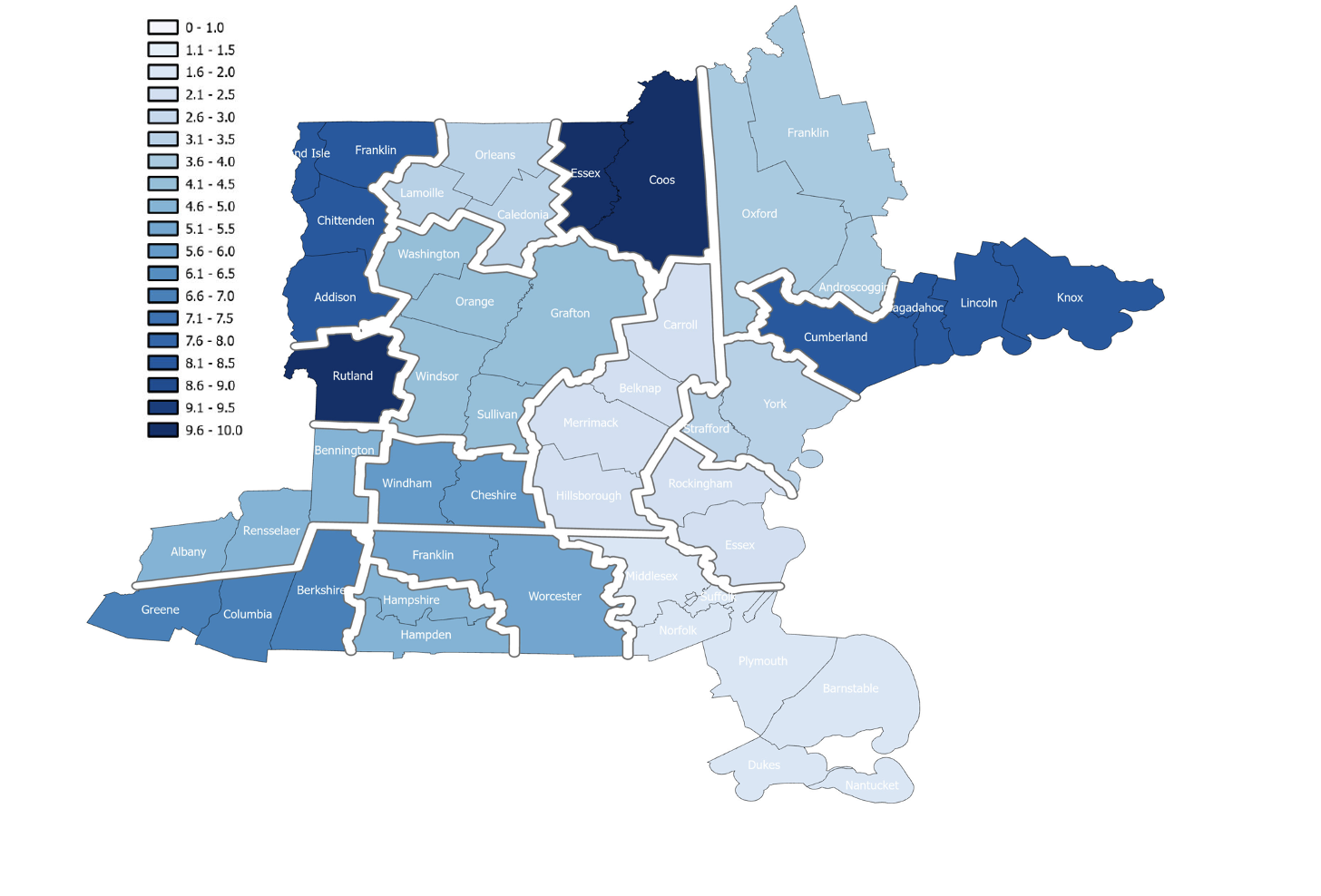
Each HSA in this map has a shade of blue representing the HHI measure of hospital market concentration for 2023 (the most recent year of the AHA Annual Survey). The HHI measure is in thousands, with progressively darker shades representing 500 point increments; lighter shades of blue therefore represent more competitive (less concentrated) hospital markets, and darker shades of blue represent more concentrated (less competitive) hospital markets. As one might expect, the relatively rural areas within New Hampshire tend to have lower levels of competition.
The Rockingham/Essex HSA is currently New Hampshire’s most competitive market; it has eight general medical/surgical hospitals, with seven hospitals in four multi-hospital systems and one independent hospital. This HSA’s HHI measure of hospital market concentration equaled 2,328 in 2023, so despite being the most competitive market in New Hampshire, the US DOJ/FTC guidelines classify it as a concentrated market (i.e., an HHI greater than 1,800). The Coos/Essex HSA is currently New Hampshire’s most concentrated market with an HHI of 10,000 in 2023; it has three general medical/surgical hospitals, but all three are owned by the same multi-hospital system.
Figure #2 shows the trends in hospital market concentration from 1996 to 2023 for New Hampshire’s six HSAs; the dotted lines show each of these HSAs separately, while the solid line shows the average across New Hampshire’s ten counties (weighting that average by each county’s total population); to estimate a state-level average, each county within an HSA is assigned that HSA’s HHI value. Each of New Hampshire’s six HSAs has seen increases in hospital market concentration over time. Overall, New Hampshire’s HHI measure of market concentration increased from 1,884 in 1996 to 3,059 in 2023.
Figure #2:
Trends in Hospital Market Concentration within New Hampshire's Health Service Areas
Herfindahl-Hirschman Indices (000s)
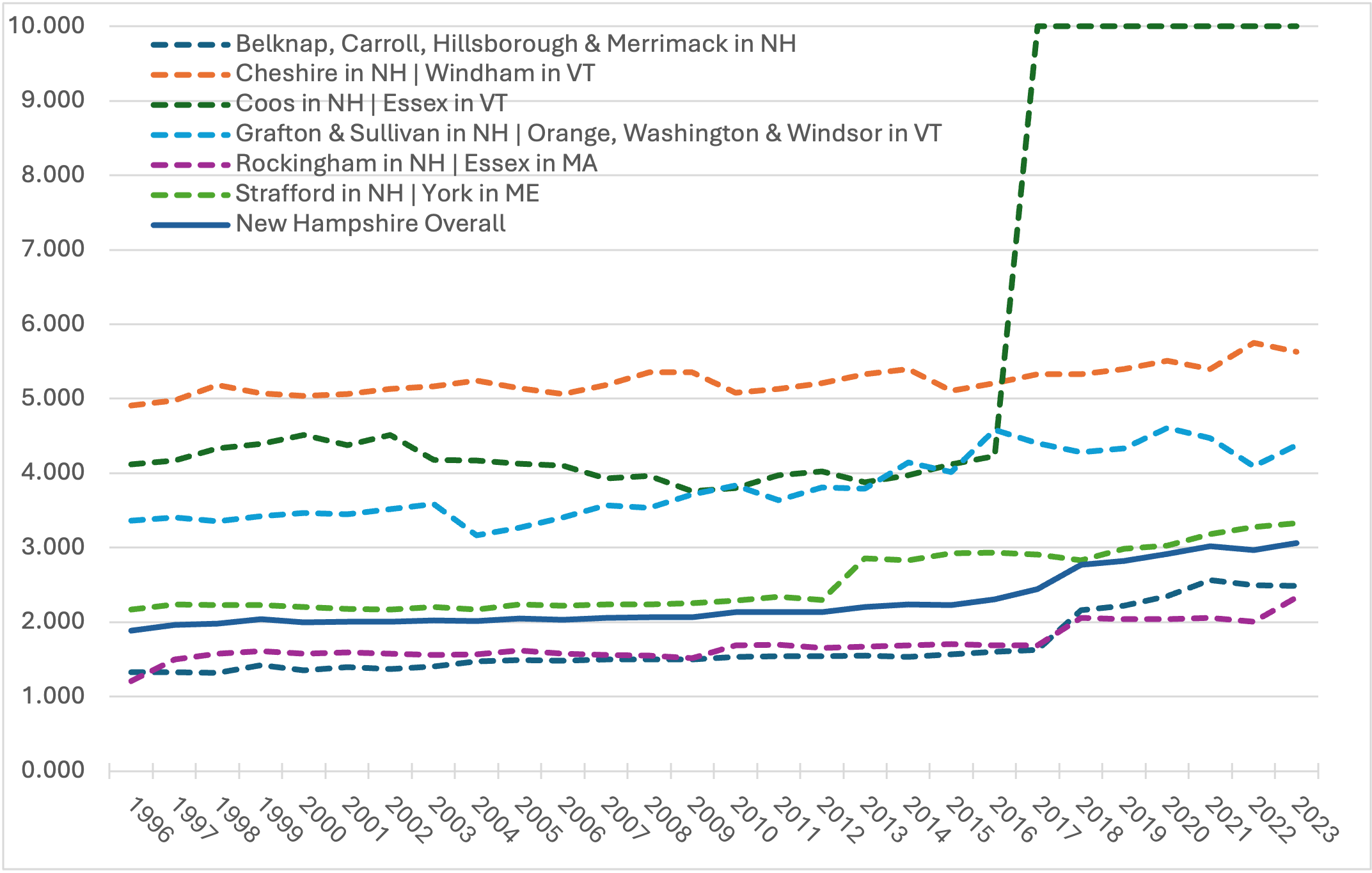
For example, market concentration increased in the Rockingham/Essex HSA in 2018 due to Beth Israel Lahey Health (BILH)’s acquisition of Anna Jaques Hospital in Newburyport and increased again in 2023 due to BILH’s acquisition of Exeter Hospital. Market concentration increased dramatically in the Coos/Essex HSA from an HHI of 4,235 to 10,000 in 2017 resulting from three formerly independent hospitals merging into North County Healthcare. Moreover, market concentration has increased in the Grafton/Sullivan HSA (which includes Orange, Washington, and Windsor counties in Vermont) since 2013 due to several hospital acquisitions by Dartmouth Health.
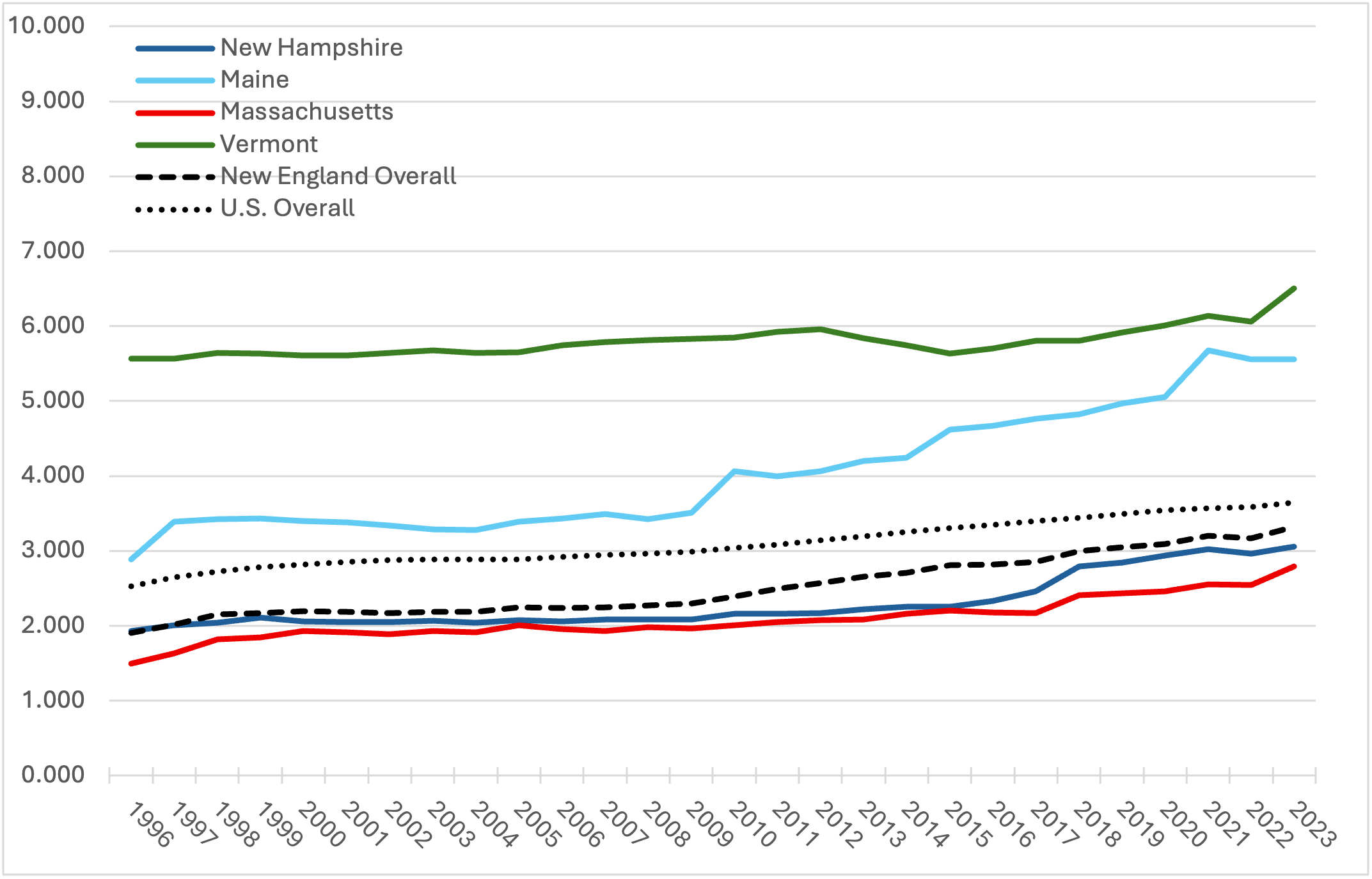
Figure #3 shows the trends in hospital market concentration from 1996 to 2023 for New Hampshire, Maine, Massachusetts, and Vermont, as well as averages for New England (i.e., these four states plus Connecticut and Rhode Island) and for the U.S. overall. As noted above, each of these averages assigns the HSA’s HHI to each county and calculates a weighted average using each county’s total population.
As this figure illustrates, the increase over time in hospital market concentration for New Hampshire has also been observed in each of the surrounding states and in the U.S. overall. That said, the increase in market concentration has been considerably higher in Maine compared to other New England states and the U.S. During the past two decades, New Hampshire’s hospital markets have been, on average, considerably more competitive than Vermont and Maine’s hospital markets, while they have been somewhat comparable to Massachusetts’ hospital markets (albeit slightly more concentrated). Finally, hospital markets in New Hampshire have been, on average, slightly more competitive than hospital markets elsewhere in the U.S.
Figure #3:
Trends in Hospital Market Concentration for New Hampshire and Other States
Herfindahl-Hirschman Indices (000s)
In conclusion, there is considerable variation in hospital market concentration within New Hampshire’s six HSA hospital markets. Each of New Hampshire’s hospital markets has seen an increase in market concentration over time, but these increases in hospital market concentration have also been observed in both the surrounding states and the U.S. overall, albeit to varying degrees.
Implications of New Hampshire’s Hospital Market Concentration on Spending and Quality
This variation in the levels and growth of hospital market concentration both within New Hampshire and across the surrounding states has important implications for New Hampshire’s healthcare system in terms of spending and quality. In this section, we use prior empirical findings from the health economics literature to translate the observed differences in the HHI measure of hospital market concentration to likely changes in hospital prices paid by private insurers, changes in employment-based premiums, and changes in hospital quality.
Specifically, published research indicates that a 1,000 increase in the HHI measure of hospital market concentration is associated with a 6.13% increase in hospital prices paid by private health insurers and, in turn, a 1.90% increase in private health insurance premiums.iii Conceptually, these increases in hospital market prices reflect the ability of hospitals facing relatively less competition to increase the markup in their prices. Additionally, published research indicates that a 1,000 increase in the HHI measure of hospital market concentration is associated with a 0.46% decrease in measures of hospital quality.iv Conceptually, this observed decrease in hospital quality reflects somewhat weakened incentives for hospitals to improve their quality of care when they face relatively less competition to attract patients.
Consider first the likely effects of the wide variation in hospital market concentration within New Hampshire, as illustrated above in Figure #1’s map of the New Hampshire region’s six HSAs (and Figure #2 for the increases in market concentration for these six HSAs). The two least concentrated markets in New Hampshire are the Rockingham/Essex HSA and the Belknap/Carroll/Hillsborough/Merrimack HSA (with an average HHI across the two of 2,409). Table #1 presents the estimates of the likely differences in outcomes for each of the other four (more concentrated) New Hampshire HSAs compared to these two (least concentrated) HSAs. For example, the 10,000 HHI for Coos/Essex’s monopoly (relative to the 2,409 HHI for the two least concentrated markets) indicates that, all else equal, hospital prices in Coos/Essex are estimated to be 46.5% higher than the two least concentrated HSAs; i.e., (10,000 - 2,409) x 6.13%.
Table #1:
Variation in Outcomes Within New Hampshire Related to Hospital Market Concentration
Four More Concentrated HSAs Compared to the two Least Concentrated HSAs in 2023
| HSA | Prices | Premiums | Quality |
|---|---|---|---|
| Coos in NH | Essex in VT | 46.5% | 14.4% | -3.5% |
| Cheshire in NH | Windham in VT | 19.7% | 6.1% | -1.5% |
| Grafton & Sullivan in NH | Orange, Washington & Windsor in VT | 12.1% | 3.7% | -0.9% |
| Strafford in NH | York in ME | 5.6% | 1.7% | -0.4% |
Consider next the likely outcomes related to New Hampshire’s average level of hospital market concentration in 2023 compared to several potential benchmarks (suggested above by Figure #3) for hospital market concentration. One set of benchmarks compares New Hampshire to other groups of states; these results are shown in the top panel of Table #2. The average level of market concentration in 2023 for New Hampshire was slightly lower than that for the U.S. overall, suggesting (all else equal) New Hampshire is achieving slightly lower hospital prices and premiums and slightly higher hospital quality by having had relatively lower levels of hospital market concentration (e.g., 3.6% lower prices). Moreover, New Hampshire’s market concentration was much lower than the average across Maine and Vermont, suggesting much lower spending and higher quality than if New Hampshire had instead experienced their higher level of market concentration. In contrast, though, New Hampshire’s market concentration was slightly higher than Massachusetts, suggesting slightly higher spending and lower quality than if New Hampshire had achieved their lower level of market concentration.
Table #2
New Hampshire’s Outcomes from Hospital Market Concentration Vs. Several Benchmarks
| Comparison to Other States in 2023: | Prices | Premiums | Quality |
|---|---|---|---|
| HHI for U.S. Overall as a Benchmark | -3.6% | -1.1% | 0.3% |
| HHI for Maine/Vermont as a Benchmark | -18.2% | -5.7% | 1.4% |
| HHI for Massachusetts as a Benchmark | 1.6% | 0.5% | -0.1% |
| Comparison to Hypothetical 1996-2023 Growth Rates: | Prices | Premiums | Quality |
| HHI from Having No Consolidation since 1996 | 7.2% | 2.2% | -0.5% |
| HHI from Having Slower Growth in Consolidation since 1996 | 2.1% | 0.7% | -0.2% |
A second set of benchmarks considers hypothetical alternative paths for hospital consolidation in New Hampshire since 1996; these results are shown in the bottom panel of Table #2. The first considers the (albeit unlikely) hypothetical benchmark of New Hampshire having had no hospital market consolidation since 1996 (and thus maintaining its initial HHI of 1,884 instead of growing to 3,059). This benchmark implies that the actual consolidation observed since 1996 has made prices 7.2% higher, premiums 2.2% higher, and quality 0.5% lower than they would have otherwise been.
The other hypothetical considers a benchmark of New Hampshire having had slower growth in hospital market consolidation since 1996 that would have matched the rate observed in the U.S. for 1996 through 2023. Figure #3 indicates that while New Hampshire’s level of hospital market concentration has consistently been lower than the U.S.’s level of hospital market concentration, that gap has shrunk over time, as the actual increase in consolidation observed in New Hampshire has outpaced the increase in consolidation in the U.S. overall (especially after 2015). This alternative benchmark implies that the actual consolidation observed since 1996 in New Hampshire has made prices 2.1% higher, premiums 0.7% higher, and quality 0.2% lower than if there had been slower growth in consolidation matching the U.S. overall.
In conclusion, the considerable variation in hospital market concentration within New Hampshire’s six HSA hospital markets indicates that there are likely large differences in hospital prices and insurance premiums and modest differences in hospital quality resulting from the differences in competitive pressure on hospitals. For New Hampshire overall, the implications of its current level of hospital market concentration are dependent on what one considers as an appropriate benchmark. On one hand, New Hampshire’s hospital markets are (on average) less concentrated than Maine, Vermont, and the U.S. overall and thus has (all else equal) likely experienced lower spending and higher quality. But on the other hand, New Hampshire’s hospital markets have indeed become more consolidated over time at a rate slightly higher than that observed in the U.S. overall, leading to (all else equal) slightly higher spending and lower quality.
Notes:
[i] The U.S. DOJ and FTC’s 2023 merger guidelines indicate that “transactions that increase the HHI by more than 100 points in highly concentrated markets are presumed likely to enhance market power.” Previously, the FTC/DOJ’s 2010 guidelines defined competitive markets as having HHIs less than 1,500; moderately concentrated markets as having HHIs between 1,500 and 2,500; concentrated markets as having HHIs over 2,500; and transactions increasing the HHI by 200 or more points in highly concentrated markets as likely enhancing market power.
[ii] NCHS’ HSAs are “defined to be a single county or cluster of contiguous counties which are relatively self-contained with respect to hospital care” (link). Alternatively, the Dartmouth Atlas defines a Hospital Referral Region (HRR) for specialty/tertiary hospitalization and are collections of ZIP codes (rather than counties). As a result, Dartmouth Atlas’ HRRs for specialty hospitalizations are larger geographic areas than NCHS’ HSAs for general hospitalizations; there are 306 HRRs in the U.S. and 805 NCHS HSAs in the U.S. One potential source of confusion with the acronym “HSA” is that Dartmouth also defines a “Hospital Service Area” designation “by assigning ZIP codes to the hospital area where the greatest proportion of their Medicare residents were hospitalized. Most Hospital Service Areas contain only one hospital” (link); Dartmouth’s HSAs therefore, by definition, do not generally represent geographic markets in which hospitals compete. There are 3,436 Dartmouth Hospital Service Areas in the U.S. A second potential source of confusion related to NCHS’s HSAs is that there are two versions of HSAs that are used: the main version originally defined by NCHS (which we use for our analyses) and a secondary version developed by the National Cancer Institute (NCI). The NCI Modified HSA “was derived from the original HSA definitions [and] modified so that any HSAs that crossed state or SEER Registry boundaries were split so that all counties from one HSA were in one state and/or SEER Registry.”
[iii] See, for example, Trish E, Herring B. How Do Health Insurer Market Concentration and Bargaining Power with Hospitals Affect Health Insurance Premiums? Journal of Health Economics 42, July 2015: 104-114 (link). Trish and Herring examine employer/year-level regression models for employment-based insurance premiums as a function of hospital market HHIs (along with insurance market HHIs, employer characteristics, and local characteristics). Their finding of a 1.9% increase in premiums resulting from a 1,000 point increase in the hospital market HHI is consistent with a 6.13% increase in private hospital prices (given that hospitals represent 31% of total healthcare spending). This 6.13% estimate is also generally consistent with Vogt, Town, and Williams’s 2006 review of the literature examining hospital market consolidation’s effect on hospital prices. See Vogt WB, Town R, Williams CH. How has Hospital Consolidation Affected the Price and Quality of Hospital Care? Research Synthesis Report No. 9, Robert Wood Johnson Foundation 2006 (link).
[iv] See, for example, Hanson C, Herring B, Trish E. Do Health Insurance and Hospital Market Concentration Influence Hospital Patients’ Experience of Care? Health Services Research 54.4, August 2019: 805-815 (link). Hanson, et al., examine hospital/year-level regression models for hospital quality (measured by HCAPS metrics for patient experience) as a function of hospital market HHIs (along with insurance market HHIs, hospital characteristics, and county characteristics). Their finding of modest decreases in patient experience is consistent with the broader health economics literature examining various effects of hospital market concentration on hospital quality.
