Click below to get more information about UNH graduate programs
Request Information Form
Request Information Form

Carsey School of Public Policy
The Carsey School's Master in Public Policy graduate program prepares policy leaders of tomorrow with the critical skills and experience sought across the full range of policymaking and advocacy employers. You’ll learn from experts in their policy fields, connect with policy practitioners and leaders working inside and outside of Washington, D.C., and become intimately familiar with major public policy issues and debates.
This is a degree for students who want to make change happen to build a better, more sustainable, future for their communities, state, country, and planet.
Application Deadlines: Apr. 15 (Summer Term) ● Aug. 1 (Fall Term) ● Dec. 15 (Spring Term)
*Number of courses and course credit hours may vary, please reach out to your academic advisor for exact requirements.
Key Links
Contact Cards
The Master in Public Policy (MPP) equips professionals with the analytical, research, and communication skills needed to tackle complex societal challenges. This program teaches you how to design sustainable, evidence-based policy solutions and effectively implement them. Graduates pursue careers in public policy, government, and nonprofit organizations, using their expertise to address pressing issues locally, nationally, and globally.
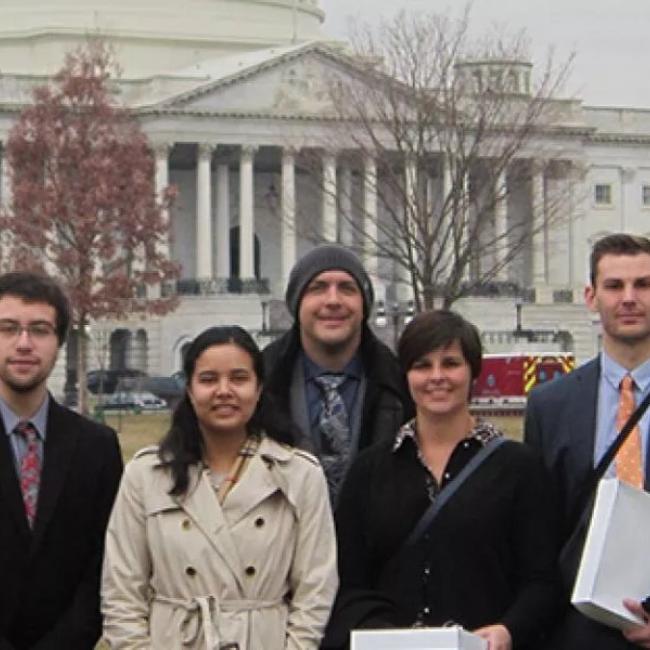
The MPP at UNH allows you to create a degree tailored to your interests. You’ll gain analytical expertise, strategic communication skills, and tools to advance effective policy. The program includes experiential learning from talking with policy makers on campus to meeting with professionals during the Washington, DC, Colloquium. You’ll build real-world experience through a policy internship and capstone project. Complete your degree in just 16 months. No GRE required.
The Master in Public Policy (MPP) program builds skills in policy analysis, strategic communication, leadership, and policy development. Students can focus their degree on policy analysis or strategic communication, with an option to add the Recreation Management and Policy track to specialize in recreation administration.
Graduates learn how to apply analytical frameworks, interpret policy research, and design policy solutions. Coursework is reinforced through internships, capstone projects, and direct engagement with policymakers, government agencies, and advocacy organizations. Note that the GRE is not required for admission to this program.
Core MPP courses are offered in person on the Durham campus. Students may take approved MPP or RMP courses on UNH campuses or online. The Washington, DC Colloquium is completed off-site in Washington, DC.
| First Year | ||
|---|---|---|
| Fall | Credits | |
| PPOL 806 | Fundamentals of Policy Analysis | 3 |
| PPOL 904 | Economics for Public Policy | 3 |
| PPOL 908 | Quantitative Methods for Policy Research | 3 |
| Public Policy Track Course, RMP Track Course, or MPP-Approved Elective Course 2, 3 | 3 | |
| Credits | 12 | |
| January Term | ||
| PPOL 950 | Washington DC Colloquium | 3 |
| Credits | 3 | |
| Spring | ||
| PPOL 810 | Policy Across Borders | 3 |
| PPOL 902 | Strategy and Practice of Public Policy | 3 |
| PPOL 990A | Policy Capstone Planning | 1 |
| Public Policy Track Course, RMP Track Course, or MPP-Approved Elective Course 2, 3 | 3 | |
| Public Policy Track Course, RMP Track Course, or MPP-Approved Elective Course 2, 3 | 3 | |
| Credits | 13 | |
| Summer | ||
| PPOL 998A or PPOL 998 | Policy Internship 1 or Policy Internship | 0 |
| Credits | 0 | |
| Second Year | ||
| Fall | ||
| PPOL 990 | Policy Capstone | 3 |
| Public Policy Track Course, RMP Track Course, or MPP-Approved Elective Course 2, 3 | 3 | |
| Public Policy Track Course, RMP Track Course, or MPP-Approved Elective Course 2, 3 | 3 | |
| Public Policy Track Course, RMP Track Course, or MPP-Approved Elective Course 2, 3 | 3 | |
| Credits | 12 | |
| Total Credits | 40 | |
| First Year | ||
|---|---|---|
| Spring | Credits | |
| PPOL 810 | Policy Across Borders | 3 |
| PPOL 902 | Strategy and Practice of Public Policy | 3 |
| Public Policy Track Course, RMP Track Course, or MPP-Approved Elective Course 2, 3 | 3 | |
| Public Policy Track Course, RMP Track Course, or MPP-Approved Elective Course 2, 3 | 3 | |
| Credits | 12 | |
| Summer | ||
| PPOL 998A or PPOL 998 | Policy Internship 1 or Policy Internship | 0 |
| Credits | 0 | |
| Fall | ||
| PPOL 806 | Fundamentals of Policy Analysis | 3 |
| PPOL 904 | Economics for Public Policy | 3 |
| PPOL 908 | Quantitative Methods for Policy Research | 3 |
| PPOL 990A | Policy Capstone Planning | 1 |
| Public Policy Track Course, RMP Track Course, or MPP-Approved Elective Course 2, 3 | 3 | |
| Credits | 13 | |
| January Term | ||
| PPOL 950 | Washington DC Colloquium | 3 |
| Credits | 3 | |
| Second Year | ||
| Spring | ||
| PPOL 990 | Policy Capstone | 3 |
| Public Policy Track Course, RMP Track Course, or MPP-Approved Elective Course 2,3 | 3 | |
| Public Policy Track Course, RMP Track Course, or MPP-Approved Elective Course 2, 3 | 3 | |
| Public Policy Track Course, RMP Track Course, or MPP-Approved Elective Course 2, 3 | 3 | |
| Credits | 12 | |
| Total Credits | 40 | |
In special cases and with your Graduate Academic Advisor's permission, the Policy Internship may be taken for credit (PPOL 998, 3 credits), supervised by a faculty member who will provide the academic structure to parallel the applied experience. If this is the case, the required number of MPP-Approved elective courses is reduced to three (3) courses.
Students choose 2 courses from their Public Policy Track: Strategy and Communication Track or Policy Analysis Track. Students pursuing an optional Recreation Management and Policy Track specialization should choose 3 or more Recreation Management & Policy (RMP) courses to fulfill 3 or more Elective course program requirements. Courses in all tracks can be taken as open Elective courses.
MPP-Approved Elective courses are available in many substantive areas. Students pursuing the Recreation Management and Policy Track specialization should select a minimum of 3 RMP courses to fulfill the Track requirements. Students may also propose additional Electives if they make sense in terms of the student’s interests and academic plan. Discussion with your departmental Graduate Academic Advisor, including Recreation Management & Policy if pursuing the Recreation Management and Policy Track, should inform this choice.
Students enrolled in the Carsey School's Master in Public Policy program (MPP degree) are required to complete a forty (40) credit program, consisting of:
These provide the foundational analytical, strategic, and communication skills for a successful career in the world of public policy making. Students focus their public policy studies by choosing a Public Policy Track: Strategy and Communication Track or Policy Analysis Track. Students can choose an additional specialization in recreation administration by adding on the Recreation Management and Policy Track to their Public Policy Track. Courses in all tracks can also be taken as open electives. Further opportunities for depth and specialization in substantive policy areas are provided by open elective courses which vary by semester. As culminating graduate experiences, students apply what they've learned through an MPP internship at a policy-oriented organization as well as conducting a capstone project by delving deeply into a policy area of interest. These experiences are provided with guidance from faculty mentors.
Students are advised to have taken an introductory level economics class prior to starting the MPP program such as a “principles of economics” (macro or micro). Students should consult with their Graduate Academic Advisor to confirm that the course(s) previously taken are sufficient or for suggestions of which courses could be taken prior to starting the MPP program.
| Code | Title | Credits |
|---|---|---|
| MPP CORE Curriculum Courses (5 Courses) | ||
| PPOL 806 | Fundamentals of Policy Analysis | 3 |
| PPOL 810 | Policy Across Borders | 3 |
| PPOL 902 | Strategy and Practice of Public Policy | 3 |
| PPOL 904 | Economics for Public Policy | 3 |
| PPOL 908 | Quantitative Methods for Policy Research | 3 |
| MPP EXPERIENTIAL LEARNING Activities (4 Courses) | ||
| PPOL 950 | Washington DC Colloquium | 3 |
| PPOL 990A | Policy Capstone Planning | 1 |
| PPOL 990 | Policy Capstone | 3 |
| PPOL 998A | Policy Internship 1 | 0 |
| or PPOL 998 | Policy Internship | |
| PUBLIC POLICY TRACK: 2 courses are chosen based upon the Public Policy Track (Strategy and Communication Track or Policy Analysis Track) 2 | 6 | |
| ELECTIVE COURSE REQUIREMENTS: 4 Courses are chosen to fulfill Elective Course Requirements and/or to pursue the optional Recreation Management and Policy Track 1, 3 | 12 | |
| Choose 4 MPP-Approved Elective courses in substantive areas approved by the MPP program | ||
And/Or | ||
| Choose a minimum of 3 RMP courses from the list below if pursuing the optional Recreation Management and Policy Track: | ||
RMP 811 | Recreation Resource Management | |
RMP 820 | Adaptive Sport Facilitation for Recreation Therapy and Related Professions | |
RMP 824 | Research, Evaluation, and Data-Driven Decisions | |
RMP 840 | Therapeutic Recreation Service Delivery in Community Settings | |
RMP 868 | Theories and Philosophies of Youth Development | |
RMP 872 | Law and Public Policy in Leisure Services | |
RMP 875 | Entrepreneurial and Commercial Recreation | |
RMP 876 | Human Dimensions of Natural Environments | |
RMP 912/PA 818 | Non-Profit Administration and Leadership | |
RMP 924/PA 802 | Fund Development and Grantwriting | |
| Total Credits | 40 | |
In special cases and with your Graduate Academic Advisor's permission, the Policy Internship may be taken for credit (PPOL 998, 3 credits), supervised by a faculty member who will provide the academic structure to parallel the applied experience. If this is the case, the required number of MPP-Approved Elective courses is reduced to 3 courses or if the Recreation Management and Policy Track is pursued, the number of RMP courses is limited to a maximum of 3 courses.
In Consultation with their advisor, students choose 2 courses from either the Strategy and Communication Track or the Policy Analysis Track (see Master in Public Policy webpage for list of suggested courses). Courses in both tracks can also be taken as open Elective courses.
MPP-Approved Elective courses are available in many substantive areas. Students pursuing the Recreation Management and Policy Track specialization should select a minimum of 3 RMP courses to fulfill the Track requirements. Students may also propose additional Electives if they make sense in terms of the student’s interests and academic plan. Discussion with your departmental Graduate Academic Advisor, including Recreation Management & Policy if pursuing the Recreation Management and Policy Track, should inform this choice.
Accelerated Master’s programs offer qualified University of New Hampshire undergraduate students the opportunity to begin graduate coursework in select graduate programs while completing a bachelor’s degree. Accelerated master's programs are designed to provide students with an efficient and cost-effective pathway to earn both a bachelor's and master's degree or graduate certificate, enhancing career opportunities and long-term earning potential.
*Some exceptions apply.
*Some exceptions apply.
This graduate degree program is approved to be taken on an accelerated basis in articulation with the following undergraduate program(s):
| Code | Title | Credits |
|---|---|---|
| Recreation Management & Policy: Outdoor Leadership and Management Option (B.S.) | ||
| Recreation Management & Policy: Program and Event Management Option (B.S.) | ||
| Recreation Management & Policy: Therapeutic Recreation Option (B.S.) | ||
| Students may select up to four (4) 800-level courses (12 credits total) from the following: | ||
Community Development Policy and Practice (M.A.) courses: | ||
DPP 801 | Integrative Approaches to Development Policy and Practice | |
DPP 802 | Economic Analysis for Development | |
DPP 805 | Fiscal Management for Development Organizations | |
DPP 806 | Organizational Management and Leadership | |
Global Conflict & Human Security (M.S.) courses: | ||
GCHS 810 | Conflict & Human Security | |
GCHS 820 | Global Governance | |
GCHS 830 | International Development & Human Security | |
GCHS 840 | Sustainable Development: Gender-Environment Nexus | |
GCHS 850 | Peace and Human Security in the Post-Atrocity State | |
Public Administration (M.P.A.) courses: | ||
PA 800 | Foundations and Theories of Public Administration | |
PA 802 | Grant-writing for Public and Non-profit Sectors | |
PA 809 | Organization and Management in Public and Non-profit Sectors | |
PA 812 | Leadership Theory and Practice | |
PA 818 | Non-Profit Management | |
PA 819 | Managing Conflict and Change in Nonprofit and Public Organizations | |
PA 820 | Strategic Communications for Public and Non-profit Sectors | |
PA 821 | Effective Change Management in Nonprofit and Public Organizations | |
Public Policy (M.P.P.) courses: | ||
PPOL 806 | Fundamentals of Policy Analysis | |
PPOL 810 | Policy Across Borders | |
PPOL 812 | Strategies for Policy Impact | |
PPOL 822 | Media Strategy and Skills | |
PPOL 897 | Advanced Special Topics | |
Recreation Management and Policy (M.S.) courses: | ||
RMP 811 | Recreation Resource Management | |
RMP 820 | Adaptive Sport Facilitation for Recreation Therapy and Related Professions | |
RMP 824 | Research, Evaluation, and Data-Driven Decisions | |
RMP 840 | Therapeutic Recreation Service Delivery in Community Settings | |
RMP 868 | Theories and Philosophies of Youth Development | |
RMP 872 | Law and Public Policy in Leisure Services | |
RMP 876 | Human Dimensions of Natural Environments | |
| Code | Title | Credits |
|---|---|---|
| Community and Environmental Planning (B.S.) | ||
| Students may select up to four (4) 800-level courses (12 credits total) from the following: | ||
Community Development Policy and Practice (M.A.) courses: | ||
DPP 801 | Integrative Approaches to Development Policy and Practice | |
DPP 802 | Economic Analysis for Development | |
DPP 805 | Fiscal Management for Development Organizations | |
DPP 806 | Organizational Management and Leadership | |
Global Conflict & Human Security (M.S.) courses: | ||
GCHS 810 | Conflict & Human Security | |
GCHS 820 | Global Governance | |
GCHS 830 | International Development & Human Security | |
GCHS 840 | Sustainable Development: Gender-Environment Nexus | |
GCHS 850 | Peace and Human Security in the Post-Atrocity State | |
Public Administration (M.P.A.) courses: | ||
PA 800 | Foundations and Theories of Public Administration | |
PA 802 | Grant-writing for Public and Non-profit Sectors | |
PA 809 | Organization and Management in Public and Non-profit Sectors | |
PA 812 | Leadership Theory and Practice | |
PA 818 | Non-Profit Management | |
PA 819 | Managing Conflict and Change in Nonprofit and Public Organizations | |
PA 820 | Strategic Communications for Public and Non-profit Sectors | |
PA 821 | Effective Change Management in Nonprofit and Public Organizations | |
Public Policy (M.P.P.) courses: | ||
PPOL 806 | Fundamentals of Policy Analysis | |
PPOL 810 | Policy Across Borders | |
PPOL 812 | Strategies for Policy Impact | |
PPOL 822 | Media Strategy and Skills | |
PPOL 897 | Advanced Special Topics | |
| Code | Title | Credits |
|---|---|---|
| Anthropology (B.A.) | ||
| Students may select up to two (2) 800-level courses (6 credits total) to count as electives in the undergraduate program from the following: | ||
PPOL 806 | Fundamentals of Policy Analysis | |
PPOL 810 | Policy Across Borders | |
PPOL 812 | Strategies for Policy Impact | |
PPOL 822 | Media Strategy and Skills | |
PPOL 897 | Advanced Special Topics | |
| Code | Title | Credits |
|---|---|---|
| Global Studies (Minor) | ||
| 800-level courses approved as electives in the undergraduate program: | ||
PPOL 810 | Policy Across Borders | |
| Code | Title | Credits |
|---|---|---|
| Political Science (B.A.) | ||
| 800-level courses approved as electives in the undergraduate program: | ||
PPOL 806 | Fundamentals of Policy Analysis | |
PPOL 810 | Policy Across Borders | |
| Code | Title | Credits |
|---|---|---|
| Cybersecurity Policy (Minor) | ||
| 800-level courses approved for the undergraduate program: | ||
CPRM 810 | Foundations of Cybersecurity Policy (Minor Required Course) | |
PPOL 806 | Fundamentals of Policy Analysis (Minor Elective Course) | |
PPOL 810 | Policy Across Borders (Minor Elective Course) | |
PPOL 822 | Media Strategy and Skills (Minor Elective Course) | |
| Code | Title | Credits |
|---|---|---|
| Global Studies (Minor) | ||
| 800-level courses approved as electives in the undergraduate program: | ||
PPOL 806 | Fundamentals of Policy Analysis (Minor Elective-Governance & Conflict pillar) | |
PPOL 810 | Policy Across Borders (Minor Elective-Governance & Conflict pillar) | |
PPOL 822 | Media Strategy and Skills (Minor Elective-Governance & Conflict pillar) | |
| Code | Title | Credits |
|---|---|---|
| Public Service and Nonprofit Leadership (B.S.) | ||
| 800-level courses approved as electives in the undergraduate program: | ||
PPOL 806 | Fundamentals of Policy Analysis | |
PPOL 810 | Policy Across Borders | |
PPOL 822 | Media Strategy and Skills | |
| Code | Title | Credits |
|---|---|---|
| Business and Technology | ||
Accounting and Finance (B.S.) | ||
Applied Studies: Management (B.S.) | ||
Business Management: Accounting Option (B.S.) | ||
Business Management: Economic Science Option (B.S.) | ||
Business Management: Emergency Management Strategy and Planning Option (B.S.) | ||
Business Management: Finance Option (B.S.) | ||
Business Management: Leadership, Change, and Social Responsibility Option (B.S.) | ||
Business Management: Management Option (B.S.) | ||
Business Management: Nonprofit Management Option (B.S.) | ||
Business Management: Organization and Business Administration Option (B.S.) | ||
Business Management: Project Management Option (B.S.) | ||
Fire Service Administration (B.S.) | ||
Human Resource Management (B.S.) | ||
Operations, Supply Chain, and Logistics Management (B.S.) | ||
Public Administration (B.S.) | ||
Technology Management (B.S.) | ||
| Health Care, Human Services, and Behavioral Science | ||
Applied Psychology: Emergency Management Strategy and Planning Option (B.S.) | ||
Criminal Justice (B.S.) | ||
| Liberal Arts, Communications, and General Education | ||
Individualized Studies: Humanities (B.A.) | ||
Individualized Studies: Management (B.S.) | ||
Professional Communication: Business and Strategic Communication Option (B.S.) | ||
Professional Communication: Interpersonal and Organizational Communication Option (B.S.) | ||
Professional Communication: Visual Communication and Social Media Option (B.S.) | ||
| The approved 800-level courses below will count as electives in the undergraduate program. | ||
| Students may select up to four (4) 800-level courses (12 credits total) from the following: | ||
Community Development Policy and Practice (M.A.) courses: | ||
DPP 801 | Integrative Approaches to Development Policy and Practice | |
DPP 802 | Economic Analysis for Development | |
DPP 805 | Fiscal Management for Development Organizations | |
DPP 806 | Organizational Management and Leadership | |
Global Conflict & Human Security (M.S.) courses: | ||
GCHS 810 | Conflict & Human Security | |
GCHS 820 | Global Governance | |
GCHS 830 | International Development & Human Security | |
GCHS 840 | Sustainable Development: Gender-Environment Nexus | |
GCHS 850 | Peace and Human Security in the Post-Atrocity State | |
Public Administration (M.P.A.) courses: | ||
PA 800 | Foundations and Theories of Public Administration | |
PA 802 | Grant-writing for Public and Non-profit Sectors | |
PA 809 | Organization and Management in Public and Non-profit Sectors | |
PA 812 | Leadership Theory and Practice | |
PA 818 | Non-Profit Management | |
PA 819 | Managing Conflict and Change in Nonprofit and Public Organizations | |
PA 820 | Strategic Communications for Public and Non-profit Sectors | |
PA 821 | Effective Change Management in Nonprofit and Public Organizations | |
Public Policy (M.P.P.) courses: | ||
PPOL 806 | Fundamentals of Policy Analysis | |
PPOL 810 | Policy Across Borders | |
PPOL 812 | Strategies for Policy Impact | |
PPOL 822 | Media Strategy and Skills | |
PPOL 897 | Advanced Special Topics | |
Applications must be completed by the following deadlines in order to be reviewed for admission:
Application Fee: See important notes below
Administered by: Durham
New England Regional: Not Needed
Accelerated Masters: Yes (for more details see the accelerated masters information page)
Students claiming in-state residency must also submit a Proof of Residence Form. This form is not required to complete your application, but you will need to submit it after you are offered admission, or you will not be able to register for classes.
If you attended UNH or Granite State College (GSC) after September 1, 1991, and have indicated so on your online application, we will retrieve your transcript internally; this includes UNH-Durham, UNH-Manchester, UNH Non-Degree work and GSC.
If you did not attend UNH, or attended prior to September 1, 1991, then you must upload a copy (PDF) of your transcript in the application form. International transcripts must be translated into English.
If admitted, you must then request an official transcript be sent directly to our office from the Registrar's Office of each college/university attended. We accept transcripts both electronically and in hard copy:
Transcripts from all previous post-secondary institutions must be submitted and applicants must disclose any previous academic or disciplinary sanctions that resulted in their temporary or permanent separation from a previous post-secondary institution. If it is found that previous academic or disciplinary separations were not disclosed, applicants may face denial and admitted students may face dismissal from their academic program.
Recommendation letters submitted by relatives or friends, as well as letters older than one year, will not be accepted.
Letters should include academic and professional references.
This should be a clear, concise statement of the applicant’s relevant past experiences, including academics, research, and/or work experience. The statement should also include an expression of interests and an explanation of the student’s goals in pursuing a master's degree.
Statements must be included with your submitted application.
Resume is optional but recommended.
Applicants may be asked to interview either in person or by conference call with the program director and/or the graduate program coordinator.
All applicants are encouraged to contact programs directly to discuss program-specific application questions.
While international applicants to this master’s program are not required to file a pre-application on the graduate school website prior to applying to the program, please see the International Applicants Instructions page for additional requirements. TOEFL scores are required if English is not your first language.
For current University of New Hampshire undergraduates, there is an exciting opportunity to accelerate the MPP program. Students can take up to 4 courses during their senior year and double count these credits for both undergraduate and graduate education. Students will then follow the standard MPP curriculum beginning the semester following completion of their undergraduate degrees. This enables students to complete their MPP degree with just one additional year of studies. For details, please visit our Accelerated Master's Programs webpage.
Carsey School Director of Academic Programs Dan Bromberg interviews Juliana Good (they/them/theirs), discussing their experience as an Accelerated MPP student and involvement in the UNH Changemaker Collaborative. Learn why Juliana chose the program and how it's preparing them for a new career.

Law Clerk
NH Superior Court
Zach utilized his MPP/JD dual degree to co-found a nonprofit organization that helps veterans find pro bono legal assistance in New Hampshire.

Director of Federal Government Relations
National Grid
The MPP sparked Kennedy's policy career. Starting in state government, she now delivers expert assessments of policy-related opportunities in the energy sector.

Manager of Community Engagement & Education
NH Housing
Sarah applied her MPP to become a top leader in New Hampshire, earning several awards, including Civic Leader of the Year (2018), 10 to Watch (2019), 40 Under Forty (2020), and UNH Alumni Sustainability Award (2023).

The Strategy and Communication track is for students who want policy careers as leaders, spokespeople, or strategists. Students selecting the Strategy and Communication Track are required to take:
And at least one additional course from among:
Students may also propose courses to fulfill the track requirement that meet their own needs and career plans. Discussion with an advisor should inform this choice.
The Policy Analysis track is for students who want policy careers as policy researchers, data analysts, and/or researchers specializing in evaluation.
Several possible areas of focus within the track are:
Research Design and Evaluation
Students selecting this area will gain skills in designing and carrying out research in real world settings, including evaluation and assessment, and experimental and quasi-experimental designs. Courses focus on different aspects of research design and data collection and on the tools of evaluation research.
Courses (2 minimum)
One course in Advanced Research Design
One course (minimum - more can be taken as open electives) in one area below:
Evaluation (one of the following)
Qualitative Inquiry
Assessment
Advanced Statistics and Data Analysis
Students selecting this area will gain skills in advanced statistics—logistic regression, time series analysis, econometrics, multi-level modeling—and data analysis—analyzing data from randomized controlled experiments, especially in a policy context, working with complex data sets (census, administrative data, available survey data like ADD Health), and graphic presentation of data.
Courses (2 minimum)
Survey Research and Public Opinion
Students selecting this area will gain skills in designing, carrying out, and interpreting survey research, particularly in the context of measuring public opinion about policy issues. Focus on survey sampling, measurement, data management, and interpretation of survey data.
Courses (2 minimum)
Students may also design their own focus by proposing courses to fulfill the track requirement that meet their own needs and career plans. Discussion with an advisor should inform this choice.
Dan Bromberg, Director of Academic Programs at the Carsey School, discusses taking elective courses for the Carsey School’s Master in Public Policy program.
Electives are available in many substantive areas. Topics and courses are added on a continuing basis. In addition, independent studies with leading experts can be arranged to match specialized student interests. Recent examples include independent studies on trade policy and tax policy.
Students may propose additional electives if those electives make sense in terms of the student’s interests and academic plan. Discussion with an advisor should inform this choice.
The Carsey School is proud to partner with public service organizations nationwide, enabling students to build upon their valued experiences by furthering their public service education and expanding their impact. These graduate school partners offer funding to employees, members, and alumni of their own credentialing programs. Education awards are also available for specific groups. Learn more about carsey's education award
Carsey welcomes part-time students, although it requires some day-time availability and other time commitments that may not be possible for all. Those interested should contact us to discuss scheduling possibilities. In general, part-time students should expect to take four or more courses per-year—including the fall semester, January Term, spring semester, and summer sessions. Please note that the five core classes are offered during the day—each taught one day per-week. In addition, the January Term Washington Colloquium requires spending a week in Washington, DC. Some electives are offered online and in the evening.
No. A GRE score is one of many pieces of information in an applicant’s file, all of which are reviewed carefully by the admissions committee. The ability of the GRE to predict admissions or graduate program success varies widely among students. GRE scores, like all aspects of a student’s record, are considered in context as a part of the overall application.
Federal Unsubsidized Direct Loans are a form of federal aid available to Graduate Students. To apply, you must complete the Free Application for Federal Student Aid (FAFSA).
Additional Financial Aid Information
The Carsey School of Public Policy offers a limited number of needs- and merit-based partial tuition scholarships to students who have submitted their online application and been accepted into the program. In order to be considered for a Carsey School Scholarship, please complete and submit your Online Scholarship Application Form by April 20. Applicants will be notified if they qualify for an award within two to three weeks after submitting a completed application. We also encourage students who are awarded a scholarship to leverage their award by seeking additional funding opportunities from other sources.
Additionally, all applicants to the program will be considered for the Tara and J. Morgan Rutman Scholarship which will be awarded to one or more students of outstanding ability who are in need of financial support.
The Carsey School offers a limited number of fellowship opportunities for MPP students during the academic year. Student fellows work 15 hours per week while classes are in session and receive a stipend of $6,500 per semester. After applying and being accepted into the MPP program, Fellowship applicants should complete the online Master in Public Policy Fellowship Application for consideration.
We strongly encourage you to look into other outside scholarship opportunities. Domestic students are eligible for both private and federal loans. More detailed information can be found on the UNH Grad School’s Financial Aid webpage or at Tuition Management Systems.
On-campus housing is available and there are many options in the seacoast region including in Durham itself as well as surrounding communities, such as Dover, Portsmouth, and Newmarket, served by a UNH-run bus service for which there is no additional charge above the mandatory student transportation fee. Learn more about off-campus housing options.
Students are tasked with demonstrating their competency through a comprehensive project that includes a substantial piece of written work. Capstone projects will be completed under the direction of faculty mentors and outside experts. The purpose of the capstone is to demonstrate student capabilities and to provide an opportunity to work with expert mentors aimed at enhancing post-graduation employment options. ?
Accommodations in Washington, some meals, and local transportation are covered for the Colloquium which takes place during the January Term. Travel to and from Washington, DC, are the student’s responsibility. Reasonable air, bus, and train fares are typically available to and from Washington from most locations in the United States at this time of year. Car-pooling is also an option.