Music Education, B.M. - COLA, UNH

Undergraduate

Music Education

Develop your musical artistry while gaining extensive teaching experience through programs like the Summer Youth Music School and UNH Youth Band and Youth Orchestras.
Degree
Bachelor of Music
Location
Durham, NH
Courses
40*
Credit
131 hrs.*
Full-time
4 yrs.
Part-time
Varies
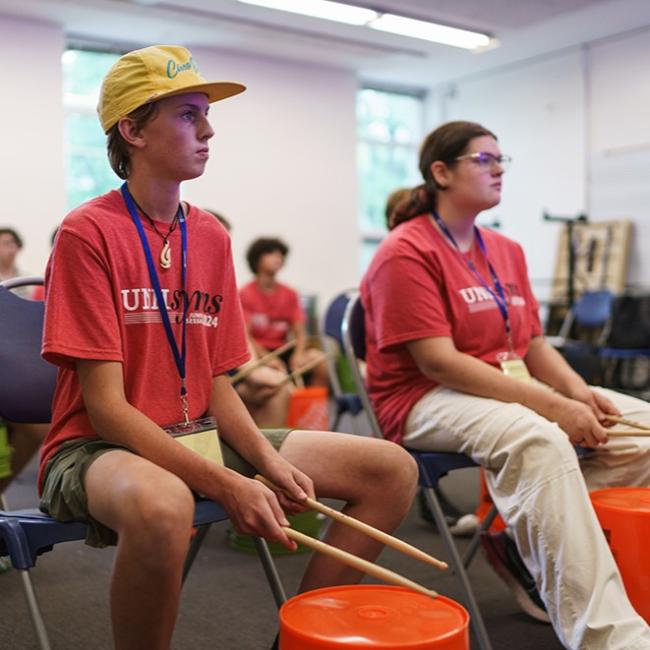
Two children sitting in front of a bucket drum holding drumsticks'

music

The Music Education major at UNH offers a comprehensive, four-year pathway to becoming an inspiring K-12 music teacher, with certification in New Hampshire and neighboring states within. Here you'll be able to develop your musical artistry while gaining extensive teaching experience through programs like the Summer Youth Music School and UNH Youth Band and Youth Orchestras.

With expert faculty mentorship, specialized tracks in vocal or instrumental music and hands-on classroom opportunities, our program boasts an exceptional graduate employment rate and prepares you to make a lasting impact through music education. Our vibrant community in the UNH Music Department provides the perfect environment to grow as both a musician and an educator.

*Number of courses and course credit hours may vary, please reach out to your academic advisor for exact requirements.

Department of Music

What is a Bachelor of Music in music education?

Educators inspire and change students’ lives. If you want to teach music in a K-12 setting, the Bachelor of Music in music education degree qualifies you for licensure in New Hampshire and neighboring states in only four years’ time. Students demonstrating musical skill and a firm commitment to leading school students to artistic success may be admitted to this program. You’ll study music performance, theory, analysis and history, as well as teaching methods and human development. You’ll be able to select an emphasis in vocal or instrumental music. Come prepare yourself to share your love of music through teaching!

Why study music education at UNH?

Music education is central to what we do. Approximately two-thirds of our students are music education majors, and all recent graduates who have sought employment as teachers have been successful. At UNH, you’ll work with renowned faculty who had significant careers as K-12 music educators. Your coursework will cover both the theory and practice of teaching, and you’ll gain valuable teaching experience through programs like Summer Youth Music School and the UNH Youth Band and Youth Orchestras. You’ll hone your own personal musicianship through private study, chamber music and some of the best performing ensembles in the region.

Potential Careers

  • Arts nonprofit team member or director
  • K-12 music teacher
  • Music education and outreach director
  • Private lesson instructor
  • Professional performer
  • School music administrator

Curriculum & Requirements

01
Program Description
Open icon icon to open the summary

The B.M. music education is the traditional program of choice for students seeking a career as a school music teacher. The bachelor of music degree in music education provides a route to undergraduate certification leading to state of New Hampshire teacher licensure in music, grades K-12 (cert. #507.39). New Hampshire also participates in a reciprocal agreement with many other states: the Interstate Certification Compact.

Successful applicants must demonstrate a high degree of musical competence and promise of future growth as a performer. A firm commitment to leading school musicians to artistic success is expected, as is a willingness to acquire the breadth of skills required for K-12 music licensure. Continuation in the B.M. music education program is made with the recommendation of the appropriate faculty members and contingent upon personal commitment to the teacher licensure program.

Students interested in a five-year, bachelor/masters degree program typically complete the B.M pre-teaching major as an undergraduate and apply to the UNH Department of Education for admission to the Master of Arts in Teaching (Secondary Education) degree program.

The four-year bachelor of music in music education curriculum is highly structured due to the number of required courses to complete. The requirements  include a list of additional classes required to earn a degree and licensure to teach. Students may elect a vocal/choral or instrumental emphasis.

02
Degree Plan
Open icon icon to open the summary

Sample Degree Plan

This sample degree plan serves as a general guide; students collaborate with their academic advisor to develop a personalized degree plan to meet their academic goals and program requirements.

Music Education: Choral

Plan of Study Grid
First Year
FallCredits
ENGL 401 First-Year Writing 4
MUSI 501 The Western Musical Canon 3
MUSI 471 Theory I 3
MUSI 473 Ear Training I 1
MUSI 475 Functional Piano I 1
MUED 745 Techniques and Methods in String Instruments 2
500 Level Lesson 1
Performing Ensemble 1 1
MUSI 540 Recital Attendance 0
 Credits16
Spring
MUSI 515 Music in World Cultures 4
MUSI 520 Diction for Singers I 2
MUSI 472 Theory I 3
MUSI 474 Ear Training I 1
MUSI 476 Functional Piano I 1
MUED 751 Techniques and Methods in Percussion Instruments 2
500 Level Lesson 1
Performing Ensemble 1 1
MUSI 540 Recital Attendance 0
 Credits15
Second Year
Fall
Discovery/QR 4
EDUC 500 Exploring Teaching 4
MUSI 571 Theory II 3
MUSI 573 Ear Training II 1
MUSI 575 Functional Piano II 1
MUED 747 Techniques and Methods in Woodwind Instruments 2
500 Level Lesson 1
Performing Ensembles 1 2
MUSI 540 Recital Attendance 0
 Credits18
Spring
MUSI 502 Musics in Context 3
MUED 755 Vocal Pedagogy 2
MUSI 572 Theory II 3
MUSI 574 Ear Training II 1
MUSI 576 Functional Piano II 1
MUED 749 Techniques and Methods in Brass Instruments 2
MUSI 731 Conducting 2
500 Level Lesson 1
Performing Ensemble 1 1
MUSI 540 Recital Attendance 0
 Credits16
Third Year
Fall
Discovery Course 4
Discovery Course 4
EDUC 605 Educational Perspectives in Critical Times 4
MUSI 732 Conducting 2
MUSI 779 Reading and Writing Musical Scores 3
700 Level Lesson 1
Performance Ensemble 1 1
MUSI 540 Recital Attendance 0
 Credits19
Spring
Discovery Course 4
Discovery Course 4
EDUC 701 Human Development & Learning: Cultural Perspectives 4
MUED 790 Teaching Elementary School Music 3
MUSI 701 Topics in Music History 3
700 Level Lesson 1
Performing Ensemble 1 1
MUSI 540 Recital Attendance 0
 Credits20
Fourth Year
Fall
Discovery Course 4
Discovery Course 4
MUED 741 Techniques and Methods in Choral Music 2
MUED 791 Teaching Secondary School Music 2
700 Level Lesson 1
Performing Ensemble 1 1
 Credits14
Spring
EDUC 694 Courses in Supervised Teaching 2 8
EDUC 751A
or EDUC 751B
Inclusive Elementary Education: Literacies and Learning for Diverse Learners
or Methods of Inclusive Secondary Education: Literacies, Learning, and Transitions
4
 Credits12
 Total Credits130

Music Education: Instrumental

Plan of Study Grid
First Year
FallCredits
ENGL 401 First-Year Writing 4
MUSI 501 The Western Musical Canon 3
MUSI 471 Theory I 3
MUSI 473 Ear Training I 1
MUSI 475 Functional Piano I 1
MUED 745 Techniques and Methods in String Instruments 2
500 Level Lesson 1
Performance Ensemble 1 1
MUSI 540 Recital Attendance 0
 Credits16
Spring
Discovery/QR 4
MUSI 515 Music in World Cultures 4
MUSI 472 Theory I 3
MUSI 474 Ear Training I 1
MUSI 476 Functional Piano I 1
MUED 751 Techniques and Methods in Percussion Instruments 2
500 Level Lesson 1
Performance Ensemble 1 1
MUSI 540 Recital Attendance 0
 Credits17
Second Year
Fall
Discovery Course 4
EDUC 500 Exploring Teaching 4
MUSI 571 Theory II 3
MUSI 573 Ear Training II 1
MUSI 575 Functional Piano II 1
MUED 747 Techniques and Methods in Woodwind Instruments 3
500 Level Lesson 1
Performance Ensembles 1 2
MUSI 540 Recital Attendance 0
 Credits19
Spring
Discovery Course 4
MUSI 502 Musics in Context 3
MUSI 572 Theory II 3
MUSI 574 Ear Training II 1
MUSI 576 Functional Piano II 1
MUED 749 Techniques and Methods in Brass Instruments 2
MUSI 731 Conducting 2
500 Level Lesson 1
Performance Ensemble 1 1
MUSI 540 Recital Attendance 0
 Credits18
Third Year
Fall
Discovery Course 4
EDUC 605 Educational Perspectives in Critical Times 4
MUSI 732 Conducting 2
MUSI 779 Reading and Writing Musical Scores 3
700 Level Lesson 1
Performance Ensemble 1 1
MUSI 540 Recital Attendance 0
 Credits15
Spring
Discovery Course 4
EDUC 701 Human Development & Learning: Cultural Perspectives 4
MUED 765 Instrumental Music Methods 2
MUED 790 Teaching Elementary School Music 3
MUSI 701 Topics in Music History 3
700 Level Lesson 1
Performance Ensemble 1 1
MUSI 540 Recital Attendance 0
 Credits18
Fourth Year
Fall
Discovery Course 4
Discovery Course 4
MUED 741 Techniques and Methods in Choral Music 2
MUED 791 Teaching Secondary School Music 2
700 Level Lesson 2
Performance Ensemble 1 1
 Credits15
Spring
EDUC 694 Courses in Supervised Teaching 2 8
EDUC 751A
or EDUC 751B
Inclusive Elementary Education: Literacies and Learning for Diverse Learners
or Methods of Inclusive Secondary Education: Literacies, Learning, and Transitions
4
 Credits12
 Total Credits130
1

Performing Ensembles are specified in the catalog.

2

PRAXIS II: Music Content Knowledge #5113 is required before EDUC 694 Student Teaching
 

03
Requirements for the Program
Open icon icon to open the summary

Degree Requirements

Minimum Credit Requirement: 131 credits (Instrumental Track) or 132 credits (Choral Track)
Minimum Residency Requirement: 32 credits must be taken at UNH
Minimum GPA: 2.0 required for conferral*
Core Curriculum Required: Discovery & Writing Program Requirements
Foreign Language Requirement: No

All Major, Option and Elective Requirements as indicated.
*Major GPA requirements as indicated.

Major Requirements

Students in music education must maintain an overall minimum 2.8 grade-point average at the time of application for student teaching (February 15 of junior year). Any education courses taken to fulfill a teacher licensure requirement must be completed with a B- or better.

Discovery Program Requirements: B.M. music education majors may use MUSI 501 The Western Musical Canon (a required core course for the major) to satisfy the Fine and Performing Arts Discovery category requirement. In addition, they may use MUSI 502 Musics in Context (a required core course for the major) to satisfy the Inquiry Discovery category requirement, and MUSI 515 Music in World Cultures (a required core course for the major) to satisfy the World Cultures Discovery category requirement.

All bachelor of music students are required to give a public performance during their senior year, which fulfills the Discovery Program capstone requirement.

For students in the music education option, a half recital is required.

Music requirements must receive a grade of C- or better. Education courses require a minimum grade of B- or better to receive credit.

Core Curriculum
MUSI 471
& MUSI 472
Theory I
and Theory I
6
MUSI 473
& MUSI 474
Ear Training I
and Ear Training I
2
MUSI 475
& MUSI 476
Functional Piano I
and Functional Piano I 1
2
MUSI 571
& MUSI 572
Theory II
and Theory II
6
MUSI 573
& MUSI 574
Ear Training II
and Ear Training II
2
MUSI 575
& MUSI 576
Functional Piano II
and Functional Piano II 1
2
MUSI 501
& MUSI 502
The Western Musical Canon
and Musics in Context
6
MUSI 515Music in World Cultures4
MUSI 540Recital Attendance0
MUSI 731Conducting2
Advanced Music History3
MUSI 701
Topics in Music History
Performance Study (Applied Lessons): select from the following coursesVariable
MUSI 541, MUSI 545, MUSI 546, MUSI 547, MUSI 548, MUSI 549, MUSI 550, MUSI 551, MUSI 552, MUSI 553, MUSI 554, MUSI 555, MUSI 556, MUSI 557, MUSI 558, MUSI 559, MUSI 560, MUSI 561, MUSI 562, MUSI 563, MUSI 564, MUSI 741, MUSI 745, MUSI 746, MUSI 747, MUSI 748, MUSI 749, MUSI 751, MUSI 752, MUSI 753, MUSI 754, MUSI 755, MUSI 756, MUSI 757, MUSI 758, MUSI 759, MUSI 760, MUSI 761, MUSI 762, MUSI 763, MUSI 764
Performing Ensemble: select from the following coursesVariable
MUSI 441, MUSI 442, MUSI 448, MUSI 450, MUSI 452, MUSI 453, MUSI 454, MUSI 455, MUSI 456, MUSI 457, MUSI 459, MUSI 460, MUSI 462, MUSI 463, MUSI 464
Total Credits35
1

Students will be given the opportunity to test out of MUSI 471 Theory I, MUSI 475 Functional Piano I, MUSI 476 Functional Piano I and MUSI 575 Functional Piano II, MUSI 576 Functional Piano II.

Bachelor of Music in Music Education Curriculum

Degree program has final approval from the National Association of Schools of Music.

MUED 741Techniques and Methods in Choral Music2
MUED 745Techniques and Methods in String Instruments2
MUED 747Techniques and Methods in Woodwind Instruments 12-3
MUED 749Techniques and Methods in Brass Instruments2
MUED 751Techniques and Methods in Percussion Instruments2
MUED 755Vocal Pedagogy 22
MUED 765Instrumental Music Methods 32
MUED 790Teaching Elementary School Music3
MUED 791Teaching Secondary School Music2
MUSI 520Diction for Singers I 42
MUSI 732Conducting2
MUSI 779Reading and Writing Musical Scores3
Performance Study (Applied Lessons): select from the following courses8
MUSI 541, MUSI 545, MUSI 546, MUSI 547, MUSI 548, MUSI 549, MUSI 550, MUSI 551, MUSI 552, MUSI 553, MUSI 554, MUSI 555, MUSI 556, MUSI 557, MUSI 558, MUSI 559, MUSI 560, MUSI 561, MUSI 562, MUSI 563, MUSI 564, MUSI 741, MUSI 745, MUSI 746, MUSI 747, MUSI 748, MUSI 749, MUSI 751, MUSI 752, MUSI 753, MUSI 754, MUSI 755, MUSI 756, MUSI 757, MUSI 758, MUSI 759, MUSI 760, MUSI 761, MUSI 762, MUSI 763, MUSI 764
Performing Ensemble: select from the following courses 5, 6, 78
MUSI 441, MUSI 442, MUSI 448, MUSI 450, MUSI 452, MUSI 453, MUSI 454, MUSI 455, MUSI 456, MUSI 457, MUSI 459, MUSI 460, MUSI 462, MUSI 463, MUSI 464
EDUC 500Exploring Teaching4
EDUC 605Educational Perspectives in Critical Times4
EDUC 701Human Development & Learning: Cultural Perspectives4
EDUC 751BMethods of Inclusive Secondary Education: Literacies, Learning, and Transitions4
EDUC 694Courses in Supervised Teaching8
Total Credits66-67
1

 Vocal track students take 2 credits. Instrumental track students take 3 credits.

2

Required for Vocal track.

3

 Required for Instrumental track.

4

 Required for Vocal track.

5

Students in the Bachelor of Music Education program are required to complete 8 credits of ensemble; a maximum of 8 ensemble credits may be counted towards graduation. Students will enroll in one conducted ensemble (MUSI 450 Symphony, MUSI 452 Wind Symphony,MUSI 453 Symphonic Band, MUSI 441 Concert Choir, MUSI 442 Chamber Singers, MUSI 460 Jazz Band, MUSI 454 UNH Marching Band) in every semester of their enrollment at UNH except for their student-teaching semester. To compensate, they will enroll in two ensembles during a previous semester.

6 of these required ensembles must be on the student’s primary instrument and 4 credits must be in a traditional conducted ensemble (MUSI 450 Symphony, MUSI 452 Wind Symphony, MUSI 453 Symphonic Band, MUSI 441 Concert Choir). For instrumentalists, at least 1 semester of participation in MUSI 454 UNH Marching Band) and MUSI 460 Jazz Band are highly desirable.

6

Guitar music education majors will take four semesters of MUSI 464 Guitar Ensemble and four semesters of a traditional conducted ensemble (MUSI 450 Symphony, MUSI 452 Wind Symphony, MUSI 453 Symphonic Band, MUSI 441 Concert Choir). Therefore, guitarists have a minimum of only 4 semesters required on their primary instrument.

7

Piano music education majors will take four semesters of MUSI 455 Collaborative Piano and four semesters of a traditional conducted ensemble (MUSI 450 Symphony, MUSI 452 Wind Symphony, MUSI 453 Symphonic Band, MUSI 441 Concert Choir). Therefore, pianists have a minimum of only 4 semesters required on their primary instrument.

Junior Standing in Music Education

Recognition of adequate completion of fundamental academic and musical competencies shall earn students declared for the Bachelor of Music: Music Education the title Junior Standing. Students will not receive permission to register for the upper-level music education methods courses (e.g., MUED 765, MUED 790, MUED 791) without such recognition. Two of the steps required for recognition are the submission of passing scores on the Pearson Basic Academic Skills Test for Educators (scores will be sent directly to the Department of Education) and clearance of the Criminal Background Check as conducted by the State of New Hampshire Department of Safety. Since students enter their freshman year as declared music education majors and must complete an audition and university application to be admitted, Junior Standing serves as a gateway/checkpoint to ensure students are maintaining adequate academic standing and meeting musical expectations/requirements.

Junior Standing Requirements

  1. Criminal Background Check
    1. Complete criminal background check, as directed by the Department of Education
    2. Pass the background check and provide evidence of clearance
  2. Academic Standing
    1. 2.8 overall grade point average
    2. Pass the Pearson Basic Academic Skills Assessment for Educators
  3. Aural Skills: Complete MUSI 574 Ear Training II with a grade of C- or better
  4. Music Performance Skills
    1. Pass Sophomore Performance Jury with a grade of C- or better
    2. Perform for at least 3 semesters as a regular member of at least one of the designated core ensembles
    3. Complete MUSI 576 Functional Piano II with a grade of C- or better
  5. Complete EDUC 500
    1. Complete all EDUC 500 Exploring Teaching coursework
    2. Receive a passing grade in EDUC 500 and complete a 1:1 meeting with a music education faculty member
04
Student Learning Outcomes
Open icon icon to open the summary

MUED Preservice Educator Preparation Program (PEPP) learning outcomes involve skills and competencies in the areas of music, music teaching/learning, and teaching/learning in general. For example, program goals include students' ability to:

Program Learning Outcomes
  • Exhibit the skills necessary for artistic expression at the highest possible level as defined by their applied area of concentration in solo and small ensemble (not conducted) and large ensemble (conducted) settings;
  • Exhibit competencies in musicianship and musical analysis through their understanding of: musical forms and processes; aural, verbal and visual analyses; skills in performance; academic, pedagogical, and compositional applications; and abilities to create derivative or original music;
  • Demonstrate familiarity with musical literature from a variety of forms, traditions, cultures, including the ability to connect music to historical, cultural, and stylistic contexts;
  • Demonstrate clear and effective communication skills in written and aural/oral formats, including musical contexts;
  • Demonstrate appropriate and relevant use of current technologies to their area of specialization for professional development and entrepreneurship, as well as career preparation and promotion;
  • Facilitate musical growth and development - both in knowledge and skills - among students, including but not limited to performance in a variety of settings and contexts;
  • Facilitate pedagogical approaches which are developmentally responsive and appropriate;
  • Apply aspects of educational learning theories and demonstrate their understanding of relevant theories through classroom practice;
  • Adequately, efficiently, and thoughtfully prepare music learning experiences and curricula to support the learning of all students - including modifying lesson plans, instruments, physical and/or multimedia materials, and classroom spaces - to ensure equal and equitable access to music-making;
  • Demonstrate the aural musicianship skills necessary to support K-12 student learning and musical development, both technically and expressively;
05
Disclosures
Open icon icon to open the summary

Music Education (B.M.)

Location/Delivery: College of Liberal Arts, Durham Campus [In Person Program]

This program is designed to prepare graduates for professional licensure/certification as follows:

Teacher Licensure

Music Education K-12

The University of New Hampshire has determined this program meets the educational requirements for licensure/certification in:1
Alabama, Alaska, Arizona, Arkansas, California, Colorado, Connecticut, Delaware, Florida, Georgia, Hawaii, Idaho, Illinois, Indiana, Iowa, Kansas, Kentucky, Louisiana, Maine, Maryland, Massachusetts, Michigan, Minnesota, Mississippi, Missouri, Montana, Nebraska, Nevada, New Hampshire, New Jersey, New Mexico, New York, North Carolina, North Dakota, Ohio, Oklahoma, Oregon, Pennsylvania, Rhode Island, South Carolina, South Dakota, Tennessee, Texas, Utah, Vermont, Virginia, West Virginia, Wisconsin, Wyoming.

Additional information and related resources are available on the Registrar's Office website.

1

State specific post-education requirements are subject to change. Students are responsible for confirming these requirements in their state of residence and intended practice.