Economics: Public Policy and Sustainability, B.A. - PAUL, UNH

Undergraduate

Economics: Public Policy and Sustainability

Study ways to solve critical issues like climate change, economic inequality, and resource management while developing solutions through policy analysis.
Degree
Bachelor of Arts
Location
Durham, NH
Courses
20*
Credit
128 hrs*
Full-time
3-4 yrs.
Part-time
N/A
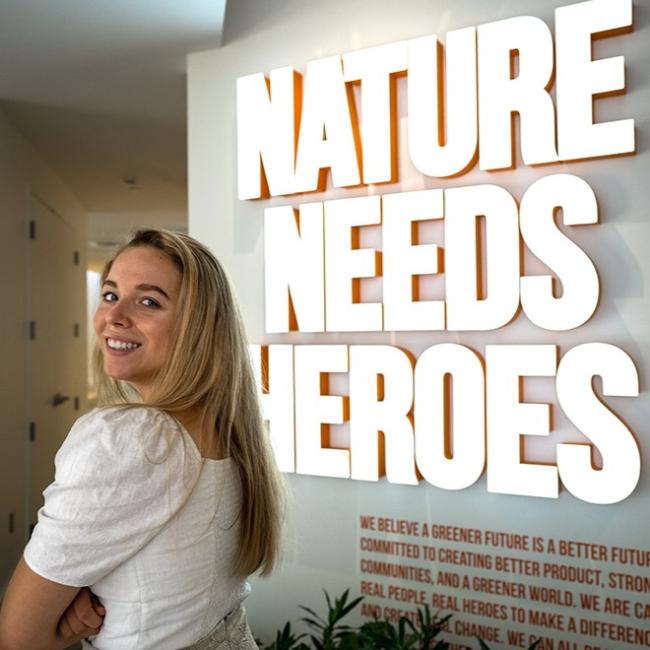
student standing in front of a sign that reads nature needs heroes

Paul College UnderGraduate Programs

The Economics Public Policy and Sustainability major at UNH offers specialized training in analyzing how economic decisions impact social and environmental outcomes. Here you'll be able to study ways to solve critical issues like climate change, economic inequality, and resource management while developing solutions through policy analysis. 

With focused coursework in law, economics, labor markets and environmental economics, this option will prepare you for impactful careers in policy research and consulting. Whether you're passionate about environmental conservation, social justice, or sustainable development, you'll gain the analytical tools needed to drive positive change through positions in government agencies, think tanks, and advocacy organizations. 

*number of courses and course credit hours may vary, please reach out to your academic advisor for exact requirements

Paul College Undergraduate Programs

Contact Cards

Professor
Paul College, Room 370j, Durham, NH 03824
(603) 862-3302
Durham, NH 03824
(603) 862-3457

What is the public policy and sustainability option in the B.A. economics major?

This option examines the factors that influence economic, social and environmental outcomes, such as unemployment, poverty, economic inequality, health disparities, technological innovation and pollution.

Why study public policy and sustainability at UNH?

In this option in the B.A. economics major you’ll develop the institutional knowledge and theoretical perspective to understand the impact that decisions of individuals, firms, communities and governments have on economic, social and environmental outcomes. You’ll analyze the impact of specific government policies and potential reforms, theoretically and realistically. Required courses cover law and economics, labor economics, economics of climate change, and natural resource economics.

Potential careers

Policy analysis and research positions with:

  • Consulting firms
  • Government agencies
  • Nongovernmental organizations
  • Think tanks (e.g., RAND Corporation, Urban Institute, Mathematica Policy Research)


Curriculum & Requirements

01
Program Description
Open icon icon to open the summary

The Option in Public Policy and Sustainability (B.A. degree) examines the factors that influence economic, social, and environmental outcomes, such as unemployment, poverty, economic inequality, health disparities, technological innovation, and pollution. Students will develop the institutional knowledge and theoretical perspective to understand the impact that decisions of individuals, firms, communities, and governments have on such outcomes. Students will analyze the impact of specific government policies and potential reforms, theoretically and empirically.

This option is designed for students seeking careers in policy analysis and research positions at government agencies; think tanks such as RAND Corporation, Urban Institute, and Mathematica Policy Research; consulting firms such as Abt Associates; and non-governmental organizations.

02
Degree Plan
Open icon icon to open the summary

Sample Degree Plan

This sample degree plan serves as a general guide; students collaborate with their academic advisor to develop a personalized degree plan to meet their academic goals and program requirements.

Plan of Study Grid
First Year
FallCredits
ECON 402
or ECON 401
Principles of Economics (Micro)
or Principles of Economics (Macro)
4
ECON 501 Business and Economic History 4
ENGL 401 First-Year Writing 4
MATH 422
or MATH 424A
Mathematics for Business Applications
or Calculus for Social Sciences
4
PAUL 405 FIRE: First-Year Innovation and Research Experience I 1
ADMN 403 Computing Essentials for Business 1
 Credits18
Spring
ECON 401
or ECON 402
Principles of Economics (Macro)
or Principles of Economics (Micro)
4
PAUL 406 First-Year Innovation and Research Experience II 1
Discovery Course 4
Discovery Course 4
Discovery Course 4
 Credits17
Second Year
Fall
ECON 611 Intermediate Macroeconomic Analysis 4
ADMN 510 Business Analytics and Statistics 4
Foreign Language 4
Discovery Course 4
PAUL 505 FOCUS: Finding Opportunities, Careers, and University Success 2
 Credits18
Spring
ECON 605 Intermediate Microeconomic Analysis 4
Foriegn Language 4
Discovery Course 4
Discovery Course 4
 Credits16
Third Year
Fall
ECON 565 Predictive Modeling: Data Driven Economic Analysis 4
Economics Elective 2 4
Course selected in consultation with advisor 1 4
 Credits16
Spring
Economics Elective 2 4
Course selected in consultation with advisor 1 4
 Credits16
Fourth Year
Fall
Economics Elective 2 4
Economics Elective 4
Course selected in consultation with advisor 1 4
 Credits16
Spring
ECON 774 Senior Economics Seminar 4
Course selected in consultation with advisor 1 4
 Credits16
 Total Credits133
1

Students can explore a second option, second major, minor, or general electives.

2

Students can use three ECON elective courses to satisfy both the Public Policy and Sustainability option and the Economics Elective requirement for the core major required courses.  

03
Requirements for the Program
Open icon icon to open the summary

Degree Requirements

Minimum Credit Requirement: 128 credits
Minimum Residency Requirement: 32 credits must be taken at UNH
Minimum GPA: 2.0 required for conferral*
Core Curriculum Required: Discovery & Writing Program Requirements
Foreign Language Requirement: Yes

All Major, Option and Elective Requirements as indicated.
*Major GPA requirements as indicated.

Major Requirements

Economics majors must complete eleven courses in economics plus ADMN 510 with a grade of at least C- (1.67) in each Paul College major course and an average grade of 2.0 or better in major courses.

B.A. economics majors may choose to focus their major electives to satisfy the requirements of the option.

Required Courses
ADMN 403Computing Essentials for Business1
ADMN 510Business Analytics and Statistics4
ECON 401Principles of Economics (Macro)4
ECON 402Principles of Economics (Micro)4
ECON 501Business and Economic History4
ECON 565Predictive Modeling: Data Driven Economic Analysis4
ECON 605Intermediate Microeconomic Analysis4
or ECON 606 Intermediate Microeconomics with Calculus
ECON 611Intermediate Macroeconomic Analysis4
MATH 422Mathematics for Business Applications4
or MATH 424A Calculus for Social Sciences
PAUL 405FIRE: First-Year Innovation and Research Experience I 1
PAUL 406First-Year Innovation and Research Experience II1
PAUL 505FOCUS: Finding Opportunities, Careers, and University Success2
PAUL 670BiP-Analytical Intelligence Topics2
Capstone
ECON 774Senior Economics Seminar 14
Economics Electives
Select four (4) courses from the following: 216
ECON 625
Economic History of the United States
ECON 635
Money and Banking
ECON 645
International Economics
ECON 652
Economics of Artificial Intelligence
ECON 653
Law and Economics
ECON 654
Industrial Economics and Business Innovation
ECON 655
Innovation in the Global Economy
ECON 656
Labor Economics
ECON 704
Economics of Health
ECON 706
Economics of Climate Change
ECON 726
Introduction to Econometrics
ECON 727
Advanced Econometrics
ECON 760
Game Theory
ECON 765
Machine Learning for Economics
ECON 620
Topics in Economics
ECON 620W
Topics in Economics
ECON 720
Economic Problems
ECON 720W
Economic Problems
Total Credits59
Public Policy and Sustainability Option Requirements
Select a minimum of two courses from the following:8
ECON 653
Law and Economics
ECON 656
Labor Economics
ECON 704
Economics of Health
ECON 706
Economics of Climate Change
Final course select from list of required courses above or from one of the approved courses below:
ECON 654
Industrial Economics and Business Innovation
ECON 620
Topics in Economics (Must be Public Economics Topics)
NR 572
Introduction to Natural Resource Economics 3
NR 606
International Energy Topics 3
NR 708W
Environmental Economics 3
HMP 746
Health Policy 3
SUST 501
Sustainability in Action 3
Approval required by petition to the Economics Department for other 600-level or 700-level ECON course, including ECON 620: Public Economics.
Total Credits8
1

Course satisfies the capstone requirement of the University Discovery Program.

2

Other elective course by approval.

3

Satisfies requirement of the option, but does not count toward the four-elective requirement of the Economics B.A degree. 

04
Student Learning Outcomes
Open icon icon to open the summary
Program Learning Outcomes
  • Students have core proficiency in microeconomics. They understand key concepts including opportunity cost, marginal analysis, voluntary exchange, diminishing marginal returns, equilibrium and market structure.
  • Students have core proficiency in macroeconomics. They understand key concepts including GDP, inflation, interest rates, business cycles, exchange rates, financial institutions and fiscal and monetary policy.
  • Students have strong oral communication skills. This includes fundamental skills in preparing and delivering presentations, as well as being able to explain technical material clearly and concisely.
  • Students are able to use economic models to understand real-world issues relevant to business, public policy and society.
  • Students are able to communicate economic concepts clearly in writing. This involves having strong fundamental writing skills as well as being able to explain technical material clearly and concisely.