
Can Surplus-Food Apps Have Too Much Competition?
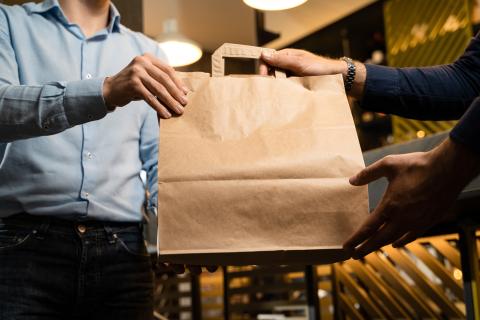
Apps that let businesses sell surplus food at a discount in “surplus bags” have become a popular way to keep edible food out of landfills while giving consumers access to lower-cost meals and groceries.
But new research from Wei Wei, assistant professor of decision sciences at UNH's Peter T. Paul College of Business and Economics, suggests the results aren't always so straightforward. While surplus-food platforms can benefit businesses, consumers, and the environment, the researchers found that when competition becomes too intense, food waste can rise and retailer profits can fall. One reason: getting surplus food out of a store doesn't necessarily mean it all gets eaten. If consumers receive more food than they need, the extra can still end up wasted at home.
In a study published in Decision Sciences, Wei and co-author Zhangchen Hu, assistant professor at California State University, Fullerton, built a mathematical model of how retailers balance traditional in-store sales with sales of discounted surplus bags through apps such as Too Good To Go. Their analysis suggests that while the platforms can create significant benefits, those benefits depend heavily on local market conditions.
"The app itself is helping, but what we're really investigating is whether it's always helping in the way it's intended," Wei says. "The result is not automatic. Under certain scenarios, competition can benefit consumers, retailers, and society, but under others, more competition may not be a good thing."
When Saving Food Gets Complicated
Too Good To Go launched in the U.S. in late 2020 and is now used nationwide. As Wei and Hu explored the platform's challenges, they spoke with participating retailers.

Wei Wei
"I went down to Boston and interviewed a few retailers that participate in the app. They told me it helped them clear out edible food that otherwise might have been thrown away or composted," Wei says. "But a grocery store manager in Cambridge told me participating can also be challenging. With perishable foods such as prepared foods, baked goods and produce, they don't know how much they'll have left at the end of the day. They have to decide how many surplus bags to make available on the app before they know what their in-store demand will be."
Make too many surplus bags available, and retailers risk missing higher-margin in-store purchases. Make too few available, and they may miss the chance to recover value from food that would otherwise go unsold.
Pricing adds another wrinkle. Under the platform’s rules, a bag's price is tied to the value of the food inside, so a higher-priced bag is required to contain food with a higher total value. In many cases, that also means more food in the bag. For example, if a bag's price can be no more than 40% of the food's value, a $4 bag would contain at least $10 worth of food. That may suit consumers who need more food but leave others with more than they can use.
Why More Competition Isn't Always Better
Competition further complicates those decisions. With more businesses offering surplus bags to the same pool of customers, retailers must decide how to price their bags and how much food to set aside while also accounting for what other participating businesses are doing.
"I would expect competition to always help," Wei says. "At first, as competition increases, food waste goes down. But there's a point where that changes. When competition becomes too intense, food waste starts to increase."
Consumers continue to benefit as competition increases, but retailers don't share in those gains. The model found that retailer profits decline as more businesses compete on the platform.
How Do Businesses Find the Right Balance?
Wei says the findings aren't an argument against surplus-food platforms. Researchers found many situations where competition among retailers produces a "win-win-win"— higher consumer benefits, higher retailer profits, and lower food waste. In the model, this can occur when surplus bags are offered at a substantial discount and consumers strongly value the bags.
The key is understanding the market. A bakery that's one of a dozen on the app in its neighborhood faces very different conditions than one with few nearby competitors, and the model suggests the right pricing and bag-size decisions can differ sharply between the two.
"Retailers should not view these platforms as an automatic solution for their surplus food," Wei says. "They need to think strategically about pricing and bag size, while considering their projected in-store demand, how much food their customers actually need and how many other retailers are competing nearby."
The platforms themselves can play a role, too. The model suggests that adjusting discount levels based on market conditions could help reduce food waste and, in some cases, improve retailer profits. Helping consumers better understand the value of surplus bags could also improve outcomes.
Wei says future research could examine the platform's decisions more directly and how it can balance the interests of businesses, consumers, and food waste reduction.
"Overall, their intention is good, and what they are doing is good," Wei says. "The question is how much good they can do and whether they can achieve the best outcome."