
Fostering biomedical research excellence
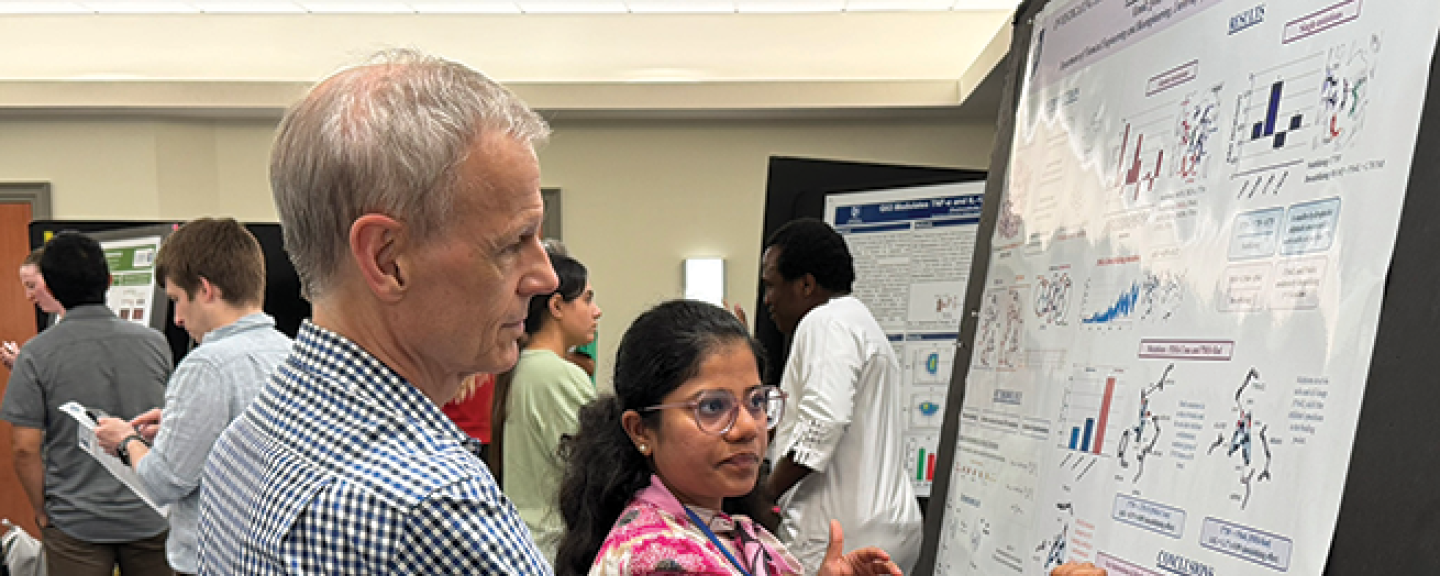
It is hard to overstate the impact that the Center of Integrated Biomedical and Bioengineering Research (CIBBR) has had at UNH since its establishment in 2017. The statistics are impressive on their own: 19 tenure-track faculty hired, $23.8 million awarded to CIBBR principal investigators, $3.2 million invested in research infrastructure, and 256 publications to date. But for Rick Cote, who spearheaded CIBBR’s formation and led it as director for nearly a decade, the numbers do not fully capture the center’s most important achievements.
“For me, one major accomplishment of CIBBR has been implementing the mentoring program that we provide for our early-stage researchers,” says Cote, a professor of biochemistry and molecular biology who stepped down from the directorship this year. “The CIBBR leadership team takes pride in working closely with them and helping them to successfully apply for major grants and to advance their research careers.”
CIBBR has also catalyzed interdisciplinary research across traditional academic silos. Researchers in the College of Engineering and Physical Sciences (CEPS) regularly collaborate with COLSA researchers to carry out research projects that span basic biomedical and bioengineering disciplines.
$23.8M Awarded to CIBBR principal investigators
“A great example is the work by Sarah Walker, who is a cancer researcher and an expert in mammalian cell culture,” says Cote. “Working with Linqing Li in CEPS, she’s using engineered scaffolds to grow cancer cells in a three-dimensional environment to mimic how they grow in the body rather than on a flat dish.”
Biomedical research excellence
The story of CIBBR’s inception begins many years before it came into existence. Historically, UNH had been very successful at attracting funding from federal agencies such as NASA and NSF, but the National Institutes of Health (NIH) was a notable exception. Early conversations between Cote and Jan Nisbet, then the senior vice provost for research, focused on how to improve NIH grant success. The conversations led to the launch of an NIH grant-writing program (UP-2-NIH) that continues to this day.
Two other developments also set the stage. First, a reorganization in COLSA included the formation of the department of molecular, cellular, and biomedical sciences (MCBS), a department that included a focus on growing biomedical research at UNH. Around the same time, CEPS saw opportunities in the biomedical research space and created its successful bioengineering undergraduate degree program. With the pieces in place, Cote teamed with Kelley Thomas, fellow MCBS professor and the director of UNH’s Hubbard Center for Genome Studies, on a successful grant application to the National Institute of General Medical Sciences’ Centers of Biomedical Research Excellence (COBRE) program to form CIBBR and begin Phase One of three planned five-year phases.
$3.2M Invested in research infrastructure
“One critical element to our success was the strong institutional commitments we received from around UNH,” says Cote. “The Office of Research and Innovation is committed to helping build the research infrastructure we needed, and the deans were willing to commit to hiring biomedical and bioengineering faculty to build a critical mass of researchers.”
Moving to Phase Three
The other members of CIBBR’s original leadership team — Thomas, Don Wojchowski, and Steve Fiering, professor of microbiology and immunology at Dartmouth College’s Geisel School of Medicine — are still in their roles. Wojchowski, also a professor in MCBS, leads the molecular and cellular phenotyping core that has acquired a suite of instruments for shared use, some of which are housed and managed by the staff of the University Instrumentation Center. Thomas leads the data science core that addresses the strong need at UNH for a single place to go for statistical, bioinformatics, research computing infrastructure, and other services related to working with large datasets, while Fiering oversees the mentoring program.
Now, CIBBR is preparing to enter a new phase in more ways than one. It is wrapping up Phase Two, and the leadership team has been joined by Alexei Tulin, an expert in epigenetics and cancer biology who came to UNH from the University of North Dakota, who is taking over as director of CIBBR as it gears up for Phase Three. Cote expects that the next five years will see a greater emphasis on building the research infrastructure along with a business model needed to support UNH biomedical research once COBRE support ends.
“Our goal is to ensure that the research programs and instrumentation supported by CIBBR will have a lasting impact in promoting interdisciplinary biomedical research at UNH that leads to enhancing human health,” says Cote.