
Water Watchers
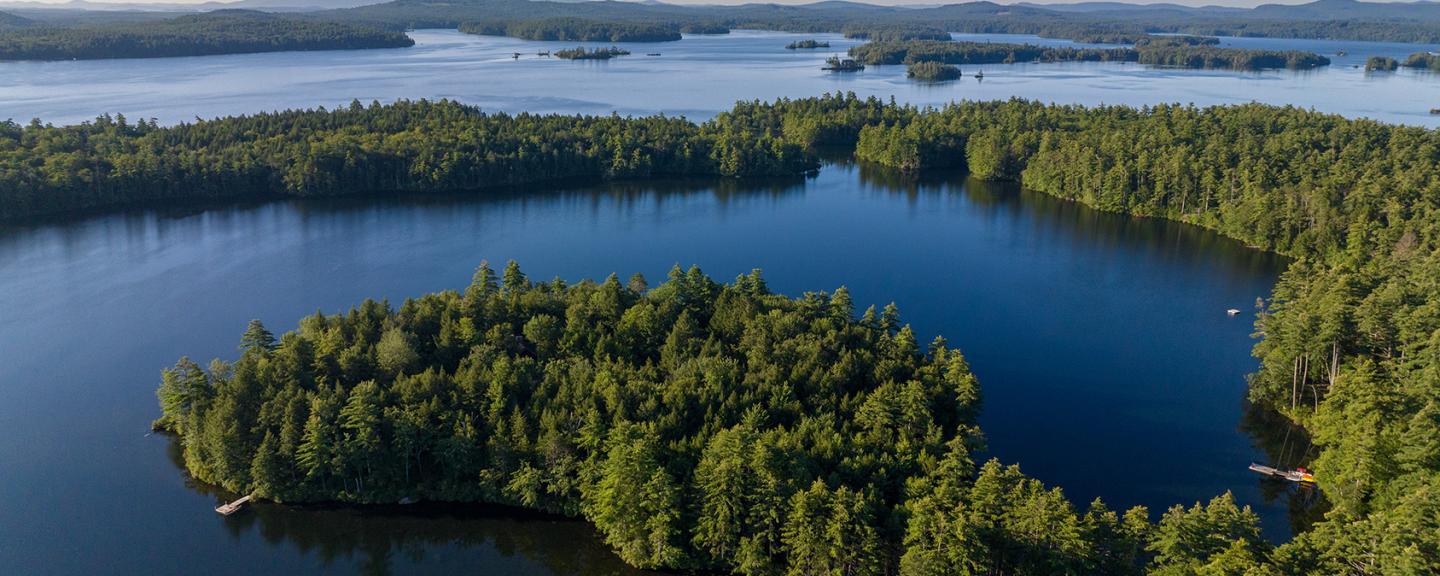
Wakondah Pond in Moultonborough, ringed by forested hills, lay quiet on a summer day last year when Jocelyn Brierley ’26 joined a handful of students and scientists from UNH to gather water samples.
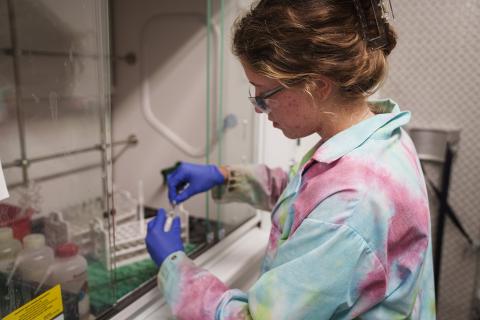
Brierley, a zoology major, took the Nalgene bottles full of pond water and packed them on ice for the trip back to Durham, where she was working as a summer intern with the Lakes Lay Monitoring Program (LLMP). The internship offered what she called a “full circle” experience of collecting samples in the field and analyzing them in a laboratory.
The researchers, students, and volunteers involved in the LLMP, which dates to 1978, know that a placid surface can conceal troubled waters. Perhaps most troubling is the threat of cyanobacteria, often called blue-green algae.
Cyanobacteria are one of the oldest life forms on Earth and occur naturally in water bodies, but that doesn’t make them harmless. In large blooms, some cyanobacteria release a chemical that is toxic to humans and many animals, including dogs. The blooms are sometimes also unsightly, covering a lake or pond’s surface with a thick greenish layer.
That’s partly what brought the crew of UNH students and faculty to Wakondah Pond. The pond hadn’t had a problem with cyanobacteria, but Lake Kanasatka, the water body it flows into, had been plagued in recent years until residents spearheaded a treatment in 2024 to remove phosphorus, a nutrient thought to spur blooms. Lake Kanasatka flows into Lake Winnipesaukee, the largest lake in the state.
In addition to the monitoring work done around the state by the LLMP, a multidisciplinary team of UNH researchers — including Amanda McQuaid ’06, ’09G, ’19G, Extension state specialist and Extension professor in the department of biological sciences who also serves as the LLMP’s director; Anna O’Brien, assistant professor in the department of molecular, cellular, and biomedical sciences; and Anyin Li, associate professor in the UNH College of Engineering and Physical Sciences’ department of chemistry — is developing new research methods, spurred by the NHAES CREATE program, to study the toxins created by cyanobacteria. They hope to learn where the toxins — and the chemicals that result when the toxins degrade — go because of the risks they can pose to human, animal, and environmental health. O’Brien
and McQuaid are also studying whether duckweed, an aquatic plant that commonly grows in irrigation ponds, can safely be used as a fertilizer
if the pond it grew in has a cyanobacteria problem.
Meanwhile, the LLMP continues to collect data on New Hampshire’s watersheds. Wakondah Pond, which was added to the program in 2021, has been shown to have pristine surface water clarity according to McQuaid, though a common cyanobacterium, Planktothrix, has been detected in its depths. Clarity, plankton, and chlorophyll and phosphorus levels are among the parameters tracked in Wakondah, which will contribute to a deeper understanding of the rest of the watershed, including Lake Winnipesaukee.
The LLMP lab, managed by program coordinator Robert Craycraft, boasts some of the most precise phosphorus detection capabilities in the country, if not the world, McQuaid says, for which she can thank long-term support from UNH Cooperative Extension and benefactors such as the Caswell Foundation.
Sustaining the impact
LLMP receives gift from the
Caswell Foundation
The LLMP has been working to protect New Hampshire’s freshwater for nearly 50 years, and such an impact can be sustained only with continued support. The program is fortunate to have found such support from the Caswell Foundation.
The Caswell Foundation has supported the LLMP for decades. Its generosity has established reliable revenue streams for the program, enabling the purchase of new equipment and testing supplies and supporting internship opportunities that provide UNH students with invaluable
hands-on experience.
This year, the LLMP lab in Spaulding Hall will be renamed to honor the Caswell Foundation in recognition of its longstanding support. The
naming will serve as a lasting tribute to the foundation’s legacy and impact on the LLMP.