
Tree Roots and the Release of CO2 in Changing Soils
It may come as a surprise, but a major source of the atmospheric carbon above our heads comes from the soil beneath our feet, which contributes an order of magnitude more carbon than fossil fuel combustion. UNH researchers are investigating root respiration, which contributes 40% to 60% of all soil respiration and release of carbon dioxide (CO2). A study led by NH Agricultural Experiment Station scientists Serita Frey and Thomas Muratore measured red maple and red oak root respiration and their responses to combinations of soil warming, nitrogen addition, or both over a 15-year period, finding that tree species release carbon at different levels in response to different environmental conditions.
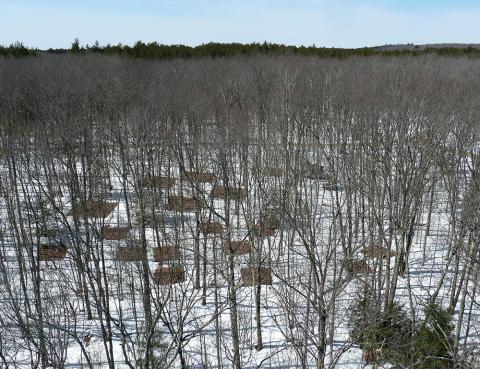
Separate plots in the Harvard Forest allowed researchers to assess the effects of different variables on tree root respiration.
Understanding how roots respond to environmental changes such as warming and nitrogen enrichment is essential for predicting soil carbon fluxes and their potential impacts on climate. Previous research indicated that the fine root biomass of trees decreases with soil warming, reducing respiration and potentially moderating the increased release of carbon from soil microbes with increased warmth. Frey, professor of natural resources and the environment, and Muratore ‘24G, now a postdoctoral researcher at Dartmouth College, found that the situation can be somewhat more complex.
The study, published in Global Change Biology, was done at the Harvard Forest in Massachusetts, which is composed of mixed hardwoods with high percentages of red oak and red maple. Working with separate plots—control, heated (with buried cables), nitrogen added, and heated with nitrogen added—the researchers found that overall root respiration decreased by 40% with either nitrogen or warming, but was similar to the control when nitrogen and warming were combined.
Interestingly, the root respiration rates responded to the varying conditions in species-specific ways. Oak and maple roots obtain their nitrogen in different forms, through different mechanisms, which may underlie some of the differences in how they respond to a changed environment.
“We found that the maple root respiration rates were consistently higher than oak,” says Muratore. “The difference became critical in the heated plus nitrogen treatment, where the maple root biomass proliferated and contributed significantly more CO2 relative to either treatment alone.”
The findings highlight the importance of incorporating root respiration in future studies that assess soil carbon loss in a changing climate. They also indicate that forest composition may represent an important variable, as different tree species may contribute more or less carbon efflux as conditions change. Finally, the study demonstrates that studying root respiration factors in isolation is not sufficient, as increases in both warmth and nitrogen availability will likely lead to effects that differ significantly from those produced by either factor alone.
The work was supported by the U.S. Department of Agriculture National Institute of Food and Agriculture through the New Hampshire Agricultural Experiment Station (NHAES; Hatch NH-00701).
This research is part of soils studies featured in the Spring 2026 issue of Inspired, a publication of the NH Agricultural Experiment Station. Sign up to receive an electronic version of the issue.