
What Is That Mysterious Cylinder on Campus? Get to Know UNH's Thermal Energy Storage Tank
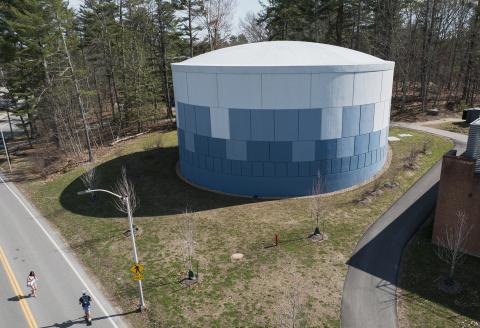
By the lead engineer’s own admission, the structure was constructed on campus virtually overnight. Curious students struck by its newness and scale took quickly to nicknaming it even though few knew its precise purpose. Since its arrival in the fall of 2024, it has remained something of a highly visible mystery.
So, what exactly is the blue-and-white concrete cylinder that suddenly appeared in the shadow of Philbrook Dining Hall, affectionally dubbed the “philander” by enterprising students?
It’s UNH’s thermal energy storage (TES) tank, and though it may have sprung up quickly in the physical sense – “In a span of two or three days, it was just there,” Adam Kohler, UNH’s director of energy and utilities, says of the speedy process of raising concrete sections of the tank – the project itself was much longer in the making, beginning as the brainstorm of Sustainability Institute student fellow Jacky Kinson ’18 in 2017.
The tank – about 45 feet tall and roughly 70 feet in diameter – was built to conserve energy for air conditioning the campus while also saving costs and reducing pollution. It acts essentially as a thermal battery, chilling water at night when demand is low and generating electricity is less expensive and releasing that chilled water to cool buildings during the day when demand is higher.
“What we’re storing is cooling energy, and we can charge it and discharge it just like a battery,” Kohler says. “At night when the sun isn’t shining and temperatures are cooler, we have additional cooling capacity, so we can use our chillers to charge up the tank and cool down the water, and then during peak afternoons where we need more cooling, we can discharge the tank by circulating the chilled water through our buildings.”
Long life, big impact
The tank holds 1.4 million gallons of water – the rough equivalent of two Olympic-sized swimming pools. The technology is relatively simple, Kohler says, leading to longer life and requiring minimal maintenance compared to traditional chillers.
The tank creates savings in a number of ways, perhaps most notably by reducing UNH’s reliance on imported electricity during peak hours. By performing the chilling at night, the university can tap into primarily self-generated electricity produced on campus instead of electricity that needs to be purchased elsewhere.
“By lowering UNH’s electricity draw during those peak hours of the grid during summer, it helps us save money year-round,” Kohler notes. Annual operating cost savings have been estimated at around $325,000, largely from the reduction in peak demand charges.
That also provides environmental benefits. Producing the chilled water during the day would rely on fossil fuels, since energy demand is highest, but producing the chilled water at night when demand is lower uses renewable energy that emits fewer carbon emissions.
Engineers chose concrete as the material for the structure for similar reasons, as it lasts longer and requires significantly less upkeep than steel. The lifespan could range anywhere between 50 and 100 years, compared to 20 to 25 years for a traditional chiller. And because it doesn’t degrade, there is “almost no maintenance,” Kohler says.
The tank is part of the largest district chilled water system on campus, a loop that combines the McDaniel Drive chiller plant (next to Philbrook) and the Combined Heat and Power plant. That system includes five chillers rated to deliver 2,700 tons of cooling that serve 11 buildings, including Parsons Hall and other research-intensive lab buildings, which require a significant amount of cooling due to the air changes necessitated by the labs.
Similar tanks are commonly used by municipalities to store drinking water, but UNH’s is different due to a few key factors – insulation to make sure water will stay properly chilled, and a diffuser system that helps to maintain a “thermocline,” allowing warmer water to stay near the top and cooler water near the bottom.
The system is a closed loop, so the water level in the tank remains essentially static – as cool water is removed from the tank, warmer water is flowing back in.
That said, the tank can be fully discharged in as quickly as four hours, or it can be drawn out over as many as 28 hours. “We needed more cooling capacity than we had in the existing Philbrook chiller plant, so rather than install a new chiller, we went back to the idea of the TES tank instead,” Kohler says.
Born from a student brainstorm
The project is particularly noteworthy because it was largely conceived by a student, Kohler says. Kinson was completing a summer Sustainability Fellowship through UNH’s Sustainability Institute when she was charged with investigating potential energy storage opportunities to implement on campus.
Kinson was hosted as a fellow by the Energy and Utilities office within UNH's Facilities Division, where Kohler served as her mentor for the project. The Sustainability Institute’s Sustainability Fellowships pair students with “municipal, educational, corporate, and nonprofit partners to work on transformative sustainability project.”
As part of her research, Kinson proposed a thermal energy storage tank, highlighting its cost-effectiveness in relation to other options and its potential benefits in terms of potential emissions reduction. A broader campus-wide utility masterplan was underway at that point, and engineers reviewed the TES concept and chose to include Kinson’s proposed tank in the plan. The TES tank also allowed UNH to increase its chilling capacity without the need to add an additional chiller.
The project is a fitting representation of UNH’s ethos, Kohler says, as it ties together an environmental emphasis and meaningful benefits both on campus and beyond.
“At UNH, we’re proud of our progressive energy systems and our commitment to sustainability, but we approach that work in a pragmatic way,” Kohler says. “This project reflects that forward‑thinking approach and the benefits it brings to the broader community, particularly in strengthening grid resilience.”