
A Tale of Trees and Turtles
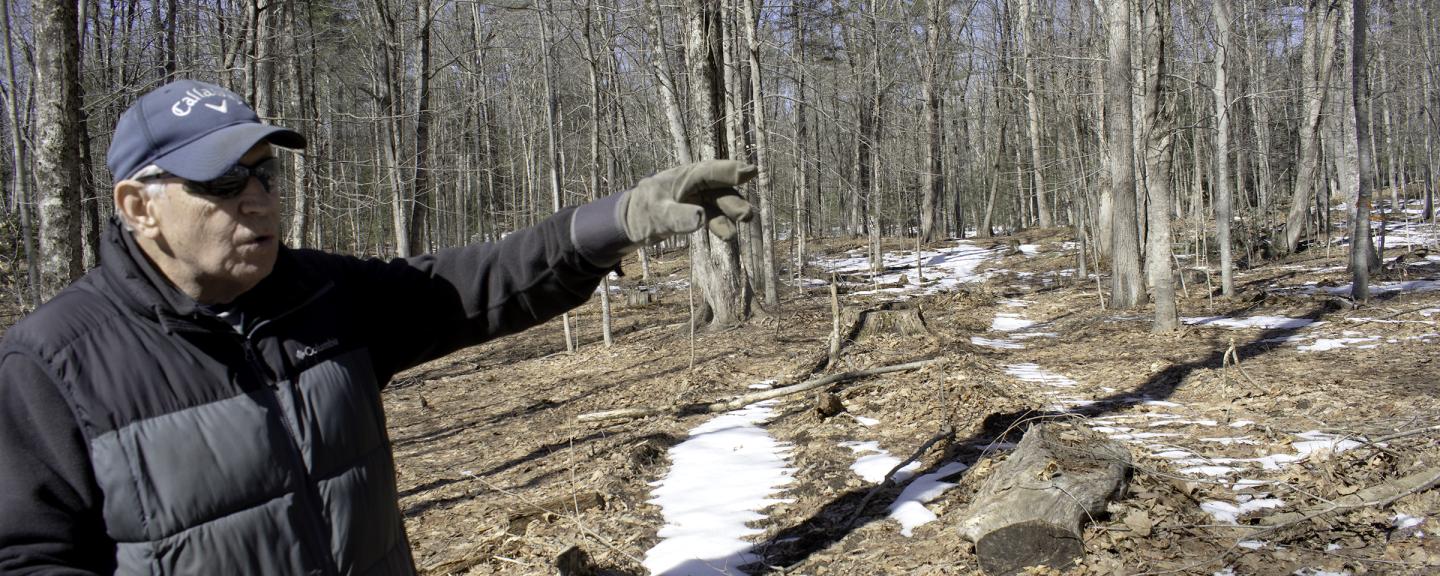
Decades of human use can take its toll on a piece of property. Gerry Langdon knows that all too well; the 93 acres he owns in Epping was typical of a lot of farmsteads in New Hampshire: used heavily for agricultural production until sometime in the 20th century, then abandoned to the whims of nature.
When he purchased the property in the 1980s, the land was trashed, he said, and not just stripped of good trees and allowed to be overrun with scrub growth. There were several trash dumps and rotting vehicles hidden among the vines.
But if human use caused the degradation, could human attention restore its value? After four decades of trying, Langdon can say that the answer is yes, thanks in part to expert help from Matt Tarr (’96, ’98G), a field specialist with UNH Extension.
There are many specialists within Extension who can help landowners manage their forests. Most of the time, management is done to maximize a landowner’s timber harvesting goals. What Tarr does is something a bit different; he specializes in forest management for wildlife, and he and Langdon have been working together for about 40 years.
Over the course of that working relationship, Langdon’s desires shifted, and so, too, did the management strategy.
“We were both avid hunters,” Langdon says about himself and Tarr when they began working together. He knew there were deer crossing his property and wanted to see them thrive. Tarr, who had only just begun to work for Extension at that point, knew what to do.
He drew up a plan to maximize cover areas, water access and stands of trees that would drop acorns, hickory and other nuts.
Like weeding a garden, Tarr and Langdon also removed unhealthy or unwanted plants, largely through a series of tree harvests. However, while some timber stand owners choose to cut for profit, Langdon and Tarr had a different goal in mind.
“We do every harvest with wildlife in mind,” Langdon says. “Especially birds.”
The Wildlife Guy
Tarr is a licensed forester and wildlife biologist who, over the course of his tenure at Extension, has carved out a specialty for himself.
“When I’m called to assist a landowner it’s usually because they have an interest in taking care of their land for a variety of wildlife species,” says Tarr, who works statewide as the wildlife habitat specialist.
When Tarr started working for Extension, most clients were interested in habitats for whitetail deer, or perhaps another game species. Tarr still has clients with those goals, but more frequently the landowners who call him are interested in habitat for conservation, rather than for hunting.
Whether for hunting or habitat, Tarr says that each client represents a novel challenge for him. First, there’s the size of the property and the features of the surrounding landscape, which will influence what is possible for the property in question. Then there’s the other ways that the owner might want to use the property, such as riding dirt bikes, agriculture or, in Langdon’s case, a driving range, which will have an impact on animal behavior.
Tarr said his interactions with landowners start when his phone rings or an email appears in his inbox. “That initiates a property visit,” he says. “When I show up, we’re going to go for a walk.” There will be soil analysis, inventory of current plant species, and discussions of what the land owner would like to see and what’s possible.
“When I first got into this, I heard, ‘I want to improve my land for grouse or for deer,” Tarr says. “Today, people say, I want to do what’s right. I want to make my land as good for as many species as possible.”
Welcoming the Turtles
Some of the people who call Tarr will work with him once. Others will call him back for a follow-up or two, and some, like Langdon, will keep him coming back for decades.
Langdon says that Tarr’s prescriptions have included the removal of trees to make space for new growth or to encourage undergrowth, prioritizing nut-bearing trees as a food source for wildlife, and the careful preservation of old trees and snags that provide cavities for birds to nest in or perches for raptors.
As his property became healthier, Langdon’s views toward it shifted. He has put his hunting behind him, and now he finds satisfaction in just walking his property, seeing which parts the deer seem to enjoy. And he’s started to gain an appreciation for other creatures, too.
Langdon has two ponds on his property, which he used to use as private parks for cookouts and beach parties. He has since pulled out the swim docks, removed the gazebo, and let the wild plants take over. The ponds are now teeming with fish, herons and, to the particular joy of Langdon’s grandson, turtles.
Langdon’s interest in the turtles was piqued when he found out that one of the species in his ponds was endangered. Now the ponds are a thriving habitat, teeming with turtles, and Langdon said he and his grandson share the joy of checking on their reptilian friends. Langdon walks his woods just about every night, hoping to see where the deer are settling for the evening and just steeping himself in the satisfaction of a healthy habitat that he can call his own.