
Seeds of a Strong Partnership

After more than 50 years in business, Johnny’s Selected Seeds, a commercial breeder and seller of plants and supplies headquartered in Winslow, Maine, has grown into an international company. But like all northern New England growers and gardeners, Johnny’s ability to develop new varieties faces limits and challenges imposed by the cold climate and long winters.
To expand its ability to develop new products more quickly and to gain mutual benefits by working side-by-side with other plant breeders throughout the year, Johnny’s is partnering with the New Hampshire Agricultural Experiment Station to co-locate its plant development work in the Macfarlane Research Greenhouses at the University of New Hampshire.
Despite its presence in national and international marketplaces, Johnny’s maintains close ties with regional research and innovation neighbors. Its relationship with UNH dates back decades and has resulted in development of award-winning plant varieties such as “Honey Bear” acorn squash, which was originally bred by UNH’s J. Brent Loy, former leader of UNH’s long-running cucurbit research program, and is now produced and sold exclusively by Johnny’s.
“Johnny’s has a long history with UNH stretching back more than 40 years,” says Kevin Cook, Johnny’s Selected Seeds’ vice president of research and development. “[Company founder] Rob Johnston and Brent Loy were friends and worked together, and we’ve had really good relationships with UNH researchers since.”
Recently, the Johnny’s–UNH partnership is budding into a new crop: zinnias.
“To me, the zinnia project we’ve started in Macfarlane is just a natural extension of that,” adds Cook.
The beautiful and popular zinnia blooms cut for bouquets and sold by florists are from plants known as Z. elegans, which are native to Mexico and well-adapted to warm, dry climates. When grown in damper, cooler locations such as New England, they are prone to powdery mildew, cercospora leaf spot, and other diseases that can be devastating to the plants, leading to frustration for home gardeners and economic losses for commercial growers.
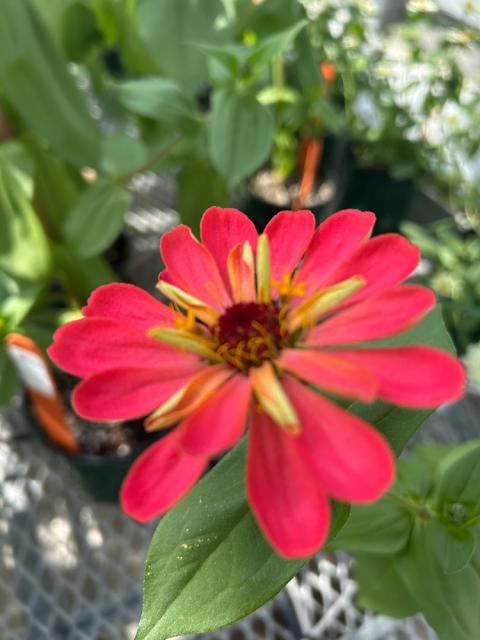
Zinnias are popular with both home gardeners and commercial growers.
Researchers began looking for solutions to Z. elegans disease-susceptibility many years ago, but with different priorities.
“The idea of disease-free zinnias is not new, and breeders began crossing Z. elegans with disease-resistant varieties several decades ago,” says Emily Starck, the plant breeding specialist at Johnny’s Seeds who developed the zinnia project. “But they selected for bedding plant characteristics, with relatively short stems and small flowers. The new variety they produced, Z. marylandica, isn’t suitable for cut flowers. We’re looking to keep the long stems and big flowers of Z. elegans and make them disease resistant as well.”
But developing new plant species with specific characteristics is not a fast or easy process. Plant genetics are complicated, and to produce viable seeds, Starck is working with UNH plant experts Thomas Davis, professor emeritus, and Mamta Kajal, a Ph.D. student in the Davis lab.
“Mamta has been working to develop strawberry species with specific characteristics, which takes a lot of genetic manipulation,” says Starck. “Her expertise is extremely valuable for the zinnia project.”
The research is taking place at UNH’s climate-controlled research greenhouse facility, infrastructure that does not exist at Johnny’s research and development farm in Albion, Maine. Access to the Macfarlane Research Greenhouses, with its year-round operation and extensive research programming, provides the company with exciting new plant innovation opportunities.
“We don’t have the kind of facility that UNH has with the Macfarlane Research Greenhouses,” says Cook. “If you drive by Johnny’s research farm, it looks like a typical New England farm, just some fields and high tunnels. But winter is slower in our business, and it’s very helpful to be able to pursue more experimental work then. And zinnias are always among the most important flowers in our product line, if not the most important, so developing the disease-free Z. elegans lines would be very beneficial for the business.”
With the zinnia project up and running, Johnny’s breeders are already thinking of potential future projects. Cook notes that Starck’s peers were “jealous” of her access to the UNH greenhouses, and that if all goes to plan, more potential projects are already being pitched.
“Right now, it’s great to have Emily have a go at it and move ahead with the flower breeding,” says Cook. “But if that work goes well, we will be very interested in expanding into other plants and other projects.”