Despite what climate-change critics may claim, my time in France showed that there is a proven way to fully transition our electric grid to renewables while building widespread public support.
Over the course of 40 days, I toured many solar, wind, hydropower, and tidal energy facilities, and was surprised to find most of the technologies I saw did not originate in Europe. Rather, an overwhelming majority of these innovations were first developed by private companies or public research laboratories in the United States, which revealed a level of technological diffusion I was not fully aware of.
Conversations showed that France only needed to create a small number of economic incentives and policies to transition to a now 95% fossil-fuel free electric grid. I will try my best not to get into the weeds of these mechanisms (as much as I enjoy discussing them!), but primarily, France was able to decarbonize their electric grid through centralizing decision making, implementing unique funding mechanisms, and investing heavily in specific projects. The main takeaway I had from this experience however was that given that the United States and Europe continue to influence one another, there is a strong and realistic likelihood that these approaches could one day be implemented in our electric grid.
France’s ability to create large-scale energy projects is deeply rooted in cultural and historical context. According to one museum curator I spoke with, “the confidence in these projects is strong” which is largely due to the country’s longstanding public trust in state-led infrastructure shaped by post-WWII reconstruction. Over the last several decades, France has leveraged this trust and technologies invented by the United States to develop projects specific to every region, such as tidal power plants that take advantage of abnormal yet favorable hydrological conditions.
The concept of investing in large-scale infrastructure projects to better society is not foreign to the United States. From New Deal projects such as the Hoover Dam to the Interstate Highway System, the United States has shown similar levels of public-buy in. The difference in progress is due to France focusing more on education, which was evident in the large number of facilities I was able to tour for free. Clearly, in the United States, the primary barrier to the energy transition is not technological, economic, or political; it is educational.
My goal throughout this experience was to learn about how France’s culture and history influenced their energy sector, and I would deem this as successfully met. But more importantly, I now can apply what I have learned in both my career and in civic life, and am incredibly grateful for this opportunity.

Rance Tidal Power Station - La Richardais, France
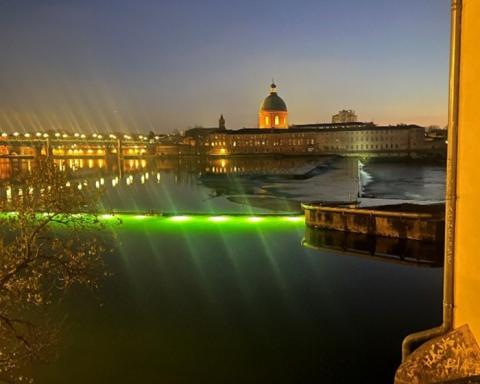
EDF Bazacle Complex – Toulouse, France
It is worth noting that the United States has many inherent differences of its own, and I am by no means advocating for a complete replacement of approaches. However, France offers a blueprint of how to decarbonize unlike anything I have seen domestically.
Recognizing when history is repeating itself is important, but so is identifying the nuanced adjustments needed to sustain progress.
-

Rance Tidal Power Station
La Richardais, France
-

EOL Centre éolien
Saint-Nazaire, France
-

EOL Centre éolien
Saint-Nazaire, France
-
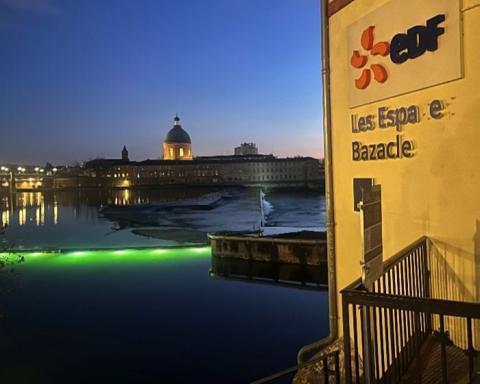
EDF Bazacle Complex
Toulouse, France


