
Before and After: Rare Opportunities to Study Stream Water Quality
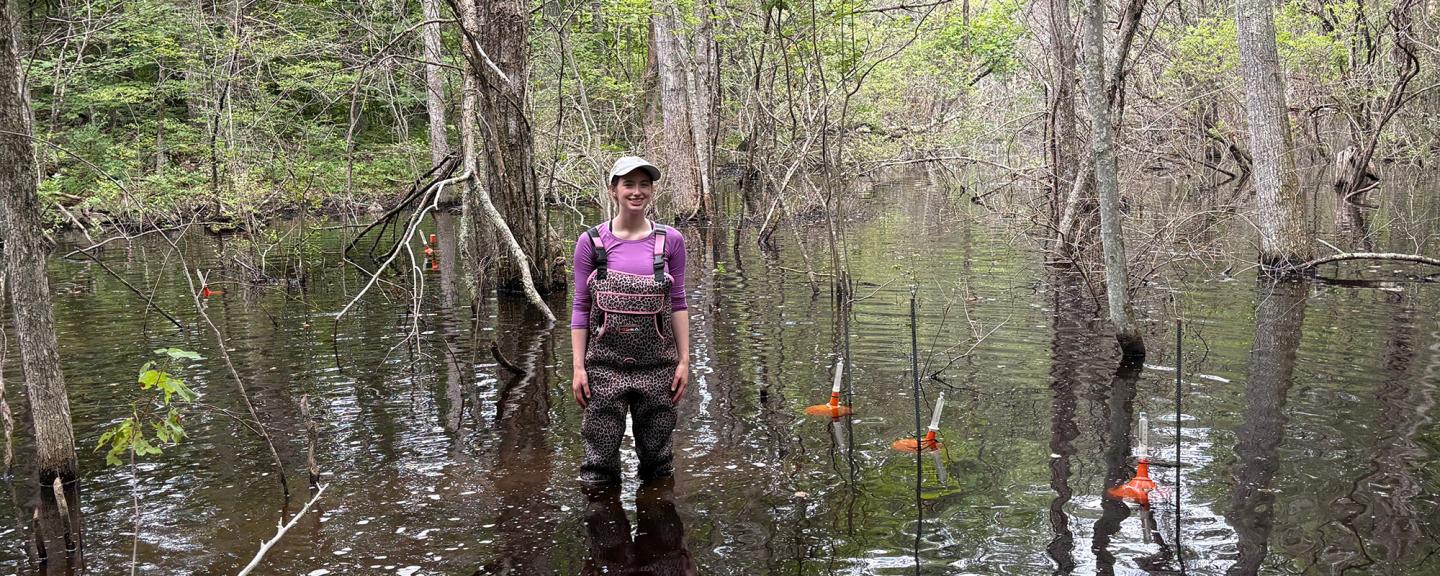
New Hampshire’s 19,000 miles of rivers and streams, from the Connecticut River in the west to the waters flowing to the Atlantic Ocean in the east, shape the state’s lives, livelihoods, and landscapes. New Hampshire Agricultural Experiment Station researchers at the University of New Hampshire are measuring how water characteristics and quality, both in and along rivers and estuaries, are directly affected by man- and nature-made changes to surrounding landscapes and infrastructure. The team is taking advantage of three rare opportunities to study rivers and streams before and after significant changes to better understand how New Hampshire’s communities along a river’s path could be impacted by changes in water quality, as well as the effects on greenhouse gas emissions and nitrogen quantities.
“It’s unusual to be able to measure streams before and after significant restoration events,” says Station scientist Wilfred Wollheim, the Josephine A. Lamprey Professor in Climate and Sustainability and professor in the UNH department of natural resources and the environment. “The data we’re collecting before and after human-made dam removal, beaver dam construction, and our own restoration project will provide insights that are relevant throughout New Hampshire.”
Wollheim, who also co-directs the Water Systems Analysis Group, is leading the studies. The research focuses on comparing water quality before and after the removal of the Mill Pond Dam in Durham, understanding the impacts of restoring a currently buried stretch of College Brook on the UNH campus, and measuring the effects of a new beaver dam built at a formerly flowing stream site that has been monitored for a quarter century.
While the expectation is that each change will help improve water quality, alter greenhouse gas emissions, and reduce the amount of nitrogen flowing downstream, the goal of each study is to test that hypothesis and quantify the size of those impacts.
Stream restoration
Many years ago, College Brook wound its way through the UNH campus. As the University campus expanded, the brook was culverted underground to accommodate new Student Recreation Fields. However, this diversion limited natural processes, including rapidly flushing water and materials such as nitrate, road salt, and sediment through the system.
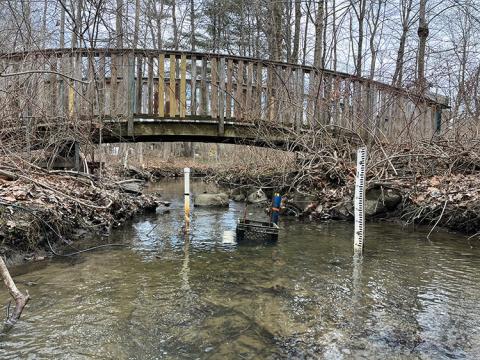
Monitoring College Brook.
Wollheim and Jojo Baldus, an ecosystem science graduate student in the Wollheim lab, are measuring pre-restoration water quality now and how it is affected by heavy rainfall in storms. Plans for the restoration itself have been prepared and once funded, the project will restore the stream above ground, allow streamside vegetation to regrow, and establish a streamside wetland to absorb storm water.
“We know that storms are especially interesting ‘hot moments,’ when rainfall and runoff can quickly transport materials from the landscape into streams like College Brook,” says Baldus. “Once restored, College Brook will be able to more effectively capture, transform, and store some of these materials in the streambed and surrounding soils and vegetation, helping to improve water quality and ecosystem health in the brook and in Great Bay.”
A new dam is built
Beavers did much of the work for Wollheim and his team on a stream at the Plum Island Ecological Research site just south of the New Hampshire state line on the coast of Massachusetts. The researchers had been monitoring water quality in the stream for about 25 years before the beavers assembled a dam just downstream from the research location.
The fortuitous change will allow Wollheim and Kylie Short, a student whose work is supported by the National Science Foundation’s Research Experiences for Undergraduates program, to measure exactly how beaver ponds change water quality and greenhouse gas emissions over time.
“The creation of beaver ponds can dramatically transform the landscape and influence methane production in the pond,” says Short. “Trees die and are eventually replaced by aquatic plants, changing the gas dynamics and establishing a new ecosystem. We can now study the process in real time and compare the stream before and after the dam was established.”
Additional recent support from the National Science Foundation to expand this work will involve combining remote sensing, artificial intelligence, and other tools to map and characterize beaver-created ecosystems in the Northeast. Working with researchers at the University of Connecticut and Cornell University, the goal is an online mapping tool to aid local decision-makers in land management efforts.
An old dam is removed
The removal of the human-made Mill Pond dam on the Oyster River in Durham provides a different before-and-after scenario. Few of New England’s estimated 14,000 dams are still used to generate power, and while data about what happens when a dam is removed is scarce, findings at other sites, such as along the Penobscot River in Maine, suggest benefits for both fish habitats and streambed and wetland environments. In Durham, researchers are measuring water quality in and around Mill Pond, including during storms, so that they can compare it post-removal and better understand how human-led landscape and river management decisions affect river characteristics.
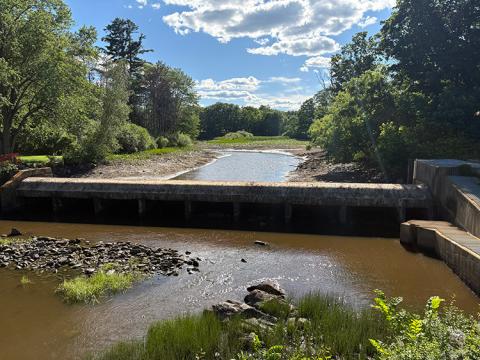
Mill Pond dam prior to removal.
The College Brook and Oyster River changes have implications that go beyond their streambeds and nearby environments. Both drain into Great Bay, a coastal estuary that plays a variety of important economic and ecosystem services roles in New Hampshire’s coastal ecosystem, such as harboring fish during their journey from stream to ocean and being the hub for New Hampshire’s oyster aquaculture industry. Lately, freshwater quality issues may have contributed to some concerning changes in Great Bay.
“The U.S. Environmental Protection Agency has classified Great Bay as nitrogen impaired, a condition in which more algae can grow and limit native plants like eelgrass,” says Wollheim. “It’s not in a good state at the moment, and its future health could be in serious jeopardy.”
The issue underscores the fact that stream health and water quality affect all parts of New Hampshire, from the mountainous inland to the busy coast. Can the latest research tools and methods help to better understand how natural and planned landscape changes impact New Hampshire’s water quality now and in the future? Wollheim and his lab are working hard to find the answer to that vital question.