
Counting the Recovery of New Hampshire Bats

New Hampshire bats have been in crisis for years. Beginning in 2009, a fatal fungal disease known as white-nose syndrome devastated all five of the state’s cave-hibernating bat species. Researchers and Extension specialists in COLSA are now teaming up with the NH Fish and Game Department and Granite State landowners to support one of the state’s key programs supporting the conservation and recovery of the remaining bat populations: NH Bat Counts.
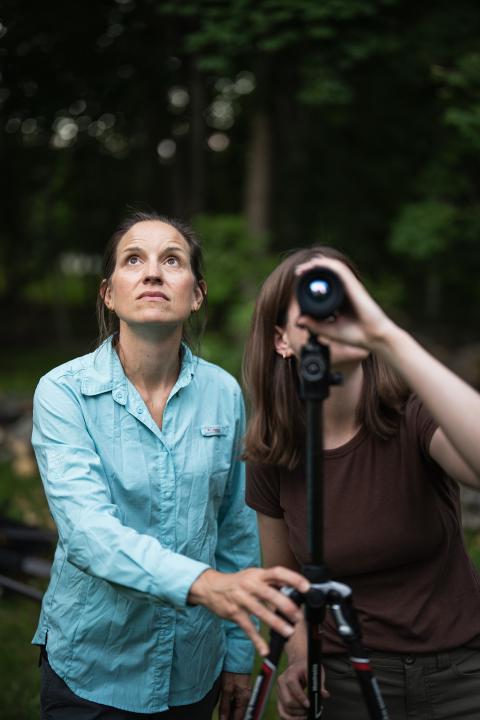
Laura Kloepper, associate professor of biological sciences, leads UNH’s Ecological Acoustics and Behavior Lab, studying how animals use acoustics to navigate the world and how we, in turn, can use acoustics to monitor them. Acoustic technology has gotten both better and less expensive in recent years, and it can now be applied to NH Bat Counts.
“NH Bat Counts has been active for a long time, and we’re joining it now to contribute our experience with advanced technology to expand and improve data gathering,” says Kloepper. “The work is vital for tracking bat abundance and providing insights to protect them and their habitats.”
Why do bats matter to us? Estimates vary, but studies indicate bats contribute at least $3.7 billion and potentially more than $50 billion in insect pest control for U.S. agriculture alone every year. Without them, controlling pests becomes more costly and losses for New Hampshire industries such as agriculture and forestry increase.
Fatal fungus
White-nose syndrome was first detected in hibernating bats in New York State in 2006. When it arrived in New Hampshire in 2009, surveys of the four largest caves and mines favored by bats for hibernation counted 3,230 of these flying mammals. By 2011, that number had plummeted to 16. For reasons that remain poorly understood, some species of bats elsewhere have proven to be more resilient to the fungus that causes white-nose syndrome. And some colonies are beginning to grow once again, though their numbers remain much smaller than pre-disease.
“There has been growth in some of the maternity colonies over the last few years,” says Haley Andreozzi ’13G, Extension state specialist and Extension professor of wildlife conservation. “In 2022, we had a colony with more than 700 individuals, the first time we’ve measured one that large. There’s a long way to go — pre-disease, some colonies had thousands of bats — but we’re beginning to see some small but needed wins for the bats.”
Beyond eyesight
The NH Fish and Game Department, NH Audubon, and U.S. Fish and Wildlife Service launched NH Bat Counts in 2012 to find and quantify the survivors. The program monitors summer bat colonies in barns, attics, steeples, and other structures where female bats gather and give birth to their young during the warmer months. NH Bat Counts is now spearheaded by Sandra Houghton ’04G, wildlife diversity biologist with the NH Fish and Game Department, and Andreozzi. Houghton and Andreozzi have worked together to extend and formalize the program over the past half dozen years.

“The data from NH Bat Counts volunteers furthers our knowledge about the location, species, and status of bat colonies in New Hampshire,” says Houghton. “It helps us prioritize conservation efforts while also creating a network of bat ambassadors.”
Kloepper’s work will make it possible to look at trends in the acoustic energy produced by the bats to get a sense of movement within the colonies, the timing of pup independence, how environmental conditions such as weather impact pup emergence and roost shifting, and more. The recorders will also allow volunteers to obtain nightly population estimates far more efficiently than previously possible.
It takes a village
Andreozzi notes the interest and enthusiasm of the volunteers, who enjoy learning about how valuable their barns and other structures are for bats and contributing to the efforts to protect bat colonies. Now, Kloepper’s expertise and recorder technologies will enable the volunteers to help even more. She has also involved her students in the research and outreach efforts, and eight undergraduates have formed a “bat count” team devoted to devising better ways to count bats for conservation.
“It’s a great example of how research is being done at UNH,” says Kloepper. “All parties — researchers, students, Extension, and state experts — are out in the New Hampshire community, working together toward a common goal.”