
Strengthening New Hampshire's Communities
The Vital Role of Community Spaces in Building Connection and Belonging
According to a recent New Hampshire Civic Health Report, fewer than half of Granite Staters feel like they matter or belong in their community. Pre-pandemic, that number was as high as 76 percent.
For Rebecca Boisvert, a Master's in Community Development alumna and community engagement professional, that decline became the problem she set out to address in her capstone project. Rebecca brought eight years of experience to the work as Director of Development at New Hampshire Humanities. And, more recently, overseeing the Community Center Investment Program at the Community Development Finance Authority (CDFA), an initiative funding 27 community centers across the state. A question kept surfacing through that work: what does a community center mean to the people who use it, and is that the same thing funders think it means?
What she found addresses the importance of "third places," the true value of shared spaces, and what it really takes to make a town feel like a home.
How would you describe "third spaces" and their importance to healthy communities?
Third spaces are the public places that aren't home or the workplace — instead, they are parks, libraries, trails, community centers, town commons, recreation facilities, and even something as informal as a community meal.
They are the "neutral ground" where neighbors casually run into each other, learn from each other, and build the everyday trust that holds a community together. When these spaces are free and open to all, they level the field across income, age, race, religion, and politics because everyone has a seat at the table.
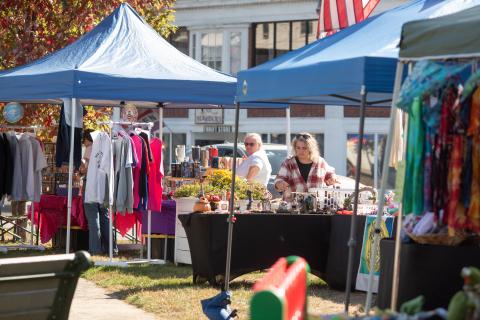
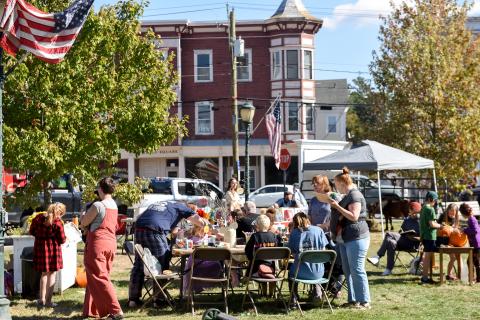
Photo courtesy of Kate Brindley Photography
That accessibility is what makes them powerful. It is what produces social capital — the networks, the reciprocity, the small acts of looking out for one another — and, as Robert Putnam has shown, that capital has measurable effects on everything from our schools and neighborhoods to our democracy, our health, and our happiness.
What's at stake when communities lose shared spaces to gather, connect, and engage?
When shared spaces disappear, so does the casual contact that builds trust. People retreat into their homes, their screens, and the company of people like them.
Without that day-to-day interaction, it becomes easier to label our neighbors and harder to empathize with them, which is exactly the dynamic driving the divisiveness that is so prevalent today.
This jeopardizes a town's capacity to come together when it matters, to respond to crises, and support its most vulnerable residents.
Were there specific examples that helped illustrate what effective community spaces can do?
Of the 27 community centers funded through CDFA's Community Center Investment Program, there are several examples that illustrate what intentional gathering spaces can do for the community. The Tamworth Community Nurse Association moved from 800 square feet inside the town offices to an adjacent 2,600 square foot addition to the town office building that is large enough to deliver free skilled nursing care, educational programs, and 10,000 Meals on Wheels each year. This lets seniors combine a flu shot with a stop at the town clerk to register a dog or pay taxes. For residents with limited mobility, this isn't a convenience; it's whether they get care at all.
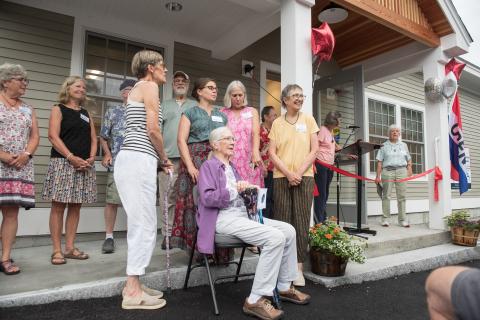
Photo courtesy of Kate Brindley Photography

Photo courtesy of Kate Brindley Photography
The Gloria Timmons Community Center in Nashua, housed in a historic firehouse, offers free programming to youth and families with a focus on academics, health and social services, and family development—services that would otherwise carry a price tag many families in the city cannot afford.
The Wakefield Community Pavilion transformed an outdoor recreation complex into a multigenerational, fully accessible community space and opened as the focal point of the town's 250th birthday celebration over Labor Day weekend in 2024, where thousands of residents gathered. This is a clear demonstration of what happens when a town has a place large enough to convene itself.
Taken together, these spaces do different things for different communities—wraparound care for seniors in Tamworth, free youth programming in Nashua, intergenerational gathering in Wakefield—but they illustrate the same point: effective community spaces create the conditions where connection, care, and belonging can actually happen.
Was there a story or moment in your work that captured why this matters?
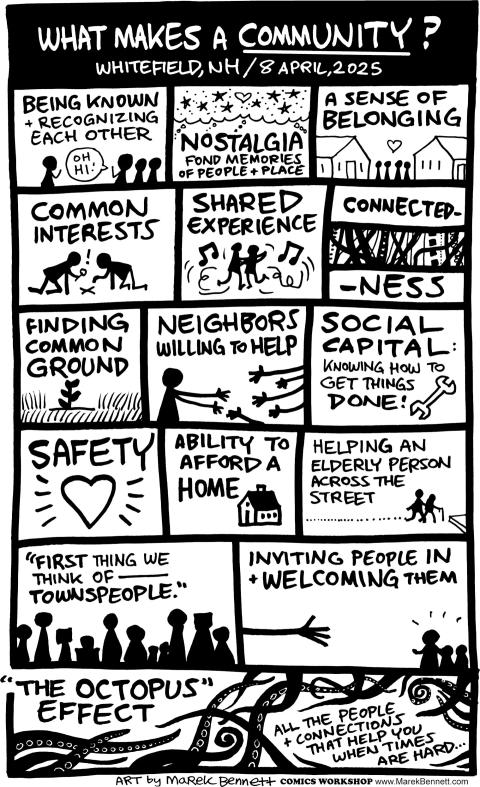
The first Community Conversation, held in Whitefield on April, 8 2025, was that moment. Forty-six residents of a town of 1,400 gathered at the Mountain View Grand Resort & Spa to talk about what their community means to them. About half were regulars at the public library; the other half were people the library director had never met, but all of them came because they cared about Whitefield and wanted their voice in the room. One participant, who had moved to Whitefield from a large city, described his new community as an octopus with each resident a tentacle, reaching out to take care of others when things get hard. He told the room he doesn't take that for granted, because most places don't operate that way. By the end of the evening, attendees had made new personal connections, surfaced a long list of needs the town can act on, and articulated a shared desire to protect Whitefield's small-town feel.
In the post-event survey, one resident summed up what makes a good community as "a shared story, shared goals, and a desire to see one another and the community succeed."
That single sentence captures, better than any data point, why this work matters.
What would success look like if this program were put into practice?
Success looks like more Granite Staters—both adults and youth—saying they belong to and matter in their community. The first five Community Conversations, held in spring 2025, have demonstrated what that looks like in practice. Residents who often didn't know each other sat down together and described community in their own words. In Harrisville, residents called community "the ability to coexist amidst disagreement"—a place where neighbors can disagree and still look out for one another. In Portsmouth, one of the facilitators told the room: "In the four sessions I've facilitated, I learned more about who we are than in 25 years of living here."
Scaled up, success means a New Hampshire in which intentional gathering spaces are treated as essential public infrastructure, not amenities.
Long term, success is a measurable decrease in isolation, polarization, and civic disengagement, and ideally, the development of infrastructure that allows this discussion model to continue well beyond the Community Conversations and associated Community Response Projects that CDFA is currently funding.