
My Three Minute Thesis Experience
What is the Three Minute Thesis?
Imagine trying to distill everything you've learned and are researching for your Ph.D. into three minutes. This is the challenge that UNH graduate students who participate in the Three Minute Thesis competition take on. Founded by the University of Queensland, this competition asks graduate students to explain their research in under three minutes with only a single PowerPoint slide as a presentation aid.
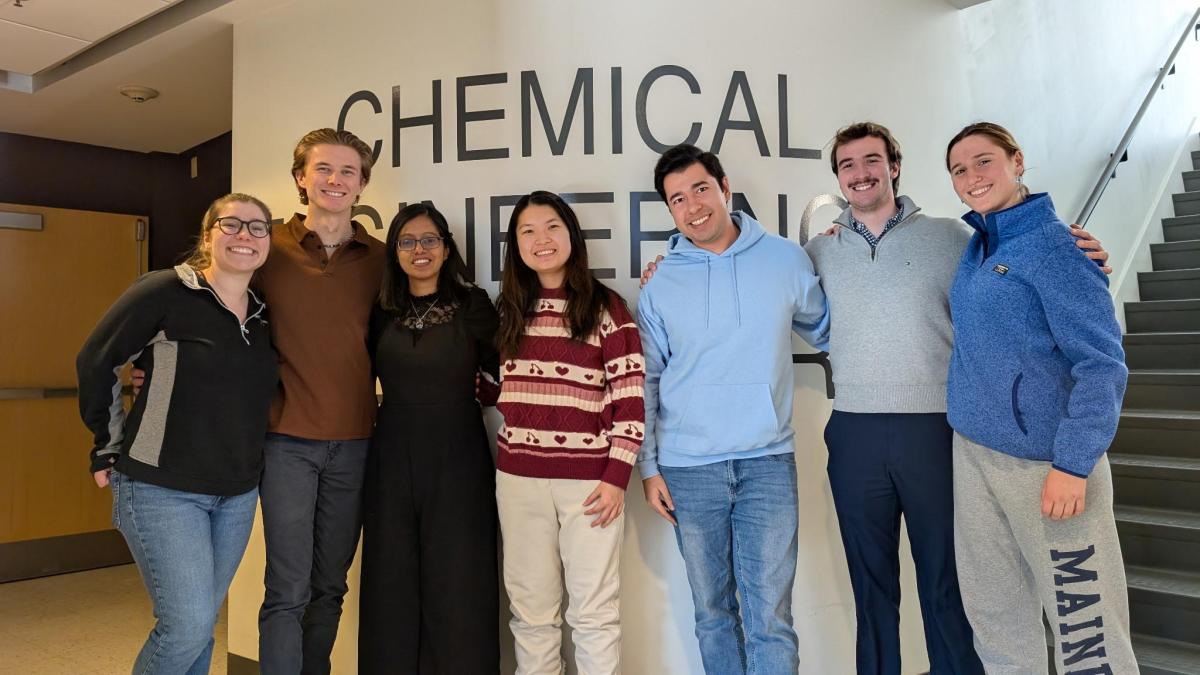
Jaxson Libby, a Ph.D. candidate in biochemistry at the University of New Hampshire, took on the challenge. Learn more about how Jaxson's drive to research specialized therapy and treatments for cancer led to a life-changing research and public speaking experience at UNH.


Interview with Jaxson
1. Why did you want to get a Ph.D. in biochemistry?
I knew I wanted to help people with cancer, and I didn’t just want to become a therapeutic line cook. I wanted to push the envelope in the world of cancer to find new treatments, new ways to test cancer, and ideally get closer to finding cures. I decided that I wanted to establish my own research laboratory for specialized cancer therapy research and treatments. To do that, and to get funding, I needed to prove that I had the ability to conduct self-led investigations. Through my Ph.D. at UNH, I’ll continue to grow my abilities and reputation as a cancer biologist.
"I decided that I wanted to establish my own research laboratory for specialized cancer therapy research and treatments."
2. What do you like about the area near UNH?
New Hampshire has everything from the White Mountains in the north to the ocean in the south. There are distinct seasons that, in my opinion, give you one week or so of intense weather and that’s it. You don't have to deal with sweltering heat or bone-chilling temperatures that last for months on end. My favorite activities are skiing or snowboarding in the mountains, skating on the many lakes and ponds, and riding my motorcycle through the many amazingly scenic areas.
"New Hampshire has everything from the White Mountains in the north to the ocean in the south."
3. What is your area of focus for your research?
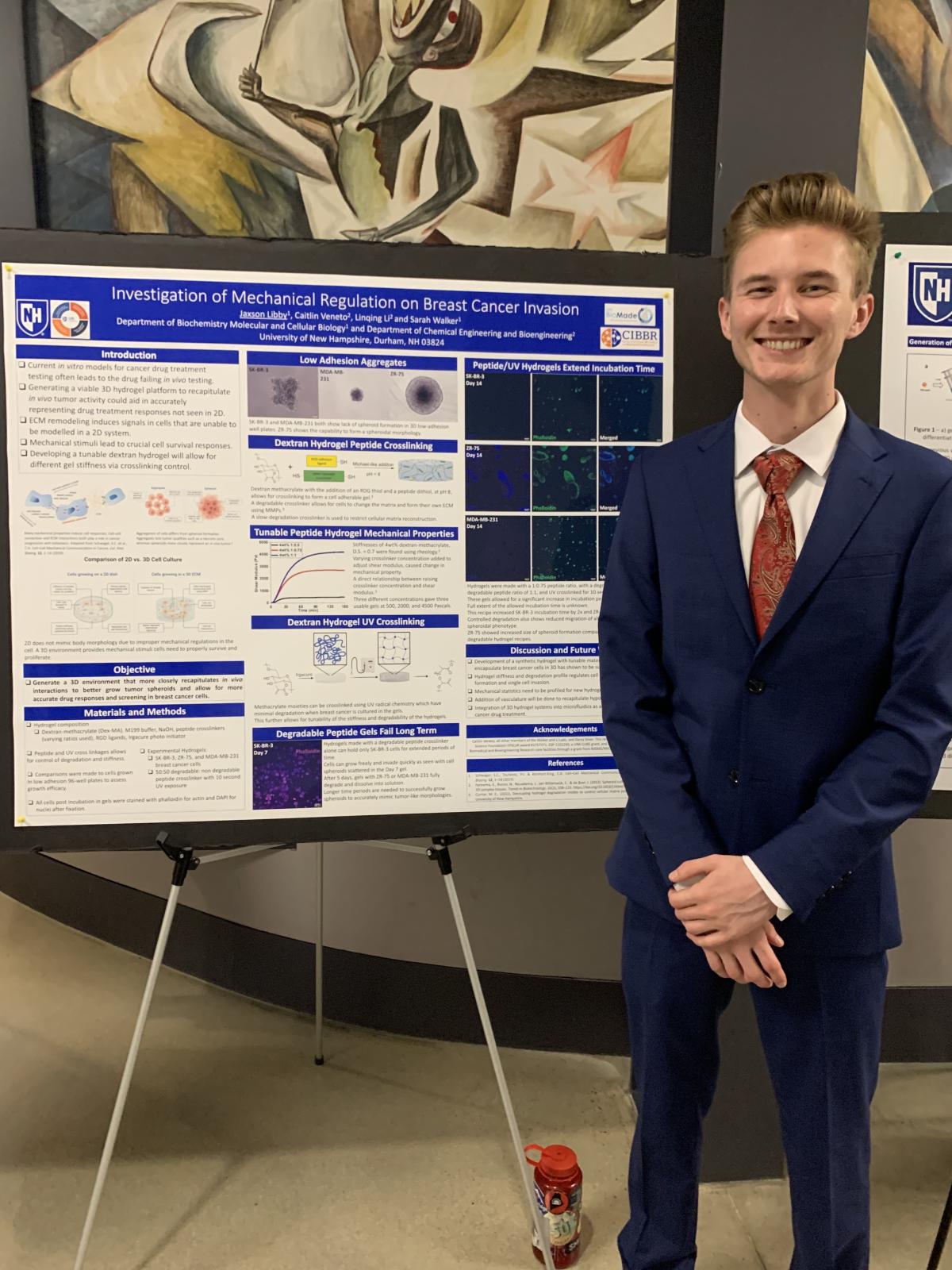
My research focuses on creating new ways to grow cancer. It sounds a little backwards, but we need to know how to grow cancer well to kill it well. I use biologically-derived materials to create a Jello-like material in which breast and ovarian cancer can grow. I then can study different behaviors of cancer like metastasis or invasion. I can test treatments against the cancer and compare it to other methods to see if the reactions are closer to human biology.
4. Why did you decide to participate in the Three Minute Thesis (3MT)?
I decided to participate in the 3MT for two reasons. The first was to learn more about public speaking. The second was to share my work with people in the community. I go to conferences and seminars, but the general public is not always there. This event is catered to share to the public, not just a group of scientists. So, I wanted to participate to get my work out there and let people know that there are people on this campus working to help them in so many ways that they may not even know was possible.
"This event is catered to share to the public, not just a group of scientists. So, I wanted to participate to get my work out there and let people know that there are people on this campus working to help them in so many ways."
5. What have you learned from trying to describe your research in three minutes?
I learned that I can talk about my work for a long time—way longer than I need to for people to understand it. I learned the important aspects of research, the right words that mean the most, and how to just deliver the information that can sometimes be hard to hear for people, especially when talking about cancer, which can be a very sensitive subject. I also honed the drive behind what I do to a much finer point. It almost reoriented me to why I am doing what I am doing again after being so wrapped up in experiments and trying to get the next set of data done.
"I learned that I can talk about my work for a long time—way longer than I need to for people to understand it. I learned the important aspects of research, the right words that mean the most, and how to deliver the information."

6. Why do you think it’s so hard to describe research in three minutes?
The most challenging part of describing my work in three minutes is using words to describe a complex subject in a way that can be understood by anyone. In any area of work, you have lingo and terms that you just know what they mean. I couldn’t go up on stage and say “extracellular matrix contributes to cell proliferation and survival to evade therapeutic intervention” because to most people that means nothing. So, finding the right words that everyone knows is really the hardest part.
"The most challenging part of describing my work in three minutes is using words to describe a complex subject in a way that can be understood by anyone."
7. What was the process of preparing your presentation like?
We all received a ton of help from the 3MT staff. We also did workshops for making our slide and script and learned how to get comfortable with public speaking. Then, I would just say it over and over again in front of a bunch of different people to see if they catch something that another person didn’t.
8. How did it feel to present for an audience and how did your public speaking skills develop?
Presenting for an audience that large and focused only on me was very new. It was much more intense than teaching a class, but it also felt fun to share my work with so many people at the same time. My public speaking skills definitely became more refined, and even the way I say words has changed for the better.
"Presenting for an audience so large and focused only on me was very new. It was much more intense than teaching a class, but it also felt fun to share my work with so many people at the same time."
9. What was it like to see the other students presenting?
Seeing the other students presenting was also very fun. We all worked with each other for months and seeing where everyone started and then their final performance was so cool. Everyone had some little last-minute trick up their sleeve too that they weren’t sharing with anyone to surprise us.
10. What would you like to do after your graduate degree?
I plan to work toward starting my own specialized therapy lab that not only researches cancer but also supports people who have cancer with new ways to treat it. I aim to find out how to modify therapies for each individual person and use the information I get from each person’s scenario to adapt therapies for them and others. Part of participating in 3MT for me was also working toward learning how to say the right thing to people who have not been sitting in a lab for years on end, so that I can convey what I am learning to them and so they can make informed decisions on how they want to proceed.