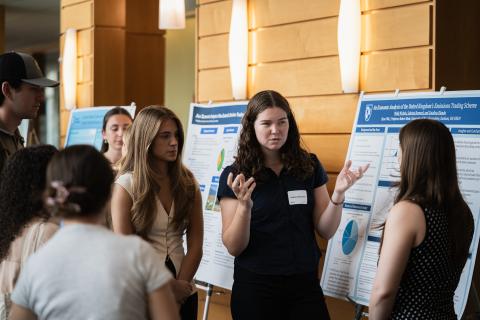
Samuel Becker ‘26, Hospitality Management and dual major in EcoGastronomy
“Utilizing AI for Predictive Analysis in Vineyards”
Becker developed an AI tool to help vineyards better predict harvest dates, addressing one of the biggest challenges in winemaking: unpredictable weather. By combining historical weather data with AI-generated formulas in an accessible Excel-based model, the project allows vineyard managers to estimate harvest timing within a matter of days.
What inspired you to explore this topic?
I worked at Flag Hill last summer doing weddings and events, so I wasn’t even involved in the agricultural part of the business, but I would ask my boss questions about the vineyards because it just fascinated me. There’s just so many variables based on the weather of how the grapes are going to turn out, and it’s getting harder with climate change.
How did you build your AI model?
Mine’s kind of a simplified version. I used AI to create formulas that take weather station data and calculate the ripeness of the grapes. I put this into a user-friendly spreadsheet that anyone can use, so it’s really just Excel powered by AI.”
What stood out in your findings?
I tested it using past data, and it predicted a harvest date of Sept. 1, while the actual date was September 3. So, it can predict within a few days of accuracy. Even with a simple model, it’s pretty accurate and super helpful for them.
What did you find most challenging about this process?
It was challenging working with the quirks of AI and even just Excel. Because I was plugging in so many data points, it would spit out weird numbers sometimes, and I’d be like, I know that’s wrong. I’d have to go through and find the issue.
How did Flag Hill react to your project?
They were really excited about it. My boss is pretty stoked to use it, especially because it means he won’t have to be in the vineyard as much. Before, they had to go out and check the grapes almost every day, which takes a lot of physical labor. This gives them a clear starting point and can really cut back on that.
How do you hope to build on this research?
I want to create more inputs for extreme weather events, like hurricanes or floods, since the model doesn’t really account for those yet. I also want to reach out to other local vineyards, because they don’t really use anything like this. I made it pretty user-friendly so anyone can use it, so hopefully it can spread and help more local businesses.