






























UNH Cooperative Extension's Community Economic Development staff engage with residents of Barrington to help achieve the vision of the town as one in which the economy is spurred by a robust network of trails and paths.
Just about every town in New Hampshire has at least one trail. Some towns have a few – and then there are towns like Barrington, where several footpaths stretch right into the town’s center.
Or, more accurately, where the town wants its center to be.
“Trails are a central part of Barrington,” says Conner MacIver ’11, ’13G, Barrington’s town administrator since 2019. The community has dozens of miles of trails, traversing thousands of acres of preserved land. “We’re a trail town,” he says.
That identity was not something Barrington was willing to take for granted, especially as residential development threatened to transform the town. In 2024, Jessica Tennis, the town’s parks and recreation director, learned about the Downtown & Trails Program offered by UNH Extension and convinced MacIver to apply; Barrington became the fifth town to go through the program.

The Downtown & Trails Program offered by UNH Extension is helping the town of Barrington leverage its trails to bring to fruition a new vision for the town center. Barrington is the fifth town to go through the program, which is designed to help towns leverage trails to shape their communities.
The Downtown & Trails Program, part of Extension’s Community and Economic Development work, is the brainchild of Shannon Rogers, an Extension state specialist and professor who found that trail systems can do more than provide opportunities for exercise and recreation. They can also act as drivers of economic development. She applied her research to create a program to help towns leverage trails to shape their communities.
Barrington applied to Downtown & Trails in late 2024 and spent much of the following year going through the process. Rogers, along with Extension colleagues, created the program to suit New Hampshire’s small towns, which typically are run by a few paid staff augmented by volunteer committees, and which intensely value their local control.
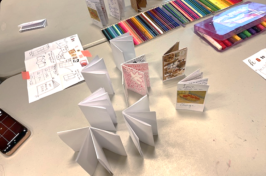
That months-long effort culminated in September as part of Barrington’s “Town Center Day” with a presentation and community engagement, as well as in a final report prepared by Extension and delivered to Barrington, recommending short-, medium- and long-term objectives that will help create the vision of the town that residents described in various feedback sessions.
For Barrington, that vision centers around the intersection of state routes 125 and 9. There, shoppers are already beckoned to a handful of destinations: Calef’s Country Store, the Christmas Dove, Village Barn, and Elf & Co. The town also recently took ownership of a 13-acre parcel of land there, now known as Barrington Common. With pathways leading to the common, the vision is for more businesses to establish and thrive nearby, bringing services closer to residents and drawing more visitors to shop and, perhaps, stroll along a trail.
Nate Bernitz, field specialist with Extension, helped guide Barrington through the process, along with program manager Trish Prescott. He says the town will next begin to tackle action items listed in the final report, such as creating seating at the Town Center property, adding signage and kiosks at trailheads, and installing crosswalks at points where the paths cross roadways.
Barrington has been planning to develop its town center for decades, and Bernitz says the trail program recommendations will catalyze that effort.
“Barrington is growing,” says Bernitz. “A lot of new residents have been coming into town. I think the town center can be a place that supports civic pride, helps Barrington transcend being a bedroom community that people leave to shop and dine, and become a destination.”
Economic development is an objective, according to Rogers, though the effort also strikes at something more fundamental.
“There may be, in five years, hopefully some more visitors to Barrington,” Rogers says, “but I also know with Barrington’s goals being multifaceted, they really care about the quality of life for the residents there.”
MacIver says the final report will give Barrington a road map it can use to reach its goals.
“Something that’s really important to our population in Barrington is preserving our rural character,” says MacIver. He says he feels fortunate to have experts like Rogers and Bernitz in the town’s corner. “These are the resources and the background that show our work here isn’t just community development, it’s economic development as well.”