






























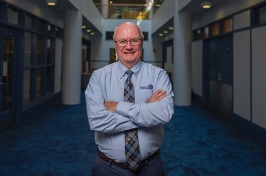

Artificial intelligence is no longer a futuristic concept. It’s a phenomenon influencing almost every human interaction with technology and every economic sector. We recently spoke with Radim Bartos, professor and chair of the Department of Computer Science, about how artificial intelligence is transforming the computing landscape — and what this rapid evolution means for innovation, education at UNH, and society at large.
You’ve seen major shifts in computing during your career—from the dot-com boom to mobile tech and now the acceleration of artificial intelligence. What takeaways can you share about how the field has adapted and what it means for the future?
If there’s one thing I’ve learned, it’s that predictions about the future of technology are often faulty, in part because they tend to imagine the future as an extension of what we already know. In reality, each wave of innovation, from the early internet to mobile technology, has created entirely new ideas, applications, jobs, and businesses that no one could have anticipated. The same will be true with AI. What we have seen is computer science’s ability to lead and adapt at the forefront of technological breakthroughs. I suspect the real demand for computing and AI professionals will come from solving problems we haven’t even identified yet. That’s what keeps computer science such a dynamic, future-proof discipline.
With AI transforming so many industries, how do you see it reshaping the field of computing?
We’re at the very beginning of the AI revolution and this is one of the most exciting moments in the history of computing. Artificial intelligence is fundamentally changing how we design, build, and use technology, but it still requires human creativity, ethics, and analytical insight at its core. This evolution isn’t replacing computer scientists. It’s expanding the kinds of problems we can solve and the scale at which we can solve them.
How are you ensuring that UNH is at the forefront of the AI revolution?
UNH is one of the few universities that combines the rigor of a research institution with the accessibility of a small-scale learning environment. Our students aren’t just learning from research, they’re contributing to it. This is bolstered by strategic faculty hires over the past decade in areas that are now leading the conversation on artificial intelligence, machine learning, cloud computing, robotics, and cybersecurity. Recently, one of our professors warned in his research funded by the NSF about the dangers of cascading cloud computing failures before the recent AWS outages while another is working on a major project funded by the NSF and NVIDIA that aims to create a fully open suite of advanced multimodal AI language models designed to support the U.S. scientific community. Our team working on an assistive robot to help with dementia care and allowing seniors to age in place recently deployed its robots in five homes for a six-month study. These are all examples of how UNH is at the forefront.
How is UNH preparing students to thrive in this new era of computing and artificial intelligence?
Our students will graduate with the skills to harness AI, not be replaced by it. Our curriculum is built on strong computing fundamentals that outlast trends and prepares students to adapt as technology evolves and focus on problem-solving and ethical reasoning. Students gain hands-on experience from the start and are contributing to emerging research in AI. They can participate in Innovation Scholars, the only first-year research and innovation program of its kind in New England, or work at our InterOperability Lab (IOL), which collaborates directly with the top technology companies in the world. These experiences build both technical expertise and critical thinking, which employers continue to tell us they value most.
How are UNH graduates using their computer science skills in today’s job market, and what new career paths do you see emerging because of AI?
Recent national surveys show that two out of three employers now expect graduates to have foundational AI skills. Our programs meet that demand by blending deep technical training with the AI literacy needed to lead in the workforce. Our graduates are thriving in fields ranging from software and cybersecurity to finance, healthcare, and defense. Many are employed at major tech firms; others are leading startups or pursuing research careers.
-
Compiled By:
Brooks Payette | College of Engineering and Physical Sciences