Click below to get more information about UNH graduate programs
Request Information Form
Request Information Form

Physics & Astronomy
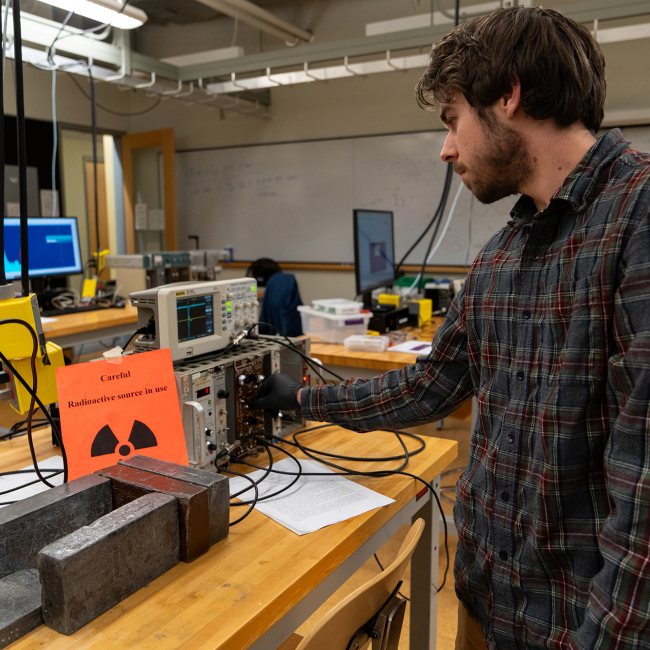
The Engineering Physics M.S. at UNH bridges the gap between fundamental physics and applied engineering, equipping students to tackle complex technological challenges. Through hands-on research in areas such as space science instrumentation, quantum and materials science, and computational modeling, students transform theoretical concepts into practical innovations.
Supported by expert faculty and UNH’s R1 research environment, graduates leave ready to lead in high-tech industries and government laboratories, or excel in doctoral programs.
Key Links
Contact Cards
The Engineering Physics M.S. program option provides a strong foundation in physics while allowing students to specialize in a chosen engineering field. Through a tailored mix of graduate coursework in physics, mathematics, and engineering, students develop advanced analytical and technical problem-solving skills. The program culminates in a capstone experience, either a master’s thesis or project, preparing graduates for careers in research, high-tech industries, or doctoral study.
UNH offers interdisciplinary research opportunities that connect physics principles with engineering innovation. Students work in advanced laboratories alongside faculty on projects in areas such as space science instrumentation, particle and nuclear detectors, materials and quantum science, computational modeling, and machine learning. As an R1 research university, UNH provides access to significant externally funded research and hands-on technical experiences.
The goal of the Engineering Physics M.S. program option is to produce broadly trained engineers with a deep understanding of the foundations of their chosen engineering specialty. Students in the program select a mix of graduate courses in physics and engineering that is tailored to support their individual interests and career goals. The M.S. program also includes a capstone experience, which can be either a Master’s Thesis or a Master’s Project.
To obtain the degree, students must complete a minimum of 30 credits as outlined below.
| Code | Title | Credits |
|---|---|---|
| Required Courses | ||
| PHYS 805 | Experimental Physics 1 | 4 |
| PHYS 806 | Introduction to Physics Research and Teaching 2 | 2 |
| 900-Level Courses | ||
| Select four (4) courses from the below list: | 12 | |
| Students must select a minimum of one course offered by the Physics department and one course outside the Physics department. The following courses will count toward this requirement. Other courses can be selected with approval of the Engineering Physics program committee. | ||
PHYS 935 | Statistical Physics | |
PHYS 939 | Classical Mechanics | |
PHYS 941 | Electromagnetic Theory I | |
PHYS 942 | Electromagnetic Theory II | |
PHYS 943 | Quantum Mechanics I | |
PHYS 944 | Quantum Mechanics II | |
PHYS 951 | Plasma Physics | |
PHYS 953 | Magnetohydrodyamics of the Heliosphere | |
PHYS 954 | Heliospheric Physics | |
PHYS 961 | Advanced Quantum Mechanics I | |
PHYS 965 | Advanced Solid-State Physics | |
PHYS 987 | Magnetospheres | |
PHYS 988 | High Energy Astrophysics | |
CS 950 | Advanced Machine Learning | |
ECE 915 | Advanced Active Circuits | |
ECE 920 | Wireless Communication Systems | |
ECE 925 | Biosensors: Fundamentals and Applications | |
ECE 941 | Digital Signal Processing | |
ECE 952 | Advanced Control Systems II | |
ECE 960 | Computer Architecture | |
IAM 932 | Graduate Partial Differential Equations | |
IAM 933 | Applied Functional Analysis | |
IAM 961 | Numerical Analysis I: Numerical Linear Algebra | |
IAM 962 | Numerical Partial Differential Equations | |
ME 922 | Continuum Mechanics | |
ME 909 | Viscous Flow | |
ME 910 | Turbulence | |
ME 927 | Theory of Plasticity | |
ME 951 | Advanced Control Systems I | |
ME 986 | Advanced Finite Element Analysis | |
| Capstone | ||
| Select one of the following options: | 12 | |
Option A: Thesis - 12 additional credits including a 6 credit Master's Thesis PHYS 899 with oral defense | ||
Option B: Project - 12 additional credits including a Master's Project PHYS 895 (up to 4 credits) with a seminar presentation | ||
| Total Credits | 30 | |
Or equivalent demonstrated experimental proficiency.
Two semesters, or equivalent professional development courses or seminars.
Accelerated Master’s programs offer qualified University of New Hampshire undergraduate students the opportunity to begin graduate coursework in select graduate programs while completing a bachelor’s degree. Accelerated master's programs are designed to provide students with an efficient and cost-effective pathway to earn both a bachelor's and master's degree or graduate certificate, enhancing career opportunities and long-term earning potential.
*Some exceptions apply.
*Some exceptions apply.
This graduate degree program is approved to be taken on an accelerated basis in articulation with the following undergraduate program(s):
| Code | Title | Credits |
|---|---|---|
| Engineering Physics (B.S.) | ||
| Physics (B.S.) | ||
| Students select any 800-level courses in physics, math, other science disciplines, and engineering that can be completed in the undergraduate senior year for dual credit. | ||
Applications must be completed by the following deadlines in order to be reviewed for admission:
Application fee: $65
Administered by: Durham
New England Regional: No
Accelerated Masters: Yes (for more details see the accelerated masters information page)
Students claiming in-state residency must also submit a Proof of Residence Form. This form is not required to complete your application, but you will need to submit it after you are offered admission, or you will not be able to register for classes.
If you attended UNH or Granite State College (GSC) after September 1, 1991, and have indicated so on your online application, we will retrieve your transcript internally; this includes UNH-Durham, UNH-Manchester, UNH Non-Degree work and GSC.
If you did not attend UNH, or attended prior to September 1, 1991, then you must upload a copy (PDF) of your transcript in the application form. International transcripts must be translated into English.
If admitted, you must then request an official transcript be sent directly to our office from the Registrar's Office of each college/university attended. We accept transcripts both electronically and in hard copy:
Transcripts from all previous post-secondary institutions must be submitted and applicants must disclose any previous academic or disciplinary sanctions that resulted in their temporary or permanent separation from a previous post-secondary institution. If it is found that previous academic or disciplinary separations were not disclosed, applicants may face denial and admitted students may face dismissal from their academic program.
Recommendation letters submitted by relatives or friends, as well as letters older than one year, will not be accepted.
The GRE scores are optional, if you wish to provide scores please email the scores directly to the department once you have submitted your application online.
Prepare a brief but careful statement regarding:
All applicants are encouraged to contact programs directly to discuss program-specific application questions.
Prospective international students are required to submit TOEFL, IELTS, or equivalent examination scores. English Language Exams may be waived if English is your first language. If you wish to request a waiver, then please visit our Test Scores webpage for more information.