Click below to get more information about UNH graduate programs
Request Information Form
Request Information Form

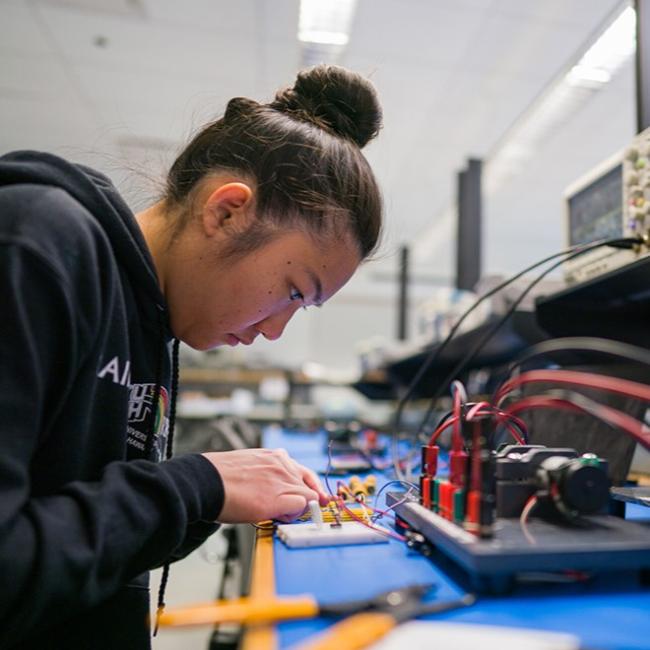
Electrical and COmputer Engineering
The Master's in Electrical and Computer Engineering program at UNH offers specialized training in biomedical instrumentation and healthcare technology. Here you'll be able to develop innovative medical devices while exploring rehabilitation engineering and clinical applications.
Through advanced study of electronics and measurement systems for healthcare, you'll gain the expertise needed for careers in biomedical technology, medical device development, or clinical engineering.
*Number of courses and course credit hours may vary, please reach out to your academic advisor for exact requirements.
Key Links
Contact Cards
An advanced degree in engineering can be the key to unlocking your career potential or becoming an entrepreneur. In fact, you may earn beyond $15,000 more annually compared to those with an undergraduate degree alone. UNH’s M.S. in electrical and computer engineering will prepare you to take a leadership role in creating future technologies. You’ll take a two-pronged approach, taking courses introducing you to advanced tools related to your field of interest, then building on these courses with research. You’ll have the opportunity to study core electrical and computer engineering subjects, as well as areas including business, law and mathematics.
At UNH, you’ll choose a path that best reflects your career goals, and you’ll have the opportunity to engage in the research efforts of faculty with a diverse range of interests, including computer networking, wireless communication systems, embedded computing, human-computer interaction, digital signal and image processing, biomedical instrumentation, controls and VLSI. You’ll also gain technical experience in one of the world’s leading testing facilities for network and data communication products, utilized by the likes of Apple, Google and Dell. You’ll have the chance to put your skills on display at international competitions, such as the Embedded Security Challenge.
Our graduate programs are flexible allowing the student a wide choice of courses as well as research topics. We will prepare students for professional skills such as working collaboratively, scholarly writing, and technical presentation and publications.
Our programs will provide the students the training needed to pursue a career both in industry and academia. The programs will increase the breadth and depth of the students’ electrical and computer engineering knowledge and help them develop the specialized skills in areas including but not limited to biomedical engineering, human-computer interaction, wireless communication, integrated circuit design, cybersecurity, control system and robotics, sensor design, wearable electronics, image processing, Internet-of-Things, computer architecture, and medical instrumentation.
Students have internship opportunities such as UNH Interoperability Laboratory (IOL), Center of Coastal Mapping (CCOM), Institute for the study of Earth, Ocean, and Space (EOS), etc.
Master of science in electrical and computer engineering (M.S. ECE) degree students must take a minimum of 31 graduate credits including:
| Code | Title | Credits |
|---|---|---|
| 20 credit hours of graduate coursework, with at least 9 of those credit hours earned in 900-level courses | ||
| ECE 900 | Research and Development From Concept to Communication | 4 |
| ECE 899 | Master's Thesis | 6 |
| ECE 910 | Graduate Seminar | 1 |
Up to 12 credits earned in 800 level non-ECE courses may be taken for graduate credit by ECE M.S. degree students provided the courses are petitioned and approved by the ECE Graduate Committee.
A student may petition that a maximum of 12 UNH graduate credits or a maximum of 8 non-UNH graduate credits taken prior to admission into the ECE master of science degree program be applied to fulfill the degree requirements.
Once the student has been admitted into the program, under certain circumstances it may be desirable to take courses outside the ECE department to attain the goals outlined in the student's program of study. In these cases, up to two non-ECE 900-level courses are allowed without petition, but you need to have your thesis advisor’s approval. Students need to take at least two 900-level courses (neither of which may be independent studies) within the department. Students must petition to the ECE Graduate Committee before course registration. To take more than 2 non-ECE courses (either 800 or 900 level) students must submit a petition to the ECE Graduate Committee.
Accelerated Master’s programs offer qualified University of New Hampshire undergraduate students the opportunity to begin graduate coursework in select graduate programs while completing a bachelor’s degree. Accelerated master's programs are designed to provide students with an efficient and cost-effective pathway to earn both a bachelor's and master's degree or graduate certificate, enhancing career opportunities and long-term earning potential.
*Some exceptions apply.
*Some exceptions apply.
This graduate degree program is approved to be taken on an accelerated basis in articulation with the following undergraduate program(s):
| Code | Title | Credits |
|---|---|---|
| Computer Engineering (B.S.) | ||
| Computer Engineering: Biomedical Engineering (B.S.) | ||
| Electrical Engineering (B.S.) | ||
| Electrical Engineering: Biomedical Engineering (B.S.) | ||
| Students select from the following approved 800-level courses that can be completed in the undergraduate senior year for dual credit: | ||
| ECE 814 | Introduction to Digital Signal Processing | 4 |
| ECE 815 | Introduction to VLSI | 4 |
| ECE 817 | Introduction to Digital Image Processing | 4 |
| ECE 857 | Fundamentals of Communication Systems | 4 |
| ECE 872 | Control Systems | 4 |
| ECE 875 | Applications of Integrated Circuits | 4 |
| ECE 884 | Biomedical Instrumentation | 4 |
| ECE 896 | Special Topics in Electrical or Computer Engineering | 1 |
Applications must be completed by the following deadlines in order to be reviewed for admission:
Application fee: $65
Administered by: Durham
New England Regional: No
Accelerated Masters: Yes (for more details see the accelerated masters information page)
Students claiming in-state residency must also submit a Proof of Residence Form. This form is not required to complete your application, but you will need to submit it after you are offered admission, or you will not be able to register for classes.
If you attended UNH or Granite State College (GSC) after September 1, 1991, and have indicated so on your online application, we will retrieve your transcript internally; this includes UNH-Durham, UNH-Manchester, UNH Non-Degree work and GSC.
If you did not attend UNH, or attended prior to September 1, 1991, then you must upload a copy (PDF) of your transcript in the application form. International transcripts must be translated into English.
If admitted, you must then request an official transcript be sent directly to our office from the Registrar's Office of each college/university attended. We accept transcripts both electronically and in hard copy:
Transcripts from all previous post-secondary institutions must be submitted and applicants must disclose any previous academic or disciplinary sanctions that resulted in their temporary or permanent separation from a previous post-secondary institution. If it is found that previous academic or disciplinary separations were not disclosed, applicants may face denial and admitted students may face dismissal from their academic program.
Recommendation letters submitted by relatives or friends, as well as letters older than one year, will not be accepted.
GRE General test scores are normally required, but UNH ECE alumni with a minimum GPA of 3.0 may request a waiver using our waiver process. Request official test scores to be sent directly to the Graduate School by the testing service. Test scores more than five years old are not acceptable. Student copies and photo copies of scores are not considered official. Our CEEB code is 3918.
Accelerated Master's applicants are not required to submit GRE test scores and will be waived after the application has been submitted by the Graduate School.
For general information about test scores required for admission into our programs please visit our Test Scores webpage.
Prepare a brief but careful statement regarding:
All applicants are encouraged to contact programs directly to discuss program-specific application questions.
Prospective international students are required to submit TOEFL, IELTS, or equivalent examination scores. English Language Exams may be waived if English is your first language. If you wish to request a waiver, then please visit our Test Scores webpage for more information.
Bachelor or master degrees in electrical engineering, computer engineering or related fields. We take a holistic view of all your application materials, so we do not have an absolute GRE or GPA minimum. However, in most cases applicants should have a GRE Quantitative score at 50th percentile or higher, and a GRE Analytic Writing score of at least 3.0, and a GPA above 3.0 on a 4-point scale. For international students, the university requires that an applicant's TOEFL (Internet Based) score be at least 80, or have an IELTS score of at least 6.5.
Many of our graduate students receive financial aid, often in the form of teaching assistantships, and research assistantships, as well as full and partial scholarships. Most of these opportunities requires you to identify a research advisor in our faculty, who will need to endorse your case through the application process. In order to learn more, review our faculty directory and get it touch with a member that shares your research interest.
Applications must be completed by the following deadlines in order to be reviewed for admission:
Fall: March 1 (for funding); April 1 (for all, except UNH accelerated M.S. students for whom the deadline is August 1)
Spring: December 1
International students need to allow enough time to apply for a visa after being admitted to the program. For those who apply for the Fall semester, most financial aid offers are made in early March. The ability to obtain financial aid after that time is very limited. There is also very little aid available for spring applicants. It takes the Graduate Committee roughly three weeks to review an application. After a decision has been made, we will inform the Graduate School and they will let you know our decision.
Though some courses are offered online, many of the courses in our program are only offered as in-person. Students can complete the program as part-time or full-time.
The graduate committee pay special attention to personal statements, GRE/TOEFL exam scores and recommendation letters during the evaluation of the application materials. Applicants to the Ph.D. program should always contact potential faculty research advisors before submitting their application, and explicitly state their interest to work with a specific faculty member in their application material.
The Computer Engineering (B Sci in Computer Engineering) program is accredited by the Engineering Accreditation Commission of ABET, https://www.abet.org, under the General Criteria and Program Criteria for Electrical, Computer, Communications, Telecommunication(s) and Similarly Named Engineering Programs.
The Electrical Engineering (B Sci in Electrical Engineering) program is accredited by the Engineering Accreditation Commission of ABET, https://www.abet.org, under the General Criteria and Program Criteria for Electrical, Computer, Communications, Telecommunication(s) and Similarly Named Engineering Programs.