Click below to get more information about UNH graduate programs
Request Information Form
Request Information Form

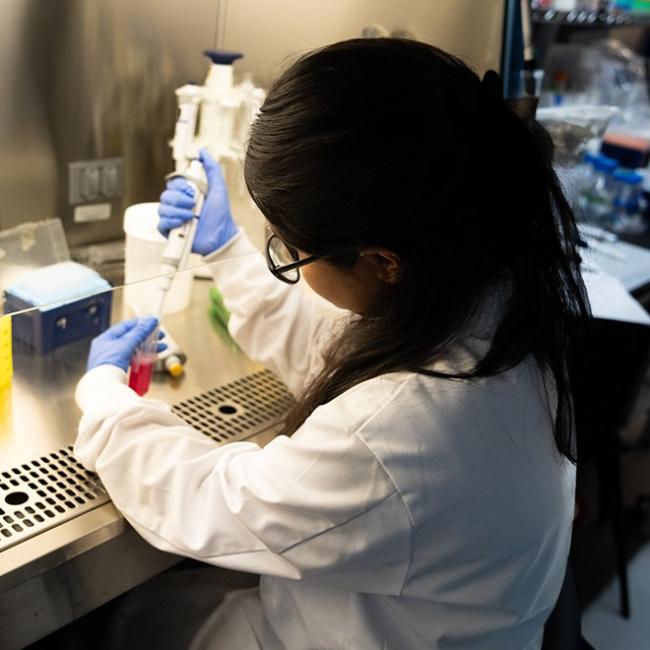
Chemical Engineering & Bioengineering
The Master's in Chemical Engineering program at UNH offers advanced research opportunities in high-impact fields like advanced materials, bioengineering, and sustainable energy.
Here you'll be able to work alongside award-winning faculty mentors in state-of-the-art laboratories while joining a supportive research community. Through personalized guidance and hands-on experience in cutting-edge projects, you'll develop the expertise needed for leadership roles in industry, academia, and beyond.
*Number of courses and course credit hours may vary, please reach out to your academic advisor for exact requirements.
Key Links
Contact Cards
An M.S. in chemical engineering can help you unlock your career potential or enter the world of entrepreneurship. In fact, this advanced degree can translate into more than $15,000 annually in salary compared to those with an undergraduate degree alone. Our program will introduce you to the exciting world of chemical engineering research, teaching you how to plan and execute research activities and interpret results. You’ll complete a research thesis in an area such as bioengineering, electrochemical engineering, advanced materials, reaction and energy engineering, or environmental engineering. You’ll be prepared to enter the workforce with a deeper understanding of the fundamentals of chemical engineering.
Our chemical engineering program is leading the way thanks to state-of-the-art facilities, award-winning faculty members and cutting-edge research. Our professors have won National Science Foundation CAREER awards. They are working to save lives and improve our quality of life through initiatives such as the NH BioMade project, which seeks to advance research on biomaterials, and an effort to design novel therapies and treatments for diabetes by running biomolecular simulations on the world’s fastest supercomputer. The department hosts a robust seminar series schedule to provide additional opportunities to learn and network within the field.
An M.S. in chemical engineering can help you unlock your career potential or enter the world of entrepreneurship. In fact, this advanced degree can translate into more than $15,000 annually in salary compared to those with an undergraduate degree alone. Our program will introduce you to the exciting world of chemical engineering research, teaching you how to plan and execute research activities and interpret results. You will complete a research thesis in an area such as catalysis, green engineering, fluid dynamics, sensors, computational biophysics, biomaterials, tissue engineering, and synthetic biology. You will be prepared to enter the workforce with a deeper understanding of the fundamentals of chemical engineering.
Admission Requirements
An applicant is expected to have completed a baccalaureate degree in chemical engineering. Students with good undergraduate records in a science or engineering field may be admitted provided they learn specific math and engineering skills that are aimed at successful completion of the Master of Science program requirements. Applicants must submit current scores (within five years) from the general test of the Graduate Record Examination. International students are required to submit TOEFL test scores. IELTS scores are accepted on a case-by-case basis, and students must have a minimum score of 6.5.
A minimum of 30 credits, which must include:
| Code | Title | Credits |
|---|---|---|
| Required Courses | ||
| CHBE 900 | Seminar 1 | 0 or 1 |
| CHBE 923 | Advanced Chemical Engineering Thermodynamics | 3 |
| CHBE 932 | Advanced Chemical Engineering Kinetics | 3 |
| CHBE 940 | Advanced Transport Phenomena | 3 |
| In addition to the above 11‐credit required courses, the M.S. student is expected to take the following courses: | ||
| Electives 2 | ||
| Select 19 elective course credits 2 | 19 | |
| CHBE 899 | Master's Thesis | 6-9 |
The M.S. elective course credits must include CHBE 899 Master's Thesis of up to 9 credits.
Students should register for CHBE 900 for 1 credit each in their first two semesters and 0 credits each additional semester until their degree is granted.
Can be made up of electives offered by the department or by the college. Courses taken within the UNH School of Law, College of Life Sciences and Agriculture, and the Paul College of Business and Economics can apply with approval. Electives must be assessed with a letter grade and cannot be pass/fail. Students take electives after consulting with their advisers. The courses the students have taken to fulfill their B.S. degree requirement cannot be counted toward their M.S. degree requirement.
Accelerated Master’s programs offer qualified University of New Hampshire undergraduate students the opportunity to begin graduate coursework in select graduate programs while completing a bachelor’s degree. Accelerated master's programs are designed to provide students with an efficient and cost-effective pathway to earn both a bachelor's and master's degree or graduate certificate, enhancing career opportunities and long-term earning potential.
*Some exceptions apply.
*Some exceptions apply.
This graduate degree program is approved to be taken on an accelerated basis in articulation with the following undergraduate program(s):
| Code | Title | Credits |
|---|---|---|
| Chemical Engineering (B.S.) | ||
| Students select from the following approved 800-level courses that can be completed in the undergraduate senior year for dual credit: | ||
| CHBE | (Any 800-level course) | 4 |
| MATH 840 | Design of Experiments I | 3 |
| Code | Title | Credits |
|---|---|---|
| Chemical Engineering: Bioengineering (B.S.) | ||
| Students select from the following approved 800-level courses that can be completed in the undergraduate senior year for dual credit: | ||
| CHBE | (Any 800-level course) | 4 |
| BCHM 850 | Physical Biochemistry | 3 |
| BCHM 851 | Principles of Biochemistry I | 4 |
| BCHM 852 | Principles of Biochemistry II | 4 |
| MATH 840 | Design of Experiments I | 3 |
| Code | Title | Credits |
|---|---|---|
| Chemical Engineering: Energy (B.S.) | ||
| Students select from the following approved 800-level courses that can be completed in the undergraduate senior year for dual credit: | ||
| CHBE | (Any 800-level course) | 4 |
| ME 806 | Renewable Energy: Physical and Engineering Principles | 3 |
| NR 887 | Advanced Topics in Sustainable Energy | 4 |
| MATH 840 | Design of Experiments I | 3 |
| Code | Title | Credits |
|---|---|---|
| Chemical Engineering: Environmental Engineering (B.S.) | ||
| Students select from the following approved 800-level courses that can be completed in the undergraduate senior year for dual credit: | ||
| CHBE | (Any 800-level course) | 4 |
| CEE 820 | Waste Management and Site Remediation | 3 |
| CEE 823 | Environmental Engineering Chemistry | 4 |
| CEE 824 | Environmental Engineering Microbiology | 4 |
| MATH 840 | Design of Experiments I | 3 |
| Code | Title | Credits |
|---|---|---|
| Bioengineering (B.S.) | ||
| Students select from the following approved 800-level courses that can be completed in the undergraduate senior year for dual credit. To count as dual credit, at least four of the elective courses must be engineering: | ||
| CHBE | (Any 800-level course) | 4 |
| CEE 805 | Introduction to Sustainable Engineering | 3 |
| CEE 824 | Environmental Engineering Microbiology | 4 |
| ECE 817 | Introduction to Digital Image Processing | 4 |
| ECE 884 | Biomedical Instrumentation | 4 |
| BCHM 802 | Endocrinology | 4 |
| BCHM 853 | Cell Culture | 5 |
| GEN 811 | Genomics and Bioinformatics | 4 |
| GEN 812 | Programming for Bioinformatics | 5 |
| GEN 817 | Molecular Microbiology | 5 |
| GEN 871 | Molecular Genetics | 4 |
| GEN 874 | Techniques in Plant Genetic Engineering and Biotechnology | 4 |
| TECH 850 | Intellectual Asset Management for Engineers and Scientists | 3 |
Program Learning Outcomes
Upon completion of the master’s of science degree, the student will be able to:Applications must be completed by the following deadlines in order to be reviewed for admission:
Application fee: $65
Campus: Durham
New England Regional: VT
Accelerated Masters: Yes (for more details see the accelerated masters information page)
Students claiming in-state residency must also submit a Proof of Residence Form. This form is not required to complete your application, but you will need to submit it after you are offered admission, or you will not be able to register for classes.
If you attended UNH or Granite State College (GSC) after September 1, 1991, and have indicated so on your online application, we will retrieve your transcript internally; this includes UNH-Durham, UNH-Manchester, UNH Non-Degree work and GSC.
If you did not attend UNH, or attended prior to September 1, 1991, then you must upload a copy (PDF) of your transcript in the application form. International transcripts must be translated into English.
If admitted, you must then request an official transcript be sent directly to our office from the Registrar's Office of each college/university attended. We accept transcripts both electronically and in hard copy:
Transcripts from all previous post-secondary institutions must be submitted and applicants must disclose any previous academic or disciplinary sanctions that resulted in their temporary or permanent separation from a previous post-secondary institution. If it is found that previous academic or disciplinary separations were not disclosed, applicants may face denial and admitted students may face dismissal from their academic program.
Recommendation letters submitted by relatives or friends, as well as letters older than one year, will not be accepted.
GRE required. Request official test scores to be sent directly to the Graduate School by the testing service. Test scores more than five years old are not acceptable. Student copies and photo copies of scores are not considered official. Our CEEB code is 3918.
For general information about test scores, including waiver requests and current COVID related impacts, please visit our Test Scores webpage.
Prepare a brief but careful statement regarding:
All applicants are encouraged to contact programs directly to discuss program-specific application questions.
Prospective international students are required to submit TOEFL, IELTS, or equivalent examination scores. English Language Exams may be waived if English is your first language. If you wish to request a waiver, then please visit our Test Scores webpage for more information.
A bachelor’s degree in Chemical Engineering is required for all graduate programs. Exceptional applicants from other closely related engineering majors and chemistry background may be admitted based on the records. Undergraduate GPA 3.0 or higher is recommended for application.
All Ph.D. students in our program receive full financial support (tuition and stipend) in the form of either research assistantship (RA) or teaching assistantship (TA).
In general, MS and MEng students do not receive financial aid from the department except for some rare occasions (temporary TA positions, graders). Once admitted, however, the students are allowed to contact individual faculty to inquire of the financial support through the external funding resources.
The review process is on a rolling basis and the decisions are typically made within 2 weeks after the completion of application. However, applications must be completed by March 15 to receive full consideration of financial aid.
Ph.D. students must maintain the full-time status. Most of the core courses are offered in -person, although online options may be available under special circumstances. M.S. and MEng. degrees may be completed part-time
The applicants are free to contact individual faculty regarding the availability of research positions. However, the assignment of thesis advisor is determined by the graduate committee. Direct all related questions to the graduate coordinator (Kyungjae.Jeong@unh.edu).
The Bioengineering program (B Sci in Bioengineering) is accredited by the Engineering Accreditation Commission of ABET, https://www.abet.org, under the General Criteria and the Program Criteria for Bioengineering and Biomedical and Similarly Named Engineering Programs.
The Chemical Engineering program (B Sci in Chemical Engineering) is accredited by the Engineering Accreditation Commission of ABET, https://www.abet.org, under the General Criteria and the Program Criteria for Chemical, Biochemical, Biomolecular and Similarly Named Engineering Programs.