Click below to get more information about UNH graduate programs
Request Information Form
Request Information Form

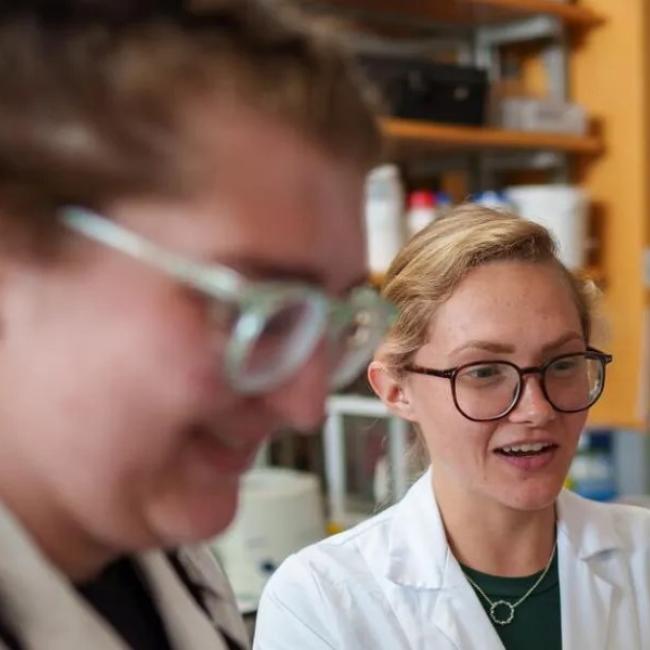
Chemical Engineering & Bioengineering
The Master’s in Bioengineering program at UNH offers advanced research opportunities in areas like regenerative medicine, biomechanics, and bioinstrumentation. Here, you’ll dive deep into research and discovery at the intersection of biology, engineering, and medicine while collaborating with expert faculty.
Whether your goal is to pursue a Ph.D. or enter the biomedical workforce with strong research credentials, the program offers a strong foundation and unparalleled access to modern labs and collaborative research centers.
*Number of courses and course credit hours may vary, please reach out to your academic advisor for exact requirements.
Key Links
An M.S. in bioengineering can help you unlock your career potential or enter the world of entrepreneurship. In fact, this advanced degree can translate into more than $15,000 annually in salary compared to those with an undergraduate degree alone. Our program will introduce you to the exciting world of bioengineering research, teaching you how to plan and execute research activities and interpret results. You’ll complete a research thesis in an area such as biophysics, biomaterials, tissue engineering, chemical and biosensors, electrochemical energy storage, or synthetic biology. You’ll be prepared to enter the workforce with a deeper understanding of the fundamentals of bioengineering.
Our bioengineering program is leading the way thanks to state-of-the-art facilities, award-winning faculty members and cutting-edge research. Our professors have won National Science Foundation CAREER awards and NIH MIRA Outstanding Investigator grants. They are working to save lives and improve our quality of life through initiatives such as CIBBR (Center for Integrated Bioengineering and Biomedical Research), NH BioMade, the ARMI (Advanced Regenerative Manufacturing Institute), and BIO-SENS (Biologically-Inspired On-demand Strategies for Engineering Nanostructured Sensors). The department hosts a robust seminar series schedule to provide additional opportunities to learn and network within the field.
An M.S. in Bioengineering can help you unlock your career potential and can translate into more than $15,000 annually in salary compared to those with an undergraduate degree alone. Our program offers a flexible pathway to integrate the life sciences, physical sciences, mathematics and engineering principles to solve problems at the interface of biology, medicine, and engineering. You will complete a research thesis in an area such as biomaterials, tissue engineering, biophysics, synthetic biology, and sensors. You will be prepared to enter the workforce with a deeper understanding of the fundamentals of bioengineering.
Admission Requirements
An applicant to the Master of Science program will have completed a baccalaureate degree in engineering or a related field. Students with good undergraduate records in the science fields may be admitted provided they learn specific math and engineering skills that are aimed at successful completion of the Master of Science program requirements. Applicants must submit current scores (within five years) from the general test of the Graduate Record Examination. International students are required to submit TOEFL test scores. IELTS scores are accepted on a case-by-case basis, and students must have a minimum score of 6.5.
A minimum of 30 credits are required as follows:
| Code | Title | Credits |
|---|---|---|
| Required Courses | ||
| CHBE 900 | Seminar 1 | 2 |
| CHBE 860 | Principles of Bioengineering | 3 |
| Select two additional CHBE Courses | 6-8 | |
| Electives | ||
| Select one Math/Data Science course 2 | 3-4 | |
| Select one Life Science course 2 | 3-5 | |
| Select additional electives 2,3 | 8-13 | |
Students should register for CHBE 900 Seminar for 2 credits in their first two semesters and CHBE 900 Seminar for 0 credits each additional semester until their degree is granted.
Can be made up of electives offered by the CHBE department, the College of Engineering and Physical Sciences or the College of Life Sciences and Agriculture. In addition, courses taken within the UNH School of Law, College of Liberal Arts, and the Paul College of Business and Economics can apply with approval. Electives must be assessed with a letter grade and cannot be pass/fail.
The elective course credits must include CHBE 899 Master's Thesis of up to 9 credits.
Accelerated Master’s programs offer qualified University of New Hampshire undergraduate students the opportunity to begin graduate coursework in select graduate programs while completing a bachelor’s degree. Accelerated master's programs are designed to provide students with an efficient and cost-effective pathway to earn both a bachelor's and master's degree or graduate certificate, enhancing career opportunities and long-term earning potential.
*Some exceptions apply.
*Some exceptions apply.
This graduate degree program is approved to be taken on an accelerated basis in articulation with the following undergraduate program(s):
| Code | Title | Credits |
|---|---|---|
| Bioengineering (B.S.) | ||
| Students select from the following approved 800-level courses that can be completed in the undergraduate senior year for dual credit. To count as dual credit, at least four of the elective courses must be engineering: | ||
| Any CEPS 800-level course | 3-5 | |
| Any COLSA 800-level course | 3-5 | |
| Code | Title | Credits |
|---|---|---|
| Chemical Engineering (B.S.) | ||
| Students select from the following approved 800-level courses that can be completed in the undergraduate senior year for dual credit: | ||
| CHBE (Any 800-level course) | 3-4 | |
| MATH 840 | Design of Experiments I | 3 |
| Code | Title | Credits |
|---|---|---|
| Chemical Engineering: Bioengineering (B.S.) | ||
| Students select from the following approved 800-level courses that can be completed in the undergraduate senior year for dual credit: | ||
| CHBE (Any 800-level course) | 3-4 | |
| MATH 840 | Design of Experiments I | 3 |
| BCHM 850 | Physical Biochemistry | 3 |
| BCHM 851 | Principles of Biochemistry I | 4 |
| BCHM 852 | Principles of Biochemistry II | 4 |
| Code | Title | Credits |
|---|---|---|
| Chemical Engineering: Energy (B.S.) | ||
| Students select from the following approved 800-level courses that can be completed in the undergraduate senior year for dual credit: | ||
| CHBE (Any 800-level course) | 3-4 | |
| MATH 840 | Design of Experiments I | 3 |
| ME 806 | Renewable Energy: Physical and Engineering Principles | 3 |
| NR 887 | Advanced Topics in Sustainable Energy | 4 |
| Code | Title | Credits |
|---|---|---|
| Chemical Engineering: Environmental Engineering (B.S.) | ||
| Students select from the following approved 800-level courses that can be completed in the undergraduate senior year for dual credit: | ||
| CHBE (Any 800-level course) | 3-4 | |
| MATH 840 | Design of Experiments I | 3 |
| CEE 820 | Waste Management and Site Remediation | 3 |
| CEE 823 | Environmental Engineering Chemistry | 4 |
| CEE 824 | Environmental Engineering Microbiology | 4 |
Applications must be completed by the following deadlines in order to be reviewed for admission:
Application fee: $65
Administered by: Durham
New England Regional: No
Accelerated Masters: Yes (for more details see the accelerated masters information page)
Students claiming in-state residency must also submit a Proof of Residence Form. This form is not required to complete your application, but you will need to submit it after you are offered admission, or you will not be able to register for classes.
If you attended UNH or Granite State College (GSC) after September 1, 1991, and have indicated so on your online application, we will retrieve your transcript internally; this includes UNH-Durham, UNH-Manchester, UNH Non-Degree work and GSC.
If you did not attend UNH, or attended prior to September 1, 1991, then you must upload a copy (PDF) of your transcript in the application form. International transcripts must be translated into English.
If admitted, you must then request an official transcript be sent directly to our office from the Registrar's Office of each college/university attended. We accept transcripts both electronically and in hard copy:
Transcripts from all previous post-secondary institutions must be submitted and applicants must disclose any previous academic or disciplinary sanctions that resulted in their temporary or permanent separation from a previous post-secondary institution. If it is found that previous academic or disciplinary separations were not disclosed, applicants may face denial and admitted students may face dismissal from their academic program.
Recommendation letters submitted by relatives or friends, as well as letters older than one year, will not be accepted.
GRE required. Request official test scores to be sent directly to the Graduate School by the testing service. Test scores more than five years old are not acceptable. Student copies and photo copies of scores are not considered official. Our CEEB code is 3918.
For general information about test scores, including waiver requests and current COVID related impacts, please visit our Test Scores webpage.
Prepare a brief but careful statement regarding:
All applicants are encouraged to contact programs directly to discuss program-specific application questions.
Prospective international students are required to submit TOEFL, IELTS, or equivalent examination scores. English Language Exams may be waived if English is your first language. If you wish to request a waiver, then please visit our Test Scores webpage for more information.
The Bioengineering program (B Sci in Bioengineering) is accredited by the Engineering Accreditation Commission of ABET, https://www.abet.org, under the General Criteria and the Program Criteria for Bioengineering and Biomedical and Similarly Named Engineering Programs.
The Chemical Engineering program (B Sci in Chemical Engineering) is accredited by the Engineering Accreditation Commission of ABET, https://www.abet.org, under the General Criteria and the Program Criteria for Chemical, Biochemical, Biomolecular and Similarly Named Engineering Programs.