Click below to get more information about UNH graduate programs
Request Information Form
Request Information Form

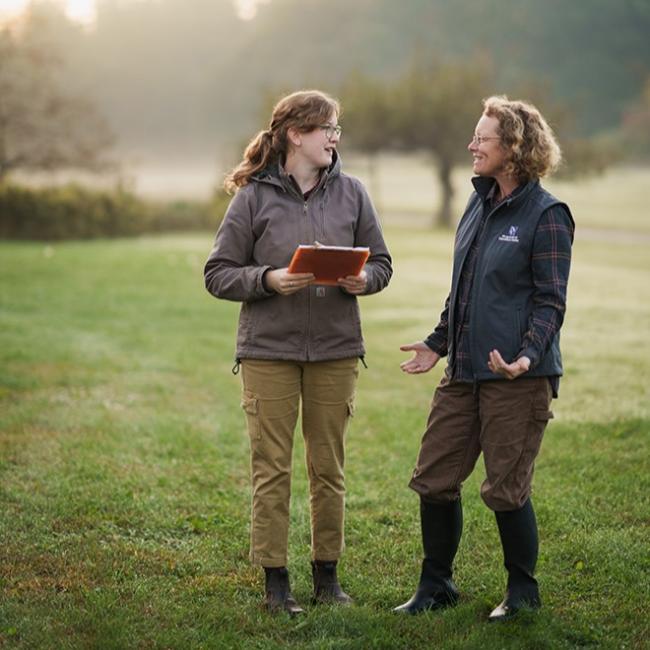
Agriculture, Nutrition, and Food Systems
The master’s in Agricultural Sciences at UNH prepares you to lead research that addresses complex challenges across agricultural, production, nutrition and food systems. Working within our interdisciplinary Department of Agriculture, Nutrition and Food Systems, you’ll collaborate with expert faculty and pursue original research that drives innovation from farm to table.
The program emphasizes independent inquiry, interdisciplinary collaboration, and real-world impact—equipping you for influential roles in academia, government, and industry. With a curriculum grounded in systems thinking and sustainability, you’ll graduate ready to lead transformative change across the agricultural landscape.
*Number of courses and course credit hours may vary, please reach out to your academic advisor for exact requirements.
Key Links
Contact Cards
An M.S. in agricultural sciences will help you advance your career in an agriculture-related field, whether you are working in agricultural production, agribusiness, policy areas in government or nonprofit sectors, education and/or research. Our master’s program focuses on the advanced study of plant and animal agriculture, aquaculture, agro-ecosystems, and the social and economic dimensions of food production and distribution systems. With the growing demand for well-trained agricultural researchers and professionals, a master’s degree in agricultural sciences will help you pursue leadership roles in collaborative and interdisciplinary initiatives that address agricultural issues and opportunities.
UNH is among the nation’s highest-performing research universities, having earned a Carnegie Classification R1. Our research portfolio brings in more than $110 million in competitive external funding each year. Federal and state funding is available for research on diverse aspects of sustainable agriculture, foods and agricultural sciences. You’ll have the opportunity to partner with state and regional growers and producers and collaborate with leading researchers worldwide. As a graduate student at UNH, you’ll have the opportunity to work in several top-notch teaching and research facilities, including the New Hampshire Agricultural Experiment Station, one of the university’s largest research organizations.
The Master of Science (M.S.) in Agricultural Sciences graduate program offers a flexible course of study that provides education and research experience in plant and animal agriculture, food systems, and related fields. Graduate students are engaged in an interdisciplinary department focusing on the farm to fork wellness continuum and an integrated approach to solving problems. Students will also develop independent and collaborative research experience.
Our faculty offer education and research opportunities studying the diverse components of food systems and plant and animal agricultural systems including breeding and genetics, physiology, environmental interactions, protected agriculture, organismal health, agroecology, and pathology. Beyond the classroom and the lab, students will hone communication skills that are essential for professional scientists through teaching, extension, and outreach opportunities with stakeholders and constituents.
The agricultural sciences graduate program prepares students to become highly knowledgeable and competent in professional fields related to agriculture and food, and leaders in collaborative and interdisciplinary efforts to address local, regional, national and/or global issues at the intersection of agriculture, food and the environment.
The M.S. program is thesis-based, with the expectation of providing substantial research experience and the opportunity to publish new knowledge in the field of interest.
Master of Science (M.S.) in Agriculture Sciences students plan a program of study in conjunction with their advisor and Master’s Thesis Committee, including required courses and competencies. A minimum of 30 graduate credits, including 6-10 research credits (ANFS 899 Master's Thesis), are required. A thesis proposal is developed within the first year for approval by the thesis committee. All M.S. students must write a thesis which must be accepted by the advisor(s), committee members, and the Graduate School. The degree is completed when the student has completed the required coursework, presented and passed a thesis defense, and the thesis is approved by the Master’s Thesis Committee and accepted by the Graduate School.
Up to 8 credits of graduate credit from another institution may be transferred, provided the credits were not counted toward another degree, and the course grade was a B or higher. Petitions requesting transfer credit must be supported by the advisor and graduate committee and approved by the UNH Graduate School
1. Core Course Requirements:
| Code | Title | Credits |
|---|---|---|
| ANFS 899 | Master's Thesis | 6-10 |
| ANFS 901 | Introduction to Agriculture, Nutrition, and Food Systems Graduate Studies 1 | 1 |
| ANFS 997 | Agriculture, Nutrition, and Food Systems Seminar 2 | 1 |
To be taken at the earliest opportunity, typically in the initial fall semester of the graduate program.
This 1 credit course may be repeated up to a maximum of 4 credits and should be taken every semester by M.S. students.
2. Competency Requirements: In addition to the core required courses, students will be expected to demonstrate competency in areas of experimental design and analysis, and in scientific writing and communication. Students must take at least one course from each competency. The competencies may be fulfilled by courses chosen in consultation with the advisor and committee. Depending on the student, one or both of these competency requirements may have been fulfilled through other course work or professional experience as approved by the committee and ANFS graduate coordinator.
| Code | Title | Credits |
|---|---|---|
| Communication Competency | ||
| Select at least one course: | ||
| BIOL 902 | Writing and Publishing Science | 2 |
| NR 905 | Grant Writing | 2 |
| BIOL 950 | Scientific Communication | 2 |
| Experimental Design and Analysis Competency | ||
| Select at least one course: | ||
| ANFS 933 | Design, Analysis, and Interpretation of Experiments | 4 |
| SOC 902 | Sociological Methods II: Research Design | 4 |
3. Electives: Each student, in consultation with their graduate committee, will define one or more areas of informal specialization, and will take additional courses appropriate for their area(s) of specialization.
4. Additional Requirements:
Additional information can be found in the program graduate handbook, which includes expectations, guidelines, and detailed policies.
Annual Evaluation: The annual evaluation of graduate students ensures that students receive the mentorship they deserve and are making progress toward completion of their degrees. The annual evaluation of graduate students consists of a collaborative effort between faculty adviser and student to:
Students graduating with an M.S. in Agricultural sciences will meet objectives in the following areas:
Discipline specific knowledgeApplications must be completed by the following deadlines in order to be reviewed for admission:
Application fee: $65
Administered by: Durham
New England Regional: MA RI
Accelerated Masters Eligible: No
Students claiming in-state residency must also submit a Proof of Residence Form. This form is not required to complete your application, but you will need to submit it after you are offered admission, or you will not be able to register for classes.
If you attended UNH or Granite State College (GSC) after September 1, 1991, and have indicated so on your online application, we will retrieve your transcript internally; this includes UNH-Durham, UNH-Manchester, UNH Non-Degree work and GSC.
If you did not attend UNH, or attended prior to September 1, 1991, then you must upload a copy (PDF) of your transcript in the application form. International transcripts must be translated into English.
If admitted, you must then request an official transcript be sent directly to our office from the Registrar's Office of each college/university attended. We accept transcripts both electronically and in hard copy:
Transcripts from all previous post-secondary institutions must be submitted and applicants must disclose any previous academic or disciplinary sanctions that resulted in their temporary or permanent separation from a previous post-secondary institution. If it is found that previous academic or disciplinary separations were not disclosed, applicants may face denial and admitted students may face dismissal from their academic program.
Recommendation letters submitted by relatives or friends, as well as letters older than one year, will not be accepted.
Prepare a brief but careful statement regarding:
Applicants should visit the Agricultural Sciences program website and review the list of faculty in their area of interest. The applicant should contact potential faculty advisors to discuss their interests and determine whether the faculty member(s) may be willing and able to serve as the student’s advisor before applying to the program. See the Agricultural Sciences Faculty List for a current list of faculty.
All applicants are encouraged to contact programs directly to discuss program specific application questions.
Prospective international students are required to submit TOEFL, IELTS, or equivalent examination scores. English Language Exams may be waived if English is your first language. If you wish to request a waiver, then please visit our Test Scores webpage for more information.
