Geospatial Science, Graduate Certificate - Post Bacc - COLSA, UNH

Graduate

Geospatial Science

Study geographic information systems (GIS) technologies and apply them to areas such as earth science, remote sensing, sociology, geography, municipal planning, civil engineering and natural resources.
Degree
Certificate
Location
Durham, NH
Courses
5
Credit
16 hrs.
Full-time
Varies
Part-time
Varies
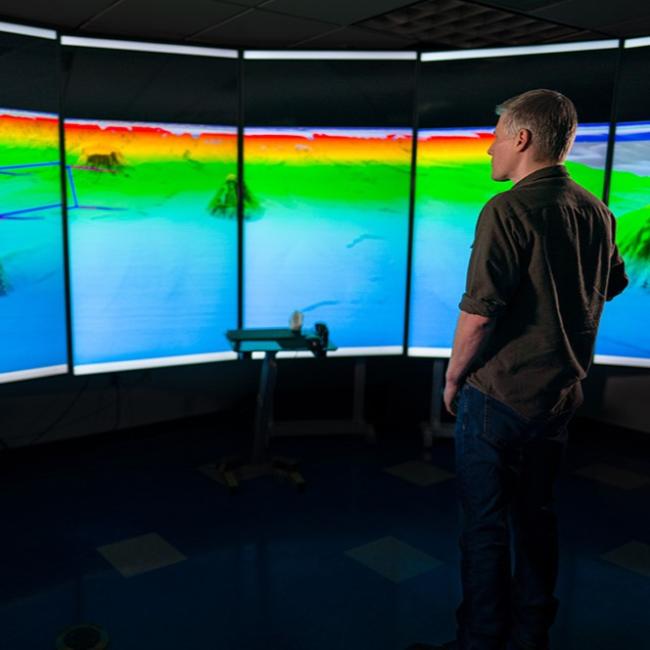
Male student staring at a large set of screens with a heat map on them

Natural Resources and the Environment

The Geospatial Science graduate certificate at UNH provides a foundation in collecting, managing, analyzing and visualizing spatial data related to the earth’s surface. You’ll study geographic information systems (GIS) technologies and apply them to areas such as earth science, remote sensing, sociology, geography, municipal planning, civil engineering and natural resources. 

The program emphasizes applied learning through labs and independent GIS projects, preparing you to advance or expand your career.

Contact Cards

Morse Hall, Durham, NH 03824
(603) 862-1792

Why pursue a graduate certificate in geospatial science?

The geospatial science graduate certificate provides a foundation in the collection, management, analysis and visualization of spatial data related to the earth’s surface. You’ll learn about geographic information systems (GIS) technologies and gain expertise in areas such as earth science,remote sensing, sociology, geography, municipal applications, civil engineering and natural resources. You’ll solve challenges through hands-on lab experience and independent GIS projects. Whether you’re exploring the field or are a professional looking to expand your knowledge, you’ll gain the skills you need to take your career to the next level.

Why pursue a geospatial science certificate at UNH?

Our program provides a cost-effective way to improve your knowledge and skills in geospatial technology. You’ll be able to take a mix of online and traditional courses, and can start the program in the fall, spring or summer semesters. The faculty for this interdisciplinary postbaccalaureate certificate hail from several departments at UNH, including biology, civil and environmental engineering, earth sciences, mathematics, natural resources, ocean engineering, and sociology. UNH is ranked among the nation’s highest-performing research universities, having earned a Carnegie Classification R1. The university’s research portfolio brings in more than $110 million in competitive external funding each year.

Potential careers

  • Business analyst
  • Data analyst
  • Data scientist
  • Geospatial intelligence analyst
  • Intelligence image analyst
  • Military analyst
  • Remote sensing scientist
  • Researcher

Curriculum & Requirements

01
Program Description
Open icon icon to open the summary

The Graduate Certificate in Geospatial Science (GSS) at the University of New Hampshire is a multidisciplinary program designed to provide graduate level education in the applied and theoretical technology and applications of geospatial science. Students within the program are afforded the opportunity to build their five course requirement certificate from a variety of required and elective classes from different disciplines to best fit their academic, research, or professional interests. The flexibility of this program makes the program ideal for a student looking to complement their degree or a professional looking to build knowledge, skill and credentials within the Geospatial Sciences.

02
Requirements for the Program
Open icon icon to open the summary

Certificate Requirements

The certificate consists of completing five courses (16 credits).

Required Courses
GSS 800Elements of Geospatial Science4
Geographic Information Systems
Select one course from the following:
GSS 805Applied Geographic Information Systems4
ESCI 895Topics4
NR 860Geographic Information Systems in Natural Resources 14
CEE 896Special Topics (GIS for Water Resources)4
Data Analysis
Select one course from the following:
BIOL 811Experimental Design & Analysis4
ESCI 896Topics (Time Series Analysis)1-4
MATH 836Advanced Statistical Modeling3
MATH 839Applied Regression Analysis3
SOC 901Sociological Methods I: Intermediate Social Statistics4
Electives
Select two courses from the following:
MATH 831Mathematics for Geodesy3
NR 857Remote Sensing of the Environment4
NR 859Digital Image Processing for Natural Resources4
NR 882Forest Health4
OE/ESCI 871Positioning for Ocean Mapping4
03
Application Requirements & Deadlines
Open icon icon to open the summary

Apply now

Deadlines

Applications must be completed by the following deadlines in order to be reviewed for admission:

  • Fall: July 1
  • Spring: Dec. 1
  • Summer: April 1
  • Special: N/A

Application fee: $25

Campus: Durham

New England Regional: No

Accelerated Masters Eligible: No

New Hampshire Residents

Students claiming in-state residency must also submit a Proof of Residence Form. This form is not required to complete your application, but you will need to submit it after you are offered admission, or you will not be able to register for classes.

Transcripts

If you attended UNH or Granite State College (GSC) after September 1, 1991, and have indicated so on your online application, we will retrieve your transcript internally; this includes UNH-Durham, UNH-Manchester, UNH Non-Degree work and GSC. 

If you did not attend UNH, or attended prior to September 1, 1991, then you must upload a copy (PDF) of your transcript in the application form. International transcripts must be translated into English.

If admitted, you must then request an official transcript be sent directly to our office from the Registrar's Office of each college/university attended. We accept transcripts both electronically and in hard copy:

  • Electronic Transcripts: Please have your institution send the transcript directly to grad.school@unh.edu. Please note that we can only accept copies sent directly from the institution.
  • Paper Transcripts: Please send hard copies of transcripts to: UNH Graduate School, Thompson Hall- 105 Main Street, Durham, NH 03824. You may request transcripts be sent to us directly from the institution or you may send them yourself as long as they remain sealed in the original university envelope.

Transcripts from all previous post-secondary institutions must be submitted and applicants must disclose any previous academic or disciplinary sanctions that resulted in their temporary or permanent separation from a previous post-secondary institution. If it is found that previous academic or disciplinary separations were not disclosed, applicants may face denial and admitted students may face dismissal from their academic program.

Letters of Recommendation: 2 Required

Recommendation letters submitted by relatives or friends, as well as letters older than one year, will not be accepted.

Personal Statement/Essay Questions

Prepare a brief but careful statement regarding:

  1. Reasons you wish to do graduate work in this field, including your immediate and long-range objectives.
  2. Your specific research or professional interest and experiences in this field.

Important Notes

All applicants are encouraged to contact programs directly to discuss program-specific application questions.

International Applicants

Prospective international students are required to submit TOEFL, IELTS, or equivalent examination scores. English Language Exams may be waived if English is your first language. If you wish to request a waiver, then please visit our Test Scores webpage for more information.

Suggested Course Tracks

01
Earth Science
Open icon icon to open the summary
Core Requirements
  • Time Series Analysis
  • Data Analysis for Earth Systems Science
  • Elements of Geospatial Science
  • GIS in Water Resources
Electives
  • Coastal Remote Sensing
  • Time Series Analysis
02
Remote Sensing
Open icon icon to open the summary
Core Requirements
  • Elements of Geospatial Science
  • GIS in Natural Resources
  • Spatial Statistics
Electives (Two of the following)
  • Remote Sensing for the Environment
  • Digital Image Processing
  • Mathematics for Geodesy
03
Sociology/Geography
Open icon icon to open the summary
Core Requirements
  • Applied GIS for Research
  • Elements of Geospatial Science
  • Intermediate Social Statistics
Electives (Two of the following)
  • Sociological Methods - Survey Research
  • Independent Study in Geospatial Science
  • Independent Study in Geospatial Science
04
Municipal Applications
Open icon icon to open the summary
Core Requirements
  • Applied GIS for Research
  • Elements of Geospatial Science
  • Intermediate Social Statistics
Electives
  • Sociological Methods - Survey Research
  • Remote Sensing for the Environment
05
Core Engineering/Water Resources
Open icon icon to open the summary
Core Requirements
  • Time Series Analysis
  • Elements of Geospatial Science
  • GIS in Water Resources
  • Spatial Statistics
Electives
  • Time Series Analysis
  • Remote Sensing for Earth Systems Science
06
Natural Resources/Forestry I
Open icon icon to open the summary
Core Requirements
  • Elements of Geospatial Science
  • GIS in Natural Resources
  • Spatial Statistics
Electives
  • Remote Sensing for the Environment
  • Digital Image Processing
07
Natural Resources/Forestry II
Open icon icon to open the summary
Core Requirements
  • Applied GIS for Research
  • Elements of Geospatial Science
  • Applied Biostatistics II
Electives (Two of the following)
  • Sociological Methods - Survey Research
  • Sampling Techniques
  • Remote Sensing for the Environment
08
Graduate Research and Professional Applications
Open icon icon to open the summary
Core Requirements
  • Applied GIS for Research
  • Elements of Geospatial Science
  • Spatial Statistics
Electives
  • Crowd Source Mapping
  • Remote Sensing for Earth Systems Science