Diagnostic Science: Medical Laboratory Science, B.S. - COLSA, UNH

Undergraduate

Diagnostic Science: Medical Laboratory Science

Identify and solve complex health challenges to drive better outcomes for individuals. This degree option is for students who wish to become certified medical laboratory scientists.
Degree
Bachelor of Science
Location
Durham, NH
Courses
36*
Credit
128 hrs.*
Full-time
4 yrs.
Part-time
Varies
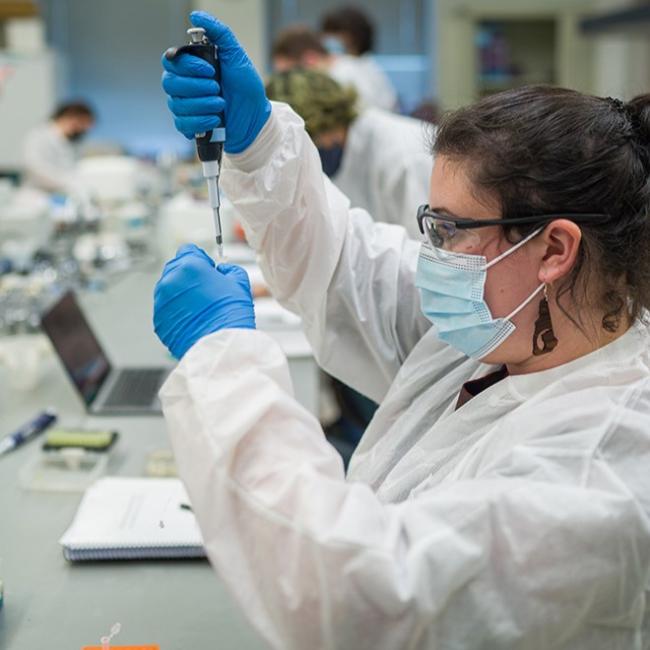
Student using a pip in lab

Molecular, Cellular, and Biomedical Sciences

The Diagnostic Science: Medical Laboratory Science B.S. aims to develop the next generation of diagnostic professionals who demonstrate innovation and compassion to advance healthcare. Through interdisciplinary education and a commitment to critical inquiry, our graduates will become pioneers in identifying and solving complex health challenges - driving better outcomes for individuals and communities.

This degree option is for students who wish to become certified Medical Laboratory Scientists and pursue careers working within a variety of clinical laboratory settings. As the only 4-year MLS program accredited by the National Accrediting Agency for Clinical Laboratory Science (NAACLS) in New Hampshire, students complete applied, multi-disciplinary coursework on campus followed by a semester-long clinical internship at an affiliated clinical laboratory.

*Number of courses and course credit hours may vary, please reach out to your academic advisor for exact requirements.

Molecular, Cellular, and Biomedical Sciences Department

What is medical laboratory science?

Medical laboratory scientists are healthcare detectives, performing the complex tests that physicians rely on to diagnose diseases, monitor treatments, and save lives. Students master techniques in blood banking, clinical chemistry, microbiology, and molecular diagnostics while developing the precision and critical thinking that define this essential profession. This hands-on field combines scientific inquiry with direct impact on patient outcomes.

Why study medical laboratory science at UNH?

UNH's program is accredited by the National Accrediting Agency for Clinical Laboratory Science (NAACLS) and prepares students for the Medical Laboratory Scientist generalist certification exam offered by the American Society for Clinical Pathology Board of Certification. This curriculum option culminates in a semester-long internship at an affiliated clinical laboratory, providing supervised hands-on experience before graduation. Students gain credentials and practical training that position them for immediate employment in a high-demand field.

Potential career areas

  • Medical laboratory scientist
  • Quality Assurance Specialist
  • Point of Care Coordinator
  • Laboratory supervisor
  • Public health laboratory scientist
  • Infection Preventionist

Curriculum & Requirements

01
Program Description
Open icon icon to open the summary

The Diagnostic Science program aims to develop the next generation of diagnostic professionals who demonstrate innovation and compassion to advance healthcare. Through interdisciplinary education and a commitment to critical inquiry, our graduates will become pioneers in identifying and solving complex health challenges - driving better outcomes for individuals and communities.

This degree option is designed for students to be eligible for the American Society for Clinical Pathology (ASCP) Board of Certification Medical Laboratory Scientist generalist examination.

Additionally, students complete the medical laboratory science internship courses in their final semester at an affiliated clinical laboratory. This pathway ensures the student completes all required electives and credit requirements needed for graduation.

The Medical Laboratory Science (MLS) option involves coursework and an applied learning experience at an affiliated hospital laboratory.

The sequence of courses offered in this option fulfills programmatic accreditation requirements outlined by the National Accrediting Agency for Clinical Laboratory Science.

02
Degree Plan
Open icon icon to open the summary

Sample Degree Plan

This sample degree plan serves as a general guide; students collaborate with their academic advisor to develop a personalized degree plan to meet their academic goals and program requirements.

Plan of Study Grid
First Year
FallCredits
MCBS 401 Professional Perspectives in Molecular, Cellular, and Biomedical Sciences 1
BIOL 411 Introductory Biology: Molecular and Cellular 4
BMS 507 Human Anatomy and Physiology I 4
ENGL 401 First-Year Writing 4
CHEM 403 General Chemistry I 4
 Credits17
Spring
BMS 508 Human Anatomy and Physiology II 4
CHEM 404 General Chemistry II 4
BIOL 528 Applied Biostatistics I 4
Discovery Course 4
 Credits16
Second Year
Fall
BMS 503
BMS 504
General Microbiology
and General Microbiology Laboratory
5
GEN 604 Principles of Genetics 4
Discovery Course (Writing Intensive) 4
Discovery Course 4
 Credits17
Spring
BMS 602
BMS 603
Pathogenic Microbiology
and Pathogenic Microbiology Laboratory
5
BMS 560
BMS 561
Body Fluids
and Body Fluids Laboratory
4
CHEM 545
CHEM 546
Organic Chemistry
and Organic Chemistry Laboratory
5
BMS 640 Phlebotomy Theory 2
 Credits16
Third Year
Fall
BMS 650 Molecular Diagnostics 4
BMCB 658
BMCB 659
General Biochemistry
and General Biochemistry Lab
5
BMS 644
BMS 645
BMS 646
Clinical Hematology
and Clinical Hematology Laboratory
and Clinical Hemostasis
6
 Credits15
Spring
BMS 642
BMS 643
Clinical Immunology and Serology
and Clinical Serology Laboratory
4
BMS 720
BMS 721
Mycology, Parasitology, and Virology
and Mycology, Parasitology, and Virology Laboratory
5
BMS 610 Biomedical Lab Management 4
Discovery Course 4
 Credits17
Fourth Year
Fall
BMS 658
BMS 659
Medical Biochemistry
and Clinical Chemistry Laboratory
5
BMS 656
BMS 657
Immunohematology
and Blood Banking Laboratory
4
Major Elective (BMS 749 and 750 recommended for Medical Laboratory Science option students) 4
Discovery 4
 Credits17
Spring
BMS 751 Advanced Clinical Microbiology Internship 4
BMS 752 Advanced Hematology Internship 4
BMS 753 Advanced Immunohematology Internship 4
BMS 754 Advanced Clinical Chemistry Internship 4
 Credits16
 Total Credits131
03
Requirements for the Program
Open icon icon to open the summary

Degree Requirements

Minimum Credit Requirement: 128 credits
Minimum Residency Requirement: 32 credits must be taken at UNH
Minimum GPA: 2.0 required for conferral*
Core Curriculum Required: Discovery & Writing Program Requirements
Foreign Language Requirement: No

All Major, Option and Elective Requirements as indicated.
*Major GPA requirements as indicated.

Major Requirements

Required Courses
Foundation Courses
CHEM 403General Chemistry I4
CHEM 404General Chemistry II4
CHEM 545
CHEM 546
Organic Chemistry
and Organic Chemistry Laboratory
5
BIOL 528Applied Biostatistics I4
Bioscience Core Courses
BMS 503
BMS 504
General Microbiology
and General Microbiology Laboratory
5
BIOL 411Introductory Biology: Molecular and Cellular4
BMS 507Human Anatomy and Physiology I4
BMS 508Human Anatomy and Physiology II4
BMCB 658
BMCB 659
General Biochemistry
and General Biochemistry Lab
5
GEN 604Principles of Genetics4
Diagnostic Science Core Courses
MCBS 401Professional Perspectives in Molecular, Cellular, and Biomedical Sciences1
BMS 560
BMS 561
Body Fluids
and Body Fluids Laboratory
4
BMS 602
BMS 603
Pathogenic Microbiology
and Pathogenic Microbiology Laboratory
5
BMS 642
BMS 643
Clinical Immunology and Serology
and Clinical Serology Laboratory
4
BMS 644
BMS 645
BMS 646
Clinical Hematology
and Clinical Hematology Laboratory
and Clinical Hemostasis
6
BMS 650Molecular Diagnostics4
BMS 656
BMS 657
Immunohematology
and Blood Banking Laboratory
4
BMS 658
BMS 659
Medical Biochemistry
and Clinical Chemistry Laboratory
5
BMS 720
BMS 721
Mycology, Parasitology, and Virology
and Mycology, Parasitology, and Virology Laboratory
5
Medical Laboratory Science Option Courses
BMS 610Biomedical Lab Management 14
BMS 640Phlebotomy Theory 12
BMS 751Advanced Clinical Microbiology Internship 24
BMS 752Advanced Hematology Internship 24
BMS 753Advanced Immunohematology Internship 24
BMS 754Advanced Clinical Chemistry Internship 24
Total Credits103
Approved Elective Courses
BMS 623Histology: Microscopic Cellular Structure and Function4
BMS 641Phlebotomy Clinical Internship1
BMS 702Endocrinology4
BMS 704Pathologic Basis of Disease4
BMS 711Toxicology4
BMS 719Host-Microbe Interactions4
BMS 740Human Microbiome4
BMS 749Case Studies in Hematology and Immunology2
BMS 750Case Studies in Microbiology2
BMS 790Undergraduate Teaching Experience 31
BMS 799HSenior Honors Thesis 41
BMS 799Senior Thesis 41
BMCB 760Pharmacology4
GEN 706Human Genetics4
SOC 635WMedical Sociology4
1

Students are required to take this course to be eligible for the clinical internship.

2

Students must complete this course to be eligible for Medical Laboratory Science (ASCP) examination.

3

To be considered a capstone, students must complete two semesters of this course after acquiring 90 credits and senior status.

4

Students must complete a minimum of 4 credits for this course to count as an elective.

04
Student Learning Outcomes
Open icon icon to open the summary
Program Learning Outcomes
  • Demonstrate an understanding of foundational knowledge in biochemistry, cell biology, genetics, and clinical science
  • Apply scientific and statistical methods to critically evaluate and draw conclusions from experimental evidence or clinical data
  • Use evidence-based strategies to troubleshoot unexpected experimental outcomes or problem solve in clinical scenarios
  • Evaluate the reliability of laboratory results using pertinent quality control and quality assurance data
  • Demonstrate effective written and verbal communication skills to effectively communicate scientific and clinical data
  • Correlate clinical and laboratory data to patient diagnosis and prognosis
  • Perform procedures routinely completed in clinical laboratories within acceptable limits of precision and accuracy.
  • Exhibit attitudes, behaviors, and ethics expected of entry-level medical professionals
  • Describe essential principles of education and laboratory management.
  • Develop an awareness of the need for continuing education amongst medical laboratory professionals

Explore Program Details

01
Accreditation
Open icon icon to open the summary

The UNH Diagnostic Science: Medical Laboratory Science Option is accredited by the National Accrediting Agency for Clinical Laboratory Science. You may contact NAACLS for more information on the web at: www.naccls.org or at 5600 N. River Road Suite 720, Rosemont, IL, 60018-2119. Telephone: 773.714.8880.

02
Program Outcome Data
Open icon icon to open the summary


Class of 2023

Class of 2024

Class of 2025

Three-Year Average

Job Placement

100%

100%

100%

100%

Graduation Rate*

100%

100%

100%

100%

ASCP-BOC Pass Rate

92%

88%

100%

93%

*For students entering the final half of the program