
Seabirds on the Wing
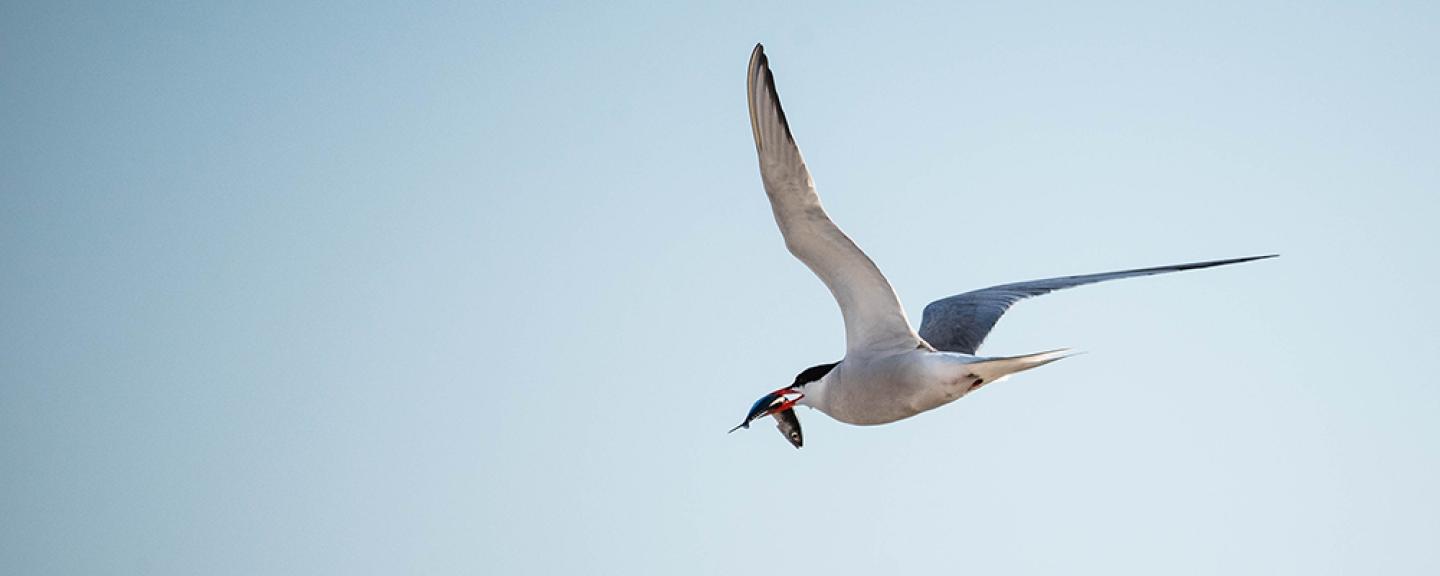
The Gulf of Maine is a literal marine hotspot, warming three times faster than ocean waters elsewhere over the past four decades. These changes affect marine life, including the distribution and abundance of fishes that other species, such as seabirds, depend on for food. UNH researchers studied how shifts in the populations of forage fish — fish species that are important sources of food — affect the ability of one seabird, the common tern, to forage efficiently in order to produce eggs and provide food for their chicks after hatching. While common terns are highly mobile and able to cover large distances, the study’s findings indicate that increased movement effort when prey is locally scarce does not improve chick diet or survival, highlighting the far-reaching effects of the changing marine environment.
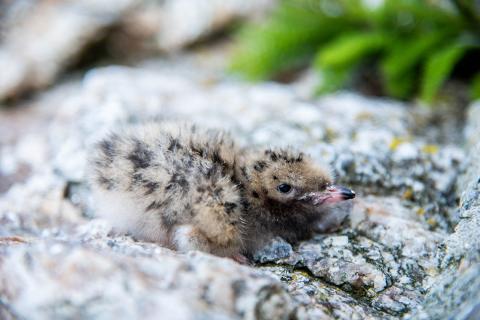
Having to fly farther to catch fish may negatively affect egg laying and tern chick survival.
In a paper published in Movement Ecology, a research team led by UNH scientists Aliya Caldwell, Elizabeth Craig, and Nathan Furey, presents data on tern movement, reproductive productivity, and chick provisioning collected across four breeding seasons. Furey, associate professor of biological sciences in the College of Life Sciences and Agriculture, Caldwell, a biological sciences doctoral candidate in Furey’s lab, and Craig, director of seabird research at the Shoals Marine Lab and affiliate faculty of the department of biological sciences, worked on White and Seavey Islands at the south end of the Isles of Shoals. The islands are home to the site of the largest common tern breeding colony in the Gulf of Maine and are managed annually by Shoals Marine Laboratory researchers in collaboration with the New Hampshire Fish and Game Department.
“Our results suggest that even though adult common terns can adjust their movements when forage fish locations shift, longer distance movements to find food may not improve chick survival rates,” says Caldwell. “The findings underscore the importance of implementing proactive management for foraging seabirds, as warming waters may increasingly lead to years of high foraging effort, poor diet, and low reproductive success.”
Terns on the move
The Gulf of Maine has historically been a rich hunting ground for common terns, boasting large populations of forage fishes such as herrings, hakes, and sand lances. These fishes are the right size and shape for terns to capture and ingest, with herrings and sand lances providing particularly high energy density. While there have always been annual variations in the exact amounts of fish available to the terns and the areas in which they congregate, the recent warming trends have led to significant shifts in abundance and location. Also, warmer water species such as Atlantic butterfish, a wide-bodied fish that most tern chicks are unable to swallow, are now moving into the Gulf.

The Isles of Shoals are located about six miles off the New Hampshire coast.
The researchers deployed solar-powered GPS tags on adult common terns to monitor their movements during the 2021–2024 breeding seasons. They also collected prey provisioning — the actual prey fed to the chicks — and reproductive productivity data including egg laying and chick survival from nests within the colony. Their observations indicated that two of the years, 2022 and 2024, had ample forage fish availability near the White and Seavey Islands colony, while local prey availability was lower in 2021 and 2023, causing foraging movement effort to increase. During 2021 and 2023, the foraging trips extended to include the waters off central and southern Massachusetts, nearly 100 miles from the colony.
Early-season access to prey is essential for egg laying, and common terns rely on energy from real-time food acquisition to produce eggs. The data showed that the years with plentiful nearby forage fish saw more eggs laid and much better chick survival than in the years that adults had to seek fish farther away.
“Looking ahead, we recently received [National Science Foundation] funding to investigate the role of individual variations in foraging behavior — that is, do some birds move or feed differently than others?” says Furey. “Perhaps some birds can be flexible and change their diets or movements within a breeding season, with an impact on chick survival. In addition to common terns, Aliya will expand her work to include roseate terns, Arctic terns, great black-backed gulls, black guillemots, and Atlantic puffins at colonies throughout the Gulf of Maine.”
The importance of the research is underscored by current projections that environmental changes will further accelerate shifts in forage fish communities. If the projections are accurate, increased foraging effort during breeding seasons may lead to increased movement effort and decreased reproductive success, threatening seabird populations in the Gulf of Maine and elsewhere.