
UNH Receives $10M for Statewide Expansion of STEM and Literacy Learning Project
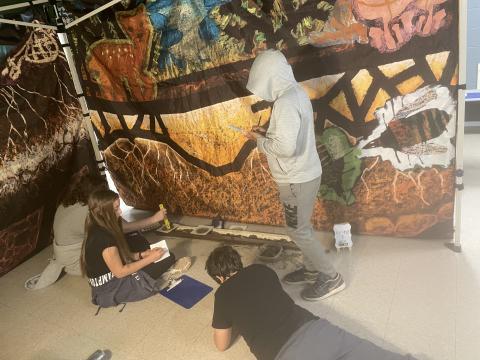
Students at Parkside Middle School in Manchester, N.H., explore soils through SLATE. Photo: UNH Leitzel Center.
What if improving middle schoolers’ literacy skills unlocked their interest in science?
That’s what a pilot initiative between UNH and Manchester and Nashua middle schools explored. Now that project, called STEM/Language Arts Teaching/learning Ecosystems (SLATE), will expand to 40 New Hampshire middle schools, primarily in rural areas, with nearly $10 million in funding from the U.S. Department of Education. SLATE, led by UNH’s Joan and James Leitzel Center for Mathematics, Science, and Engineering Education, combines tutoring by UNH students with professional learning for middle school teachers to enhance student achievement in literacy, writing, and STEM.
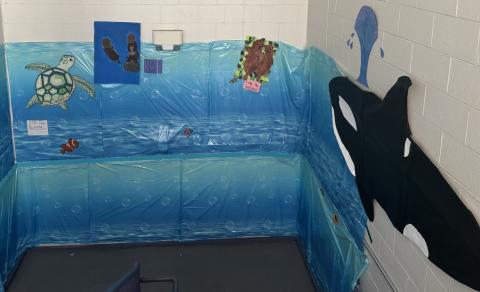
A stairway at Manchester's Hillside Middle School became an aquarium in the "Manchester Zoo," created by students working with SLATE. Photo by Christina Ortmeier-Hooper.
“We know that when students reach the middle grades without strong foundational literacy skills, content area instruction often becomes inaccessible and students fall behind,” says Leitzel Center director Julie Bryce, who is also a professor of Earth sciences. “Literacy is one way to give students greater access to STEM.” Students involved in the first phase of SLATE, which launched in 2021 with $3.5 million in Department of Education funding, showed significant gains in language arts and math assessments.
In partnership with UNH’s NH Literacy Institutes and Community Literacy Center, SLATE supports middle school teachers to work across the curriculum to engage students with a 360-degree exploration of subject matter. “We take a writing-across-the-content areas (including STEM) approach,” says Christina Ortmeier-Hooper, NH Literacy Institutes’ director and associate professor of writing studies. “Our goal is to help students develop a savviness and knowledge base to help them navigate and build success in writing and literacy across a range of academic areas.”
Creating a Zoo, Building a Monster
At Manchester’s Hillside Middle School, for example, students created the Manchester Zoo, researching the biology and environment of their animals, reading about Manchester city history, and using their math skills to calculate how much feed their creatures would need. Also at Hillside, eighth graders reading Mary Shelley’s Frankenstein in language arts designed their own monsters using stem cells and tissue regeneration.
“The students on my team this year benefited in a big way,” says Hillside eighth grade science teacher Mary Hartigan-Demers, who worked with the SLATE team and a language arts teacher to design the Frankenstein unit. “They could bring what they were learning in science into language arts class. I think it is beneficial for the students to see the adults working cooperatively and having fun, too.”
It’s not just teachers who get support; UNH “near-peer” tutors work with select middle schoolers to shore up the fundamental reading and math skills that will help them master more complex STEM subjects. “Even a small drag on a student’s automaticity with foundational skills impacts a student a lot,” says Bethany Silva, research assistant professor and director of the Community Literacy Center, which oversees the tutoring.
Tutoring benefits extend far beyond the classroom, says Silva. “People who never thought they would [teach] are considering becoming teachers,” she says of the UNH student tutors. “And many of those tutors are going to go on to become New Hampshire teachers.”
Expanding Opportunities
This next phase of SLATE will expand beyond the Manchester and Nashua middle schools from the pilot to include many rural middle schools in New Hampshire. SLATE organizers anticipate that at least 240 teachers will participate in SLATE professional learning opportunities; 720 students will receive literacy tutoring; and 10,000 New Hampshire middle school students will benefit from the curricular support SLATE provides to participating teachers.
As with the SLATE pilot, the UNH team will study the effectiveness of this program, particularly in rural schools, throughout the state. Results from the first phase of SLATE give Bryce an optimistic outlook. “When you see kids’ scores and engagement change direction in such a positive way like this, it’s pretty exciting.”
Funding for SLATE is from the Education Innovation and Research program of the U.S. Department of Education.