
Home Towns
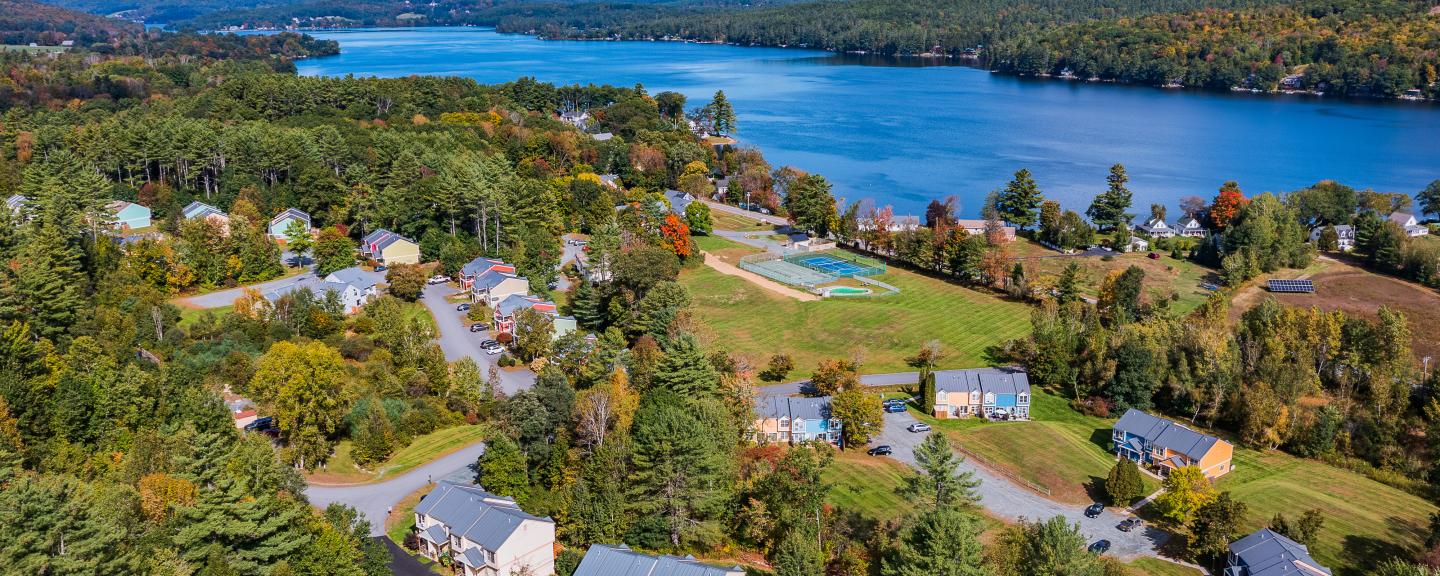
Plymouth is a growing hub for commercial activity as well as home to a state university. Enfield is quiet and wants to stay that way. Both Grafton County towns have a similar problem, though, and it’s a challenge facing just about every community in the state: affordable housing.
Enfield and Plymouth are two of dozens of New Hampshire municipalities that have sought to swim against the current of rising prices. They’ve done so through UNH Extension’s NH Housing Academy, which approaches housing affordability in a very New Hampshire way – enabling towns to craft their own remedies, which one organizer says is the reason for the program’s remarkable success.
The Housing Academy dates to 2022, when then-Governor Chris Sununu championed the goal of making housing more affordable. As part of that larger initiative, the Housing Opportunity Grant Program was developed to assist communities with assessing their own town’s needs and developing local solutions. In many cases, attention focused on local zoning regulations.
A Problem 50 Years in the Making
Most zoning regulations in New Hampshire got their start about a half-century ago, when the main concern of most towns was restricting growth. Zoning rules that required a certain size lot per household, or a certain amount of road frontage, were designed to keep residential developments below a certain density, while other rules restricted residences from being constructed in parts of town deemed better suited for commercial or industrial uses. The policies were designed to head off one problem but created another: a critical shortage of homes, particularly those that would be affordable to people making less than the median income.
As UNH Extension Field Specialist Sue Cagle puts it, the only way to correct the problem was to engage local land-use boards and the communities they serve. And that’s precisely what the Housing Academy does. “Long-term change is going to depend on communities being the solution,” she says.
Rather than prescribing specific solutions, Housing Academy, which was created in partnership with NH Housing, is set up as a laboratory of sorts. It’s a place where land use officials and board members can discover what is hindering the development of affordable housing in their own community, and how they can address the barriers.
“Sandwich is different from Nashua is different from Berlin,” Cagle says. Not only does the Academy help officials identify solutions, it also equips them with strategies for building support among their neighbors. “In New Hampshire, it’s not as simple as passing a state law. You’ve got to get it through town meeting.”
Promising Returns
In addition to learning about the technicalities of zoning and the housing market, academy participants learn about engaging with neighbors and having difficult conversations about community change.
Such work can seem tedious, but it pays off. In 2024, when the first batch of Housing Academy proposals went before local voters, more than 30 ordinances were passed, Cagle reports. “What really struck me is they didn’t just squeak past. They passed with wide margins. To us, that’s a huge indicator of community support and that the work is going to sustain.”
Expanding the possibilities of accessory dwelling units (ADUs), sometimes called in-law apartments, has proven to be popular. In Enfield, Rob Taylor is the land use and community development administrator. Taylor says that in his town, anywhere that a single ADU would have been permitted, the landowner can now build two. And they can be built pretty big, up to 1,200 square feet, which is significantly larger than the standard allowed size of 800 square feet.
Enfield is a quiet town in a beautiful part of the state. But it’s also 10 minutes from Dartmouth-Hitchcock Medical Center, one of the largest employers in the region. The cost of housing has left young families looking for a home elsewhere, which has leaders concerned.
“A big problem in Enfield is declining school enrollment. It’s unsustainable.” Taylor says it conjures fears of a shuttered school. “That’s an existential crisis.”
Currently going through the permitting process in Enfield is a development that will add 300 residential units, on a lot that would have only allowed 150 under prior zoning regulations. Taylor says that the development will be attractive to young families on a budget, or to young professionals who would rather spend their weekends on mountain bikes than lawnmowers.
Plymouth, though it has a similar year-round population to Enfield, is navigating a different development path. Home to Plymouth State University, the town is also growing into one of the largest commercial centers north of Concord. Joseph Perez, director of planning and economic development for Plymouth, says that the town was able to pass four zoning amendments recently.
Of those amendments, two created entirely new zoning district overlays, designating parts of town as suitable for specific kinds of development. The Tenney Mountain Overlay District will allow for larger-scale developments on the western side of town, while the Fairgrounds Road Overlay encourages a mix of housing densities. Some smaller changes, such as updating definitions, or enabling co-location of multiple residences on a single lot, also added up to a significant change.
Perez says that the format of the Housing Academy, which provided expertise not just in land use policy but also in community outreach, was the reason for their success.
“A lot of people In Plymouth had different views,” Perez says. “The community has to feel like they have a sense of ownership. The community feels like these are our solutions that we’ve come up with together.”
For Taylor, the power of the Housing Academy came from getting local land use officers and volunteers together to talk about a problem they all share.
“We all exist in our little silos,” Taylor says, noting that the Housing Academy put him in a room with 200 other planners, from across the state. “It was great, productive, they gave opportunities to break out and share with one another. That’s where the rubber meets the road, that convening. It’s something Extension has done a great job of, getting people together and disseminating knowledge into the rural areas.”