
UNH MBA Students Bring the Classroom to Panama
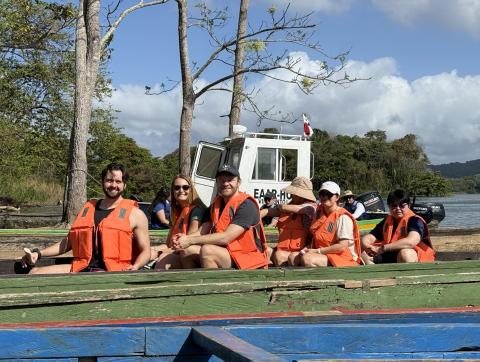
UNH MBA students recently visited Panama as part of the program’s annual International Residency, which provides students with exposure to global business environments and cultures.
With a professional background in international education, including time in Spain, Kyle Duval is no stranger to working abroad.
But it wasn’t until she went through UNH’s full-time MBA program that she gained a deeper understanding of how international settings shape business strategy and decision-making. Duval and her MBA cohort recently saw these lessons in action during the program’s international residency in Panama.
The trip is the culmination of the International Business course and has been a feature of UNH’s full-time MBA program for 20 years. Designed to provide firsthand exposure to global business environments, the weeklong residency includes company visits, cultural immersion, and academic seminars. In recent years, students have also spent the term working remotely on consulting projects for companies in the countries they visit, leading to in-person presentations during the residency.
“A lot of my international background was rooted in cross-cultural learning and education,” Duval says. “What I found most valuable was being introduced to the frameworks that shape international business — how corporations and multinationals operate across different countries, cultures and economies.”
The program’s early years focused on China, because of its rapid economic growth and global influence. In recent years, the residency has expanded to countries like Peru, Canada, Portugal, and Germany, with the past two trips taking place in Panama — a global hub for trade, logistics, and finance anchored by the Panama Canal.
“We look for countries with vibrant international business activity and a strong role in the global economy, where students can engage with different industries, global companies, and investment environments,” says Jun Li , associate professor of strategy and entrepreneurship. “Equally important is cultural experience. We want students to step outside their comfort zones, see how business is done in different parts of the world, and develop a deeper understanding of cross-cultural differences.”
While in Panama, students visited DHL, Maersk, Adidas, Banco General, the Panama Football Federation, and the Panama Canal.
“The level and speed of growth in Panama is wild to comprehend, and so much of it is tied to the canal,” Duval says. “International trade depends on it — ships are literally designed to fit through it. I hadn’t really thought about that before, but seeing it in person and watching a ship pass through made its impact on global business really hit home.”
Students also worked directly with two Panamanian client organizations — Clínica Ford Dental Spa and La Prensa, the country’s leading independent newspaper.
Duval says her team built a customized marketing toolkit for La Prensa based on frameworks from their coursework, recommending a structured approach to help the company better understand its audience, strengthen brand loyalty, and reduce subscription cancellations.
“Like other news outlets around the world — they’re trying to figure out how to maintain subscribers when attention spans are shorter, and people are getting their news from their phones, whether that’s Instagram, TikTok, or other platforms,” Duval says. “We didn’t just offer recommendations, we gave them tools and templates they can continue to use and adapt and build on with their own expertise.”
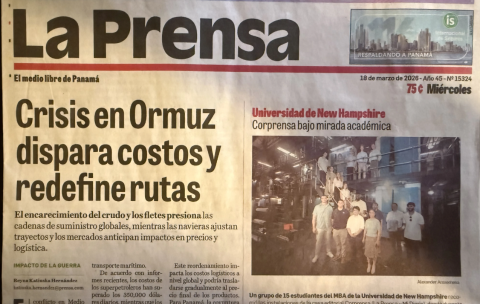
UNH students were recognized with a photo on the front page of La Prensa, Panama's leading independent newspaper.
La Prensa recognized the students on the front page of the March 18 newspaper.
MBA student Emma Guagnini and her team worked with Clínica Ford Dental Spa to develop a marketing strategy focused on expanding into Caribbean markets, including social media outreach. The students recommended using Instagram Stories to boost engagement through interactive polls that asked followers about their smile and what kinds of content they’d like to see.
“Within a couple of days of getting home, we saw on their Instagram that they were already using our suggestions,” Guagnini says. “It’s a once-in-a-lifetime opportunity to travel to a country many of us have never been to, immerse ourselves in the culture, work directly with clients, and take what we’ve learned in class and turn it into meaningful deliverables.”
Students also visited the Emberá indigenous community, known for its traditional practices, craftsmanship, and close ties to the rainforest. Duval says the visit to the Emberá community offered a different perspective on Panama’s economy.
“Seeing that juxtaposition was really interesting,” Duval says. “On the business side, we were mostly interacting with the upper levels, but there’s also a large portion of the population that doesn’t have access to those same benefits. It made me think about how a country manages all of that — when you have a strong economy, but not everyone is benefiting from it.”
Li says the international exposure students gain from the trip is invaluable and can give them a leg up as they seek their next professional opportunities.
“I think this residency provides students with a valuable, real-world window into business before they graduate,” Li says. “They’re also able to build connections with managers at these companies, and in some cases, those relationships have led to internships.”
Duval believes the entire MBA experience will benefit her as she re-enters the workforce.
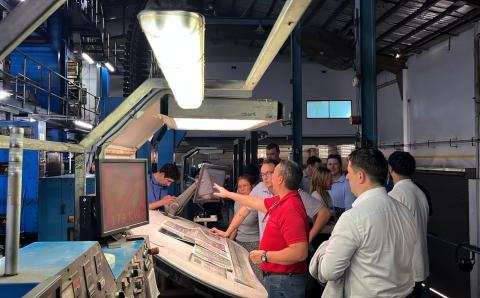
“It’s been really valuable to get that broader exposure through the MBA —across accounting, economics, information systems, international business, and marketing” she says. “I feel like I’ve become a more well-rounded person and will be a more well-rounded employee when I return to the workforce.”
Guagnini says she hopes to pursue a career in brand management after completing her MBA, with an interest in working for a large consumer goods company. The Panama residency, she says, reshaped how she thinks about global business.
“Before taking this class and going on the trip, I thought companies just did business globally and made it work,” she says. “But there’s so much more that goes into it — especially understanding culture and how companies adapt to different markets. It also made me more interested in the supply side, particularly seeing a major global hub like the Panama Canal.”