
From Surviving to Thriving: How UNH-Led START Program Changed One Family's Life
For years, Shelley Bucy-Culver balanced a small business, a household, and the needs of her two children with autism in Tennessee. Her older son, John Paul - affectionately known as JP or Bubby - had experienced several challenges throughout his teenage years. As he grew older, those challenges became increasingly difficult for his family to support.
Then COVID-19 changed everything.
During the pandemic, Bubby could stay home, avoid difficult transitions, and live within a predictable environment. In many ways, Shelley says, it was his dream. But when restrictions lifted and everyday life resumed, the transition was overwhelming.
"It ended up in chaos," Shelley recalls. "We weren't living. We were just surviving every day."
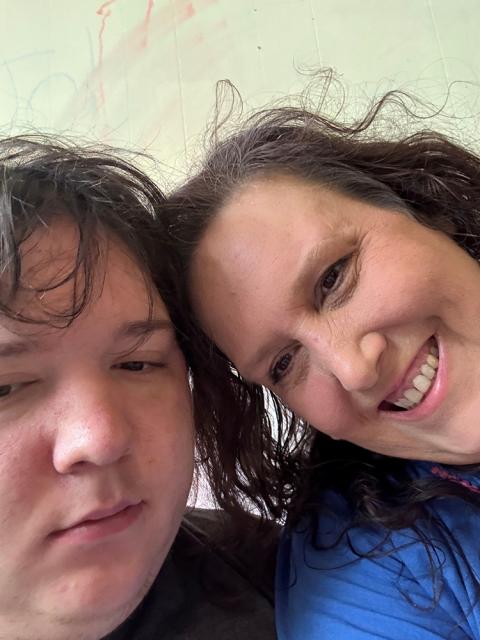
Bubby and Shelley. (Courtesy photo)
Bubby's crises included property damage, self-injury, and aggression toward family members and neighbors. Shelley had to call the police 44 times during a 16-month period. Because Bubby is a large adult who is nonspeaking, Shelley often feared that calling the police could make a dangerous situation worse.
Although the family had worked with a counseling center for years, Shelley felt they were not receiving the crisis support they needed. She began searching urgently for another option and discovered the Tennessee START Program (TN START). The program is based on the START Model, maintained by the National Center for START Services (NCSS) at the University of New Hampshire Institute on Disability (IOD).
START (Systemic, Therapeutic, Assessment, Resources, and Treatment) is a crisis prevention and intervention service model for individuals aged 6 and older with intellectual and developmental disabilities and mental health needs.
When the family enrolled in TN START in May 2024, Shelley was exhausted, isolated, and unsure whether anything could truly help. Still, she decided to commit fully to the process. And the results have been nothing short of life changing.
“They have really been just instrumental in us returning to living life” Shelley says. “I'm very grateful for them.”
Seeing Progress in the Answers
At first, the assessments and repeated questions felt like one more burden. Over time, however, Shelley noticed something important: the questions remained the same, but her answers began to change. They showed improvements not only in Bubby's behavior and independence, but also in Shelley's confidence and skills.
Previously, Shelley had struggled to speak with Bubby's doctors while also trying to keep him calm. START team members attended appointments with her, bringing activities such as Legos, crayons, and bubbles to help Bubby stay engaged. For the first time, Shelley could have focused conversations with his doctors, and they could work together to make more informed decisions about his care, with data to back it up.
"The pieces started to fall into place from there," Shelley says.
The START Model focuses on the whole person and their system of support, says NCSS Executive Director Julie Lago. “The TN START Team really got to know Bubby, not just his needs, but also his strengths, and they were able to support Shelley and be present for the family in different ways. They were able to connect the dots with the supports in Bubby’s life, his doctors, even the police department.”
A Team That Shows Up
For Shelley, one of the greatest differences was knowing she was no longer facing each crisis alone.
"This can be very isolating," Shelley says. "They made me feel like I had a safe place to speak for him and for me."
TN START and other START programs around the country provide 24-7 crisis response and stabilization services, in conjunction with healthcare providers and first responders. The team also helped the family put plans in place to prevent crises, not just intervene.
“They [Bubby and Shelley] were my first case with TN START,” said START Coordinator Kaisey Taylor. “So, it’s been great to see things come full circle.”
TN START Clinical Team Lead Marlene Burcham has also responded to calls from Shelley, even going into the backyard when Bubby needed help there.
"People want to be able to make their own choices. I didn't know how to give my nonverbal son a choice, and now I do."
Supporting Bubby's Choices
Because Bubby is nonspeaking, Shelley had made decisions for him throughout his childhood. She believed she knew what he liked and wanted. She realized that making those decisions herself had often been easier than finding a way to ask him.
For example, Shelley had often taken Bubby to McDonald’s, thinking that was his favorite. But when the TN START team helped her create picture boards featuring restaurant logos, Bubby revealed that he actually preferred Wendy's.
It was a small discovery with a much larger meaning: Bubby had preferences he wanted to communicate; he just needed a way to express them. Despite having phones, tablets, and experience with multiple therapies, it was the picture board that worked best.
"Sometimes easier is better," Shelley says.
Independence and Dignity of Risk
As Bubby gained more opportunities to make choices, Shelley also began recognizing how much he could do independently.
He learned to clip his own fingernails, use an electric razor, cut his hair, and bathe himself. Shelley admits that she once would have insisted he could not perform those tasks. In some cases, however, the barrier was not his ability. It was that he had never been given the opportunity.
The experience changed how she understood her son. At 23, Bubby does not necessarily want his mother choosing his clothes, deciding where he will eat, or managing his daily schedule. Like any other adult, he wants a say in his own life.
"People want to be able to make their own choices," Shelley says. "I didn't know how to give my nonverbal son a choice, and now I do."
After the family began working with TN START, police were called only twice over the following 18 months. One of those incidents was later connected to severe pain from kidney stones rather than a behavioral crisis.
The TN START team was also able to provide training to the local police department so they could be prepared if Bubby had another crisis.
The family also regained experiences that had once felt impossible. They could visit parks, eat at restaurants, and buy groceries together.
'Be Ready to Do the Work'
Shelley understands why overwhelmed parents may initially resist another program, another assessment, or another list of things to do. Her advice to other families is to remain open.
"Don't expect somebody to come in and wave a magic wand," she says. "Be ready to do the work. You have to come into this willing to listen."

The TN START team.
Since the START Model was developed in the 1990s, there are now START Programs in around a dozen states across the country. The National Center for START Services provides both in-person and virtual support to programs at all stages of development.
The START Model is ultimately about helping people experience greater mental health stability, better quality of care, and fewer crises that require emergency services, according to NCSS Project Manager Felicia Bates, who supports the TN START team from the National Center for START Services.
“Bubby’s story shows what that can look like in real life,” Bates said. “It didn’t happen overnight or by chance, and it didn’t happen without the hard work and dedication of Bubby, his family, his providers, and the START team. Things won’t be perfect every day, but today Bubby has more opportunities for choice, meaning, positive experiences, and connection, and a strong relationship with a deeply committed mom who continues to be an important part of his journey.”
For Shelley and Bubby, the TN START program has transformed nearly every part of daily life. It has replaced isolation with support, fear with confidence, and constant reaction with thoughtful planning.
Shelley encourages parents not to assume their children cannot learn, participate, communicate, or become more independent.
"I was that mom," Shelley says. "I thought, ‘It's never going to work. He can't do it. He won't do it.’ Well, guess what? They can, and they will, and they want to. It's not going to be the easiest thing that you ever did, but I promise it'll be the best thing you ever did."
"I thought, ‘It's never going to work. He can't do it. He won't do it.’ Well, guess what? They can, and they will, and they want to. It's not going to be the easiest thing that you ever did, but I promise it'll be the best thing you ever did."