
Food Amongst the Trees: Growing UNH’s Agroforestry Program

New England is known for its mountains and forests, and the region’s farmers and landowners must adapt to the challenges of its rugged terrain and cool climate. At UNH, however, the Adaptive Agroforestry Principles and Teaching (ADAPT) program is developing research and education that will turn these challenges into innovation opportunities, supporting the economic and environmental vitality of the region’s agricultural community.
“Agroforestry can increase crop diversity and sustainability, providing farmers and growers with more resilience in changing conditions,” says New Hampshire Agricultural Experiment Station (NHAES) scientist Heidi Asbjornsen and ADAPT’s lead. “But agroforestry systems are complex to manage, and education and Cooperative Extension are critical parts of ADAPT so that we can share research-based insights with the community.”
Agroforestry, the intentional integration of trees with crops and/or livestock, provides economic as well as environmental benefits by embracing, rather than seeking to overcome, the heavily forested landscapes common to the Northeast. To study the complexities of these systems, ADAPT assembled a multi-institutional project funded by USDA’s Sustainable Agricultural Systems program. The project involves dozens of researchers, Extension specialists, and educators across UNH, Yale, and Dartmouth, as well as farmers at 12 operating regional farms that are establishing agroforestry systems.
The Northeast is a particularly ideal region for the work. For example, New Hampshire is second to only Maine in its forest coverage in the U.S., with more than 80% of its land forested. With the Granite State’s mountainous terrain and small footprint, agricultural production is difficult to scale up, and currently only about 3% of the food consumed in the state is grown locally. Higher levels of local production has been shown to improve food quality, food security, and meet more of the growing demand for local foods. Agroforestry can help to achieve these goals in the Northeast.
Asbjornsen, professor in the department of natural resources and the environment in the UNH College of Life Sciences and Agriculture, first laid the groundwork for agroforestry research with NHAES support at the Organic Dairy Research Farm (ODRF) and the Kingman Research Farm, both at UNH. The ADAPT program is now working with three primary types of agroforestry systems: Forest farming, which involves planting different shade-tolerant crops under an existing tree canopy; silvopasture, which allows livestock to pasture and graze amongst trees; and food forests, where plants of varying heights — for example nut trees, berry bushes, and herbs — grow within the same space. These agroforestry systems also provide welcoming habitats for beneficial insects, pollinators, and wildlife, with readily accessed food and shelter.
Living Laboratory for Forest Farming
Some of agroforestry’s challenges are obvious. It’s much easier to manage clear-cut land with mechanical help, such as tractors. Trees or other woody plants require more time to grow and become productive than annual crops. But since ADAPT’s launch in 2024, researchers have been working with growers to reduce those challenges by developing and growing their experimental forest farming and food forests sites at the Kingman Research Farm.
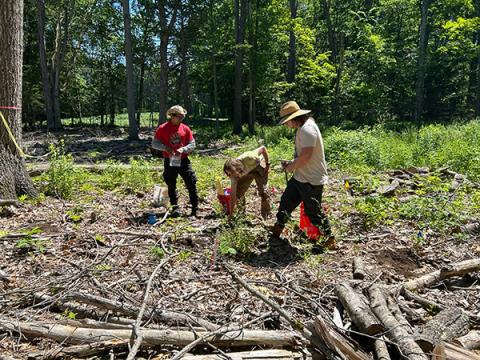
Establishing a forest farm at Kingman Research Farm.
One of the farm’s adjacent woods has been thinned for planned forest farming plantings. While sunshine pours through the gaps in the canopy, tall trees still tower over the area, with colored flags marking the locations where the understory crops have been planted. Edwin Hernandez Garcia, doctoral student in natural resources and environmental studies, is developing the experimental forest farming research to explore how agroforestry systems can generate income with minimal impact on the ecosystem. Promising forest farming species planted at the site include pawpaw, hazelnut, elderberry, as well as medicinal and culinary herbs.
Out in the fields, the food forest plots at the Kingman Research Farm are organized into a grid system, with each grid meticulously planted and monitored. When fully grown, the plots will have four layers: canopy, sub-canopy, shrub, and ground cover. Laurie Mooney, a doctoral student with Asbjornsen’s lab, is studying how integrating nitrogen fixing plants into food forests affects the growth and yield of the tree- and shrub-based crops.
While the research farm provides a spacious environment for experimentation, the findings can be applied in a variety of settings. Even in urban environments, far from rural forests and fields, small spaces can be turned into food forest oases, expanding the definition of “agricultural land”.
“Often we think that agriculture requires large properties, but people are establishing food forests in a variety of settings, including more urban and suburban areas, such as in vacant lots and backyards,” says Asbjornsen. “You can grow berries, fruit trees, herbs, pollinator attractors, and more on a small plot and convert unused or inactive land into a productive and attractive space.”
ADAPT is supported by funding from the McIntire-Stennis program (Accession #7005871) from the US Department of Agriculture's National Institute of Food and Agriculture and the state of New Hampshire and the USDA’s Sustainable Agriculture Systems program (Accession #1031713).