
Eyes on the (Cow's) Inside
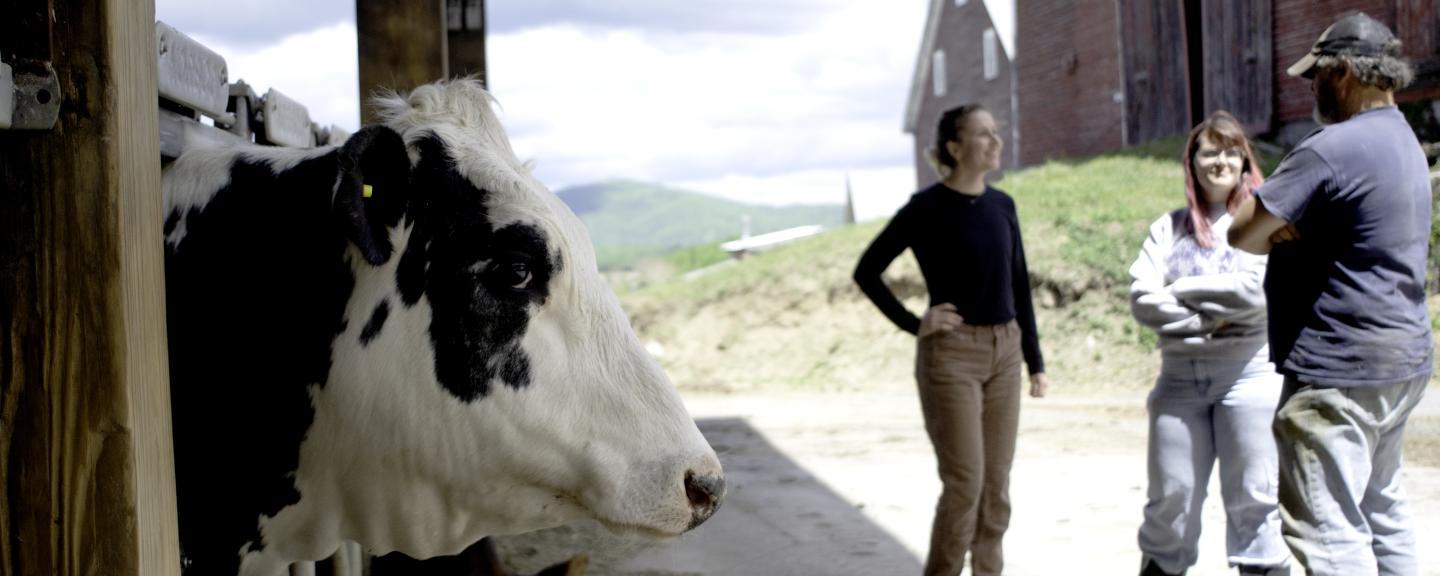
Dairy farmers in New Hampshire need help. The NH Food Alliance reports only 75 licensed dairy farms remain in the state, down 50% since 2012. Some help is on the way.
UNH researchers Claira Seely and Sarah Allen are partnering with the Grafton County Farm to see if new technology, similar to activity trackers used by humans, could help dairy operations gain efficiency and productivity.
Their research focuses on a device called a bolus, a capsule about four inches long that is swallowed by the cow and resides in her stomach. For the rest of the cow’s life, the bolus measures the animal’s body temperature, eating, drinking, and activity levels. That data is transmitted in real time via cell towers and relayed to a dashboard that the farmer can navigate via a computer or smart phone.
The system doesn’t just report trends around those four parameters — activity, eating, drinking, and body temperature — it also uses artificial intelligence to tell the farmer what might be causing any aberrations. Seely and Allen are investigating how useful this information and analysis could be for the small farms that define New Hampshire’s dairy industry.
Allen, an Extension state specialist in dairy production, and Seely, an assistant professor in the department of agriculture, nutrition, and food systems, have been using the same technology with the dairy cows on UNH’s Durham campus, where students participate in the research by drawing and testing blood samples to see if they can improve the system’s algorithms. One unique aspect of the smaXtec system is its ability to incorporate farmer feedback into its analyses.
“As quality labor gets more expensive, we need an inexpensive and reliable form of labor,” Seely says. “Cow monitoring systems like smaXtec don’t take vacation days and don’t need time off.”
Allen says the information provided by the boluses could help farmers optimize the management of high-risk cows and improve reproductive efficiency.
It’s one thing to achieve such results on campus. To see if those results hold in the real world, they’re partnering with Grafton County Farm.
Grafton County is the last of the state’s counties to operate a dairy herd. The farm has 111 cows, about half of which are currently being milked. Inmates at the county jail can work there, while the 5,000 pounds of milk produced each day covers costs. Ben White is the farm’s herdsman, an apt title for someone who’s been around cows since he was short enough to walk underneath one.
White can’t constantly observe all 111 cows. The boluses can, though, and in the first six months since they’ve been collecting data, White has been impressed.
“It’s an extra pair of eyes,” White says. In one instance, the system alerted him to an infection in one of his cows before she had any observable symptoms.
Early detection is one of the promises of this new technology. The earlier a farmer can intervene the better — less impact on the affected animal, reduced disruption to milk production, and less expended on labor and medicine to treat the illness.
“Most people want the smaller farms to succeed, from what I can see, and it’s really hard for a small farm to compete,” Allen says. “These monitoring systems are another way to help farms be more efficient and hopefully save businesses, which is good for all of our communities, to keep small farms in business.”
By keeping dairy farms viable, such adaptations will help preserve traditional New England landscapes, support other agricultural businesses, and bolster the local food web. Nicole Cardwell, director of the NH Food Alliance, says Seely and Allen’s work exemplifies the advances that could save this industry.
“The future of dairy farming in New Hampshire depends not only on hard work and dedication but also innovation,” Cardwell says. “As the number of dairy farms continues to decline, research that helps farmers make informed decisions, improve animal welfare, and strengthen farm profitability becomes increasingly valuable.”