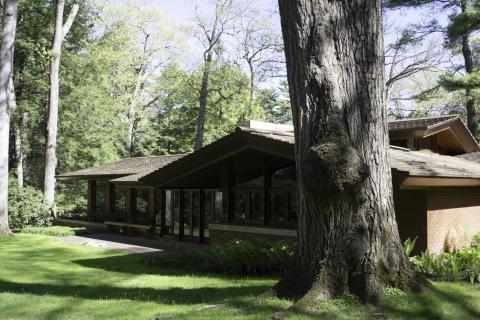
The Architect’s Garden

On a bright morning in May, Master Gardener Jan Litvin takes a brush to a concrete bird bath that had taken on a verdant hue.
“I do like moss, but in its place,” says Litvin as her bristles scrape away the enterprising plant, which was seeking to overgrow the avian amenity in a backyard perennial garden at the Zimmerman House, one of two Frank Lloyd Wright-designed homes owned by the Currier Museum.
Litvin is among 37 volunteers, who have all been through Extension's Master Gardener or Natural Resource Steward programs. They represented this year’s gardening strike force, a kind of green-thumbed cavalry that appears at the start of the growing season to ensure that the grounds are in precise harmony with the home they surround.

Jan Litvin, Master Gardener, cleans out a birdbath in the perennial garden on the grounds of the Zimmerman House, one of the Frank Lloyd Wright-designed homes owned by the Currier Museum in Manchester. Each year, dozens of expert gardeners, all trained by UNH Extension, help bring the gardens on the property back to a standard of which they think the famed architect would approve.
Among the most accomplished of American architects, Frank Lloyd Wright was famously exacting in his design approach, including dimensions and placement of furniture within the homes he created.
That level of specificity extended beyond the building itself to the landscaping surrounding it. Such was the case for the Zimmerman House, built in Manchester in 1949, and bequested to the Currier Museum in 1988. By that point, there had been years of deferred maintenance to both the home and landscape, and the first several years of the museum’s ownership were focused on the structure. In 1999, UNH Cooperative Extension was invited to restore the gardens, beginning a long-running partnership that continues to this day.
The UNH volunteers get so much heavy lifting done that the gardens can be kept up the rest of the year by a single volunteer, Jane Beaulieu, who has been tending to the Zimmerman House’s flower beds for 20 years.
Beaulieu says that her work is directed by a garden plan taken from Wright’s original designs, which made no clear distinction between the structure of the home and the landscape surrounding it.
“I have the original plan and we follow it, because this is a museum property and we consider the landscape part of the museum,” Beaulieau says. She has an unusual connection to the property because her mother was treated by Dr. Isadore Zimmerman, who resided there along with his wife Lucille, when Beaulieu was young.
Since taking over the gardens, Beaulieau has developed a deeper connection to the property, gained from countless quiet mornings, making sure the gardens are museum-perfect before that day’s tours arrive. She has developed an appreciation for the nuances of the space and its planting, such as in the use of rhododendrons. Along the edge of the property, the perennial flowering bushes are allowed to grow to their full height. In the garden, though, the rhododendron bushes are pruned to about chest-height, which evokes the long, low roofline of the home when viewed from outside and affords an unobstructed view of the backyard from inside.
Rhododendron height is just one of the details that Beaulieau aims to get just right. Staying true to Wright’s vision throughout the year is made easier thanks to the cadre of volunteers — all elite gardeners — who contribute a day of labor to the cause.
“They work so hard, they don’t stop,” Beaulieau says of the volunteers, estimating that their labor is worth “thousands of dollars” if it were even possible to hire such a crew. “I maintain it after they leave, and it’s so much easier for me because all the hard work is done.”
Litvin, one of those volunteers, has been attending the Zimmerman House clean-ups for 20 years, off and on. On this particular clean-up, she’s spending her day edging and weeding a perennial garden and transplanting some ferns, once she scrubs the moss from the bird bath.
Litvin keeps coming back because she sees the property as a public amenity, a house in a neighborhood that stands as a reminder that things can be done differently, that modest homes can still be created with great attention to detail.
The famed architect would likely have held Litvin’s ilk in high esteem, according to Justin Kedl, who manages the Zimmerman House for the Currier Museum.
“Wright’s philosophy was called organic architecture,” Kedl says. “He believed in this close relationship between the house and the landscape itself. He said, ‘Every house is an indoor garden, and every garden is an outdoor house.’”
When designing a home, Wright considered the contours of the land, the kinds of wood and stone that would naturally exist there, and the way that sun and shade developed throughout the day.
“This day is really, really important to us, to get the landscape back to where it was supposed to be, and then keep it that way going forward,” Kedl says.
Now nearly 80 years old, the Zimmerman House continues to speak to visitors today, Kedl says, as an example of “a very intentional way of designing, and an intentional way of living. Most houses don’t look like this today. Visitors see all these small choices that can add up to a more beautiful and intentional life.”
As she banishes the last of the moss from the birdbath, Litvin concurs.
“It’s like an art treasure that’s hidden away,” says Litvin, “It’s a different way of looking at things, even how to place a home on a lot or what to focus on within a home to make it a sanctuary or a work of art, really.”