
Scientists Find Electrons 'Smiling' in Earth’s Magnetic Shield
Scientists have discovered a surprise inside the magnetic explosions that take place in Earth’s protective magnetic field. Along the field’s curved boundary where the sun’s supersonic solar wind plasma slams into Earth’s magnetic shield, a new map of the velocities of energetic electrons clearly show the shape of a smile.
It’s more than just a playful finding; this first-of-its-kind discovery opens a new window into how the small-scale origin of energetic explosions, called magnetic reconnection events, drives space weather — the forces that can disrupt satellites, communications systems, and even power grids back on Earth.
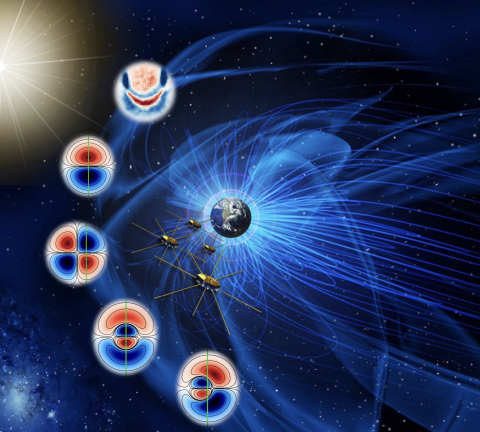
The study, published in Nature: Communications Physics, was led by Jason Shuster ’12, ’16G, a UNH research assistant professor of physics. Shuster examined what’s called the electron diffusion region, an area of the Earth’s magnetosphere where the energetic explosions occur. Shuster and his colleagues compare this region to a ‘black box’ because it hasn’t been extensively probed before so scientists didn’t really know what was happening there in a detailed way.
By way of analogy, Shuster compared the space processes in that region to a car engine: “If you don’t know how a combustion engine works and you only see the car driving by, then you wouldn’t have any idea where the engine was located or what’s powering the pistons,” he says. “We want to know what those electrons in the magnetosphere are doing to build back a picture of what’s happening within magnetic reconnection sites and the explosive energy transfers that occur there.”
Shuster has spent the past 16 years studying magnetic reconnection — a plasma phenomenon where the magnetic field lines that run in opposite directions suddenly reconfigure, creating explosive releases of energy and heat in the process. Understanding magnetic reconnection is crucial for predicting space weather events that can impact our technological infrastructure.
A few years ago, while working alongside the team from NASA’s Magnetospheric Multi-Scale (MMS) mission at the Goddard Space Flight Center, Shuster was using a state-of-the-art computer model to predict electron distribution structures within that diffusion region, and the simulations predicted a smile. Shuster was surprised but he needed to verify the results in real space data, so he pulled data from the MMS mission, which launched in 2015 and is still enabling scientific breakthroughs to this day. Shuster developed a new methodology for visualizing the electron velocity data and applied it to the first MMS observations of the electron diffusion region at Earth. It turned out that the smile-shaped electrons were indeed legitimate, and very relevant to the reconnection process.
The negatively charged, lightweight electrons stream along the magnetic field lines all the time, but they move much more quickly than other plasma species (such as heavier, positively charged ions); electrons get to the scene rapidly when the field lines move, bend, or reconfigure, so they act as a near-instant diagnostic to tell scientists what’s happening, Shuster explains.
“Researchers today consider magnetic reconnection to be a fundamental process that accelerates and energizes plasmas throughout the universe,” he says. “Our work is a case study of a relatively small region of Earth’s magnetic field, but the smile-shaped electron structure that we found offers insights that can be applied to other plasma environments wherever reconnection occurs, such as in the solar wind, near black holes, within the magnetospheres of other planets in our solar system, and even in magnetic confinement fusion devices that seek to magnetically confine, and ultimately harness, the extremely hot and energetic plasmas.”
And, as Shuster quips playfully, his discovery taught us that “electrons can smile, even though they’re negative.”
You can watch Shuster explain the discovery in detail in a video from a UNH Space Science Seminar in March of 2024.
This research was funded by NASA.