
Child Welfare Education Partnership Celebrates First Cohort of Program Graduates
The first cohort of the Family Empowerment & Lived Experience Integration Academy (FELEIA) – a new program designed to elevate family voice and strengthen collaboration in the child welfare system – recently held its inaugural graduation ceremony, recognizing a group of 12 participants who completed the leadership development course.
The program, which is a partnership between the New Hampshire Department of Health and Human Services, Division for Children, Youth and Families (DCYF) and the University of New Hampshire’s Child Welfare Education Partnership (CWEP), celebrated the inaugural group of participants made up of family leaders, caregivers, parents, youth, and more who completed the 10-week, 50-hour course.
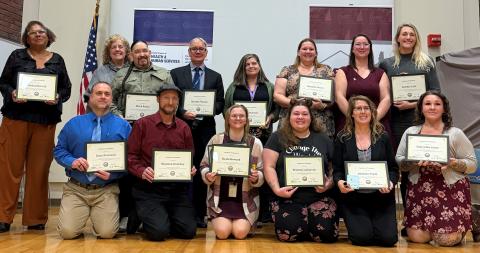
The program is designed to be a trauma-informed co-learning experiential space that brings those with lived experience in the child welfare system together to build leadership skills that can be used to make a difference in New Hampshire communities.
“It was so amazing to see something that was a vision and a concept come to fruition. It was really just so fulfilling,” says Ciaira Kyden, FELEIA program coordinator from CWEP in UNH’s College of Professional Studies. “It’s about taking the opportunity to learn about leadership skills and qualities, policy changes, and networking so the participants can ultimately go out and inform policy, practice, and trainings that fuel continuous improvements across the New Hampshire child welfare system.”
Adds Alicia St. Louis, event and program coordinator at CWEP: “I told Ciaira, I’ve worked on many events, and this graduation just had a different feel – it was such a community feeling to me, and the impact it’s going to make on families and on the staff as they bring that lived experience and family voice into their work, it’s deeply uplifting.”
Kyden is not only a facilitator in the program but also a person with lived experience, and making sure as many of those voices as possible were represented in the creation and implementation of the program was a major focus. Kyden and Wendy Bibeau, curriculum and instructional design specialist, played key roles in spearheading that effort, and there were five participants with lived experience specific to New Hampshire that served as subject matter experts to help inform the building of the curriculum. It took about a year and a half to complete that curriculum ahead of the program kickoff.
The academy featured a variety of delivery methods, including traditional classroom-style learnings as well as experiential opportunities focused on both knowledge building and self-care. That included yoga, dance-offs, and other activities to keep the participants engaged mentally and physically.
“We implemented things around wellness and well-being throughout. We talk a lot about taking care of ourselves, because if we’re not taking care of ourselves, we can’t take care of others,” Kyden says. “It was about getting people up and moving and not just sitting and listening to a bunch of things thrown at you.”
The next cohort of the program is ready to begin in late March, and the hope is to continue offering the course going forward. The size of the group will remain relatively small, though – Kyden says she’d want to cap it at around 16 – in order to best facilitate meaningful discussion and offer the ideal type of experiential opportunities.
The hope is as the cohorts continue to graduate and bring the learnings from the academy into their daily lives they can continue to make a positive impact on the child welfare system in New Hampshire.
“We’re trying to build capacity to have more of a pipeline,” Kyden says. “A lot of people like myself make career shifts to become more involved in this work. A lot of people come to the state to work in child welfare for a reason, and this is giving more of a platform to that. It’s about bringing more of that humanity piece back into human services.”