
Marty Castriotta
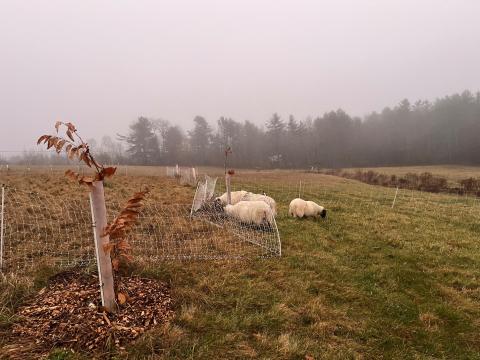
A silvopasture project demonstrated by Marty Castriotta.
Credit: Marty Castriotta
When Marty Castriotta describes this year’s Radically Rural event, his first word is “phenomenal.” Invited to facilitate the “Land and Community” track, Castriotta, a farmer, educator, and designer, spent a full day guiding participants through a hands-on exploration of what it means to reconnect with the land.
“The Hannah Grimes crew are some of the most incredible organizers I know,” he said, referring to the Keene-based Center for Entrepreneurship that coordinates Radically Rural. “They understand that our disconnection from the land sits at the root of so much.” Center Director Julianna Dodson, who has been exploring perennial solutions in agriculture, worked with Castriotta to design a program focused on regional food sovereignty and the role of agroforestry in that effort.
A Walking Story of Land and People
The day began with a walking tour through downtown Keene, New Hampshire, looking at how land use patterns have shifted over time. At each stop, Castriotta encouraged participants to think about the overlap between social and ecological systems, where community and land come together to form solutions.
The first visit was to Hundred Nights Shelter, where Castriotta has helped design and install a forest garden. “It was the perfect starting place,” he said. “People asked, ‘Why put so much energy into making this beautiful?’ The answer is that beauty is nourishment.” The group discussed the connections between food security and housing security, including the importance of spaces where residents can prepare and share food. Staff and volunteers from Hundred Nights spoke with participants before the group toured the site. “We are building perennial solutions for those in most need,” Castriotta said.
The next stop was the Monadnock Food Co-op, where participants met with Michael Faber to discuss the Co-op’s role as a regional food hub and its plans to strengthen ties with local farmers. The Co-op team shared ideas for turning a large unused area near the parking lot into a demonstration food forest with fruit and nut trees, understory plantings, signage, and seating for visitors. The vision is for the site to serve as an educational space that brings together community members and local producers.

Perennial crops enhance a social gathering space and provide ecological benefits.
Credit: Marty Castriotta
The group then visited Brewbakers Café, where participants tasted chestnut muffins made by the farmers at Big River Chestnuts and heard stories about the chestnut’s potential as a regional food crop. Castriotta noted how the café illustrates the social dimension of agroecology. “Brewbakers brings together people from different parts of the world through coffee, herbs, and food,” he said. “They are using an urban café space for ecological restoration and community connection.” Owner Jeff Murphy spoke about following core values and how some choices that might not seem profitable at first have proven sustainable in the long run. “Green choices bring more people and more revenue,” he said.
From Trees to Table: Lessons from Yellow Bud Farm
After lunch, participants boarded a bus for Yellow Bud Farm in Northfield, Massachusetts. For Castriotta, this visit was a highlight. “They are phenomenal storytellers,” he said. “They show what perennial agriculture can look like at scale.”
The farm’s name comes from the yellow bud hickory, one of six key species grown on the site along with chestnut, persimmon, mulberry, bur oak, and honey locust. Trees are planted in alley-cropping systems with nursery beds of young tree stock between them. The team is selecting seed from the most productive trees in the Northeast and now maintains about 100,000 young trees. Their work focuses on developing tree crops for both human and animal consumption, emphasizing nut crops as potential sources of carbohydrates, protein, and oils for the region.
Visitors were treated to snacks made entirely from farm ingredients: nut and seed shortbread with whipped pawpaw cream, persimmon spread, and aronia-mulberry jam. “It was the alchemy of the land we were standing on,” Marty said.
Gathering Focus
The final stop of the day brought everyone to Orchard Hill Community in Alstead, NH, where participants from another Radically Rural track joined for a shared meal. Baker Noah Elbers prepared soup in a large cauldron over an open fire, served with Orchard Hill’s own organic sourdough bread. The gathering featured music and presentations from local food system leaders, including Melissa Hoffman of Sho Farm and Erik Schellenberg from Black Creek Farm and Nursery.
Chief Paul Bunnell (Gwilawato) of the Koasek band spoke about reestablishing perennial plants that can feed local communities. The event also featured new voices such as Emily Turner, a local farmer beginning a silvopasture system, and Marty’s niece Abbie Castriotta, a teacher at Woodstock (Vermont) High School and participant in the Climate Resilient Agriculture, Forestry, and Trade (CRAFT) program. Lionel Chute, district manager for the Sullivan County Conservation District, discussed recent grant funding that has supported food processing equipment, including nut-processing tools that will serve farms like Yellow Bud.
The evening’s panel discussion centered on how agroforestry fits into the equation of food sovereignty and resilience. Panelists spoke about the importance of involving food industry professionals in introducing regionally appropriate crops to local markets, helping people become familiar with foods that can be grown nearby. The conversation was serious and lively. “We really went there,” Marty said. “People saw that this is not just about growing tomatoes. It’s about a dramatic change in how we grow food and what that means for our communities.”
Participants noted that perennial systems integrate ecological, cultural, and social well-being. As one attendee reflected, “You can’t have food sovereignty unless everyone is fed.” Marty agreed. “Perennial systems allow for peaceful culture,” he said.
Looking Ahead
The response to the event was overwhelmingly positive. “Community participation was phenomenal,” Marty said. “Each stop showed how transformation happens. The landscape changes, people change, and neighbors begin to appreciate it as a beautiful place.”
Marty and his collaborators plan to build on this momentum. Similar programs may be offered in the future, combining field-based learning with community conversations about food resilience. Through his design business, Earth Craft, and his educational work with Keene State College, where he teaches agroecology and permaculture design, Marty continues to explore ways to connect built environments and living systems.
After 18 years operating a vegetable and pastured meat CSA through Village Roots Farm, Castriotta has shifted focus to perennial installations in visible, community-oriented spaces. He is also developing a “forest garden CSA,” where members receive trees, shrubs, and companion plants rather than weekly produce boxes. His team has expanded into building food infrastructure such as garden beds, arbors, barns, sheds, and greenhouses. “We are trying to show the whole picture,” he said, “how natural and built components can support each other.”
What comes next? “We are in transition,” Marty says. “But the goal is the same: to keep painting the picture of what change looks like and to help people see what is possible. The work is about connection—between people, systems, and generations. If we can keep that alive, the land will keep feeding us.”