
Research That Never Stops Growing

“I love growing everything.”
New Hampshire Agricultural Research Station researcher Rebecca (Becky) Sideman says this in her office on a sunny day in June. It is a rare indoor respite during the summer growing season—most of the time, Sideman can be found outside at the University of New Hampshire’s research farms or in her home garden. As professor of horticulture and chair of the department of agriculture, nutrition, and food systems at the UNH College of Life Sciences and Agriculture, Sideman’s work is firmly rooted in the soil, exploring ways to innovate in horticulture and provide vital information for local farmers and growers.
Sideman’s research largely focuses on developing more effective ways to grow crops, both familiar and not, in New Hampshire’s climate. As an instructor, she cultivates her students’ curiosity and interest in solving problems related to horticulture and food production, while also supporting her colleagues’ professional calling to use science and education to overcome future food system challenges in New Hampshire and far beyond.
Discoveries for today and tomorrow
Sideman leads a wide-ranging academic research program and works with a variety of crops and growing systems. The Station scientist enjoys working with crops that are both frequently found across New England farms as well as those that she calls “unusual,” leading innovation within the industry. What she has learned and discovered in her research can be found not only in the pages of research journals, but in fields and on farms throughout New Hampshire and the Northeast.
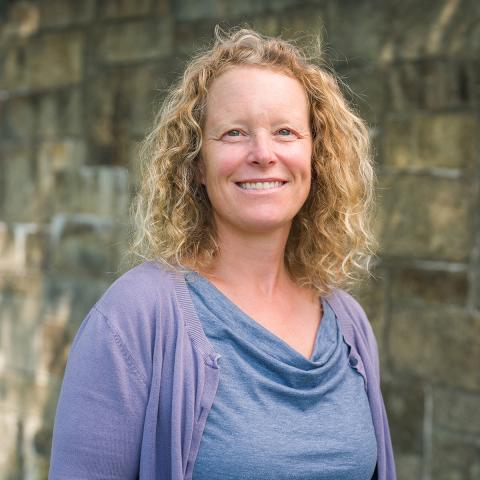
Becky Sideman's horticulture innovations provide vital information for local farmers and growers.
“What’s challenging and wonderful about local agricultural systems is that it isn’t possible to grow anything on a vast scale here, and people aren’t locked into any one system,” Sideman says. “A lot of consumers are interested in good local food, so there are commercial opportunities out there, but growers and farmers have to diversify and figure a lot of things out for themselves. My work can give them a head start with that.”
The process is seldom quick or easy. A good example is Sideman’s NHAES work on sweetpotatoes, a crop that is widely grown in the south but one that was not even on growers’ radars this far north until recently. More than 15 years ago, Sideman began investigating whether sweetpotatoes could be a viable commercial crop despite New Hampshire’s short growing season. Her research showed that certain varieties produce quite well in the Durham fields, and sweetpotatoes are easy to store into the winter months as well. The findings caught the eye of many local growers, and between 2007 and 2022 New England sweetpotato crop values grew by 98 percent.
Sideman has also worked with seedless table grapes, a popular crop that, at this time, is almost always trucked to New Hampshire from distant warm-weather growers. In a study that took seven years to complete, Sideman and her team worked with eight table grape varieties that had showed promise in preliminary studies. They assessed two different growing systems and the yield, disease resistance, and storage potential of the grape varieties over multiple harvests. The results showed that while some varieties fared poorly, others have real potential for commercial growing, providing growers with the insight needed to explore an appealing new crop option.
In addition to introducing new crops, Sideman is an expert in protected agriculture. While greenhouses are the most familiar protected agriculture facilities, far more economical options such as row covers and high tunnels, the simple plastic-sided structures that dot the countryside, are also quite effective at protecting crops when managed properly.
“You can use low-tech structures to shift crops’ seasons, such as growing onions through the winter,” Sideman says. “Then in spring, when fall-harvested onions are fading, you can harvest fresh onions for sale at time when local fresh produce is scarce.”
A lifelong passion
For Sideman, her lifelong passion for food production was an inspiration for her professional career and now transcends her work.
“I grew up on a farm, and gardening and food production have always been important parts of my life,” she says. “Now I love to work on my homestead farm with my husband Eric. There, I can also try things on small scale that might be worth exploring from a research standpoint.”
While hard pressed to name a favorite crop, Sideman allows that she and Eric take charge of different plants, and she particularly enjoys growing cucurbits—the pumpkins, squash, and melons that make up UNH’s most famous plant breeding program—cut flowers, and mini experiments with new crops or methods. Succeed or fail, the small proof-of-concept tryouts are low risk, fun, and can inform what is worth doing from a research standpoint.
“I’m now trying some new things to better manage squash vine borers,” she says. “If they don’t work, the borers would have gotten to the plants anyway! But if they do, that’s something I can communicate to other gardeners. Not everything I do at home can be adapted for commercial growing, but if there’s potential, we can study whether something will scale up enough to be helpful for industry as well.”