
Green Earth Charitable Organization Supports Shea Agroforestry Research and Farmer Livelihoods in Northern Ghana
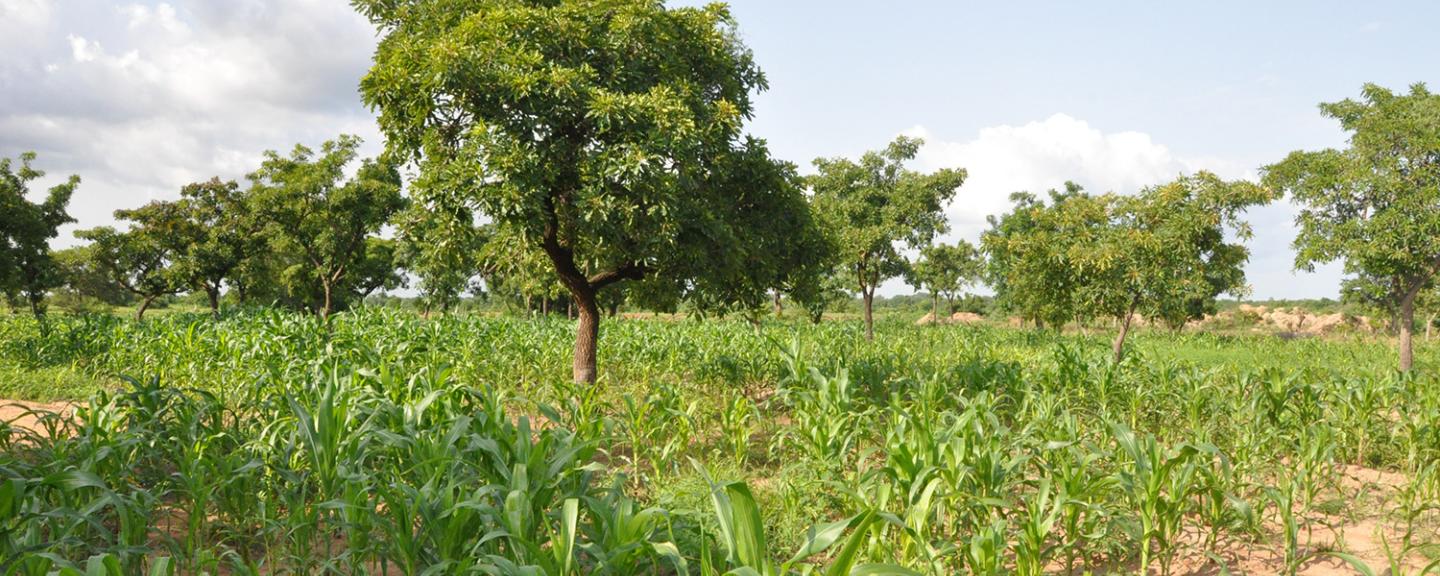
A $1.1 million, five-year gift to the University of New Hampshire (UNH) from the Green Earth Charitable Organization will support a comprehensive research and implementation project focused on strengthening shea-based agroforestry systems in northern Ghana. The project, Transforming shea-based agroforestry systems in Ghana for improved ecological resilience and livelihoods of rural households, will be led by Iago Hale, professor of agriculture, nutrition and food systems, in close collaboration with scientists at the Cocoa Research Institute of Ghana (CRIG).
An ecologically resilient keystone agroforestry species across sub-Saharan Africa, the shea tree (Vitellaria paradoxa) is highly valued for its role in supporting rural livelihoods, especially those of women who gather its seeds for processing into shea butter for use in both food and cosmetics. However, shea populations are in sharp decline due to land-use pressure, slow regeneration, and environmental degradation.
The funded work seeks to restore approximately 1,000 acres of shea-depleted farmland by integrating improved, early bearing shea trees into modern food-crop farming systems. Through participatory engagement, 400 smallholder households will be trained in tree planting and cultivation, with farms serving as demonstration sites for communities across Ghana’s shea belt.
Building on prior research led by Hale that sequenced and annotated the shea genome, identified key agronomic traits, and laid the groundwork for developing early-bearing breeding lines, the project has two primary objectives. The first is to identify superior shea tree genotypes (varieties) for long-term conservation, propagation, and breeding by combining detailed field measurements with genomic analyses.
The second objective focuses on improving farm productivity and resilience by establishing shea–food crop agroforestry systems on 400 participatory farms. Approximately 40,000 grafted, early bearing shea trees will be produced and planted at a target density of 40 trees per acre. The improved varieties are designed to fruit in less than five years—a significant improvement over the 25+ years it typically takes for a shea tree to enter reproductive maturity—and to integrate with mechanized food-crop production while maintaining the traditional ecological benefits of shea parklands.
"In this era of increasingly short funding cycles, it's difficult to find resources to work on the genetic improvement of a slow-growing tree species like shea, despite its clear ecological and economic importance," Hale said. "We're so thankful for this opportunity to build on our decade-long work with this remarkable tree to bring practical benefit to farming families."
In Ghana, project implementation will be led by Dr. Michael Barnor and a dedicated technical team based at CRIG's Bole Research Substation, while drawing on the expertise of Hale, who will serve as genomics lead, joint project coordinator, and administrative manager. The project includes long-term, multi-locational evaluation of tree performance as well as a shea conference and outreach events to share results, best practices, and improved planting materials with stakeholders across the shea value chain.
“Dr. Hale recognizes that meaningful agricultural research requires local, place-based, and farmer-engaged experimentation,” said Anton Bekkerman, director of the New Hampshire Agricultural Experiment Station and associate dean of research for the UNH College of Life Sciences and Agriculture. “By pairing this with modern genetic science, he has been able to significantly reduce the time between a nascent idea and impactful innovation—an approach that enables him to deliver real benefits to Northeast producers and now promises global impacts. And, undoubtedly, the expertise gained through this project will strengthen his future work in New Hampshire.”
The gift to UNH comes from the Green Earth Charitable Organization. With a focus on drought- and fire-resistant tree species, the organization aims to enhance biodiversity and resilience through science and engineering, enabling ecosystems to better adapt to future environmental changes.
PHOTOS AVAILABLE FOR DOWNLOAD
Intercropped Shea.JPG – A photo showing maize intercropped with shea trees in Northern Ghana (Credit: Iago Hale)
Grafting.jpg – CRIG staff grafting seedlings of superior shea selections for this project (Credit: Michael Barnor)
Early Bearing.JPG – One of this project’s promising early-bearing shea selections (Credit: Michael Barnor)
Shea in Landscape.JPG – A photo showing the size and form of a typical mature shea tree (background), as well as the species’ fire-resistant bark (foreground) (Credit: Iago Hale)
Cooking.jpg – Women processing shea nuts into shea butter (Credit: Michael Barnor)
Shea fruits.JPG – Shea butter is extracted from the seeds (kernels) of the shea fruit, seen here still on the tree (Credit: Iago Hale)