
Powerful Solar Storms May Change Weather Patterns Across North America
For decades, scientists have searched for a clear link between the sun’s explosive storms and the weather we experience on Earth. Now, a breakthrough study from the University of New Hampshire reveals that in the hours and days following a solar storm, parts of North America can see sharp changes in the weather, such as declines in precipitation — and the more powerful the storm, the more dramatic the shift.
The study, published in Geophysical Research Letters, offers the first detailed look at how Earth’s weather responds immediately after a solar flare blasts electromagnetic radiation and high-energy particles toward our planet.
“We’ve long understood that the sun influences our atmosphere over its roughly 11-year cycle — it’s subtle, but it’s there,” says Joachim Raeder, UNH professor emeritus of physics and the study’s sole author. “What’s exciting is that we’re now seeing a much stronger, short-term impact — happening within a single day of a solar storm.”
Raeder’s analysis uncovered surprising patterns: regions like Canada’s Hudson Bay and the Rocky Mountains in the western U.S. showed notable drops in rainfall and snowfall following solar storms. While the geographic concentration of these changes remains a mystery, the patterns in the data are unmistakable. Even more intriguing, large solar storms that strike in summer or winter appear more likely to suppress precipitation than those occurring in spring or fall.
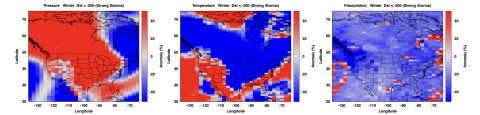
Weather anomaly maps show the potential changes in surface pressure, temperature, and precipitation following a strong solar storm.
Beyond precipitation, Raeder examined other weather factors, including wind speed, temperature, radiation, and surface pressure. While also significant, those effects were more scattered and localized across North America, defying simple, across-the-board conclusions.
The findings were made possible by combining 67 years of space weather records with newly available atmospheric data, then analyzing them with advanced computer models and anomaly mapping techniques. The result: Patterns that had never been visible before suddenly came into focus.
Earth’s atmosphere is an intricate, dynamic system, and tracing a direct cause-and-effect relationship with space weather is no easy task. Still, Raeder’s research offers valuable clues to determine why solar storms might suppress precipitation events. One possible explanation noted in the paper is the electromagnetic radiation from the solar flares penetrate through to the Earth’s lower atmosphere via the Polar vortex — the large area of low pressure and cold temperatures at the poles. Raeder suggests this could provide a more likely pathway to drive weather changes than competing hypotheses, such as the idea that the sun modulates cosmic rays and subsequently affects cloud formation.
While this discovery won’t change the daily weather forecast just yet — predicting space weather remains a major challenge — it opens the door to something bigger. By factoring solar storms into climate models, researchers may ultimately sharpen long-term projections and deepen our understanding of how forces far beyond Earth influence life here at home.
Raeder also notes, “Like many other studies on the same topic, I cannot provide the ultimate answer, but my results narrow down the list of possible physical processes, and in particular, challenge the atmosphere models to reproduce these solar effects on weather.”