What is a minor in Computer Science?
Learn essential skills through specialized courses in programming and software development.

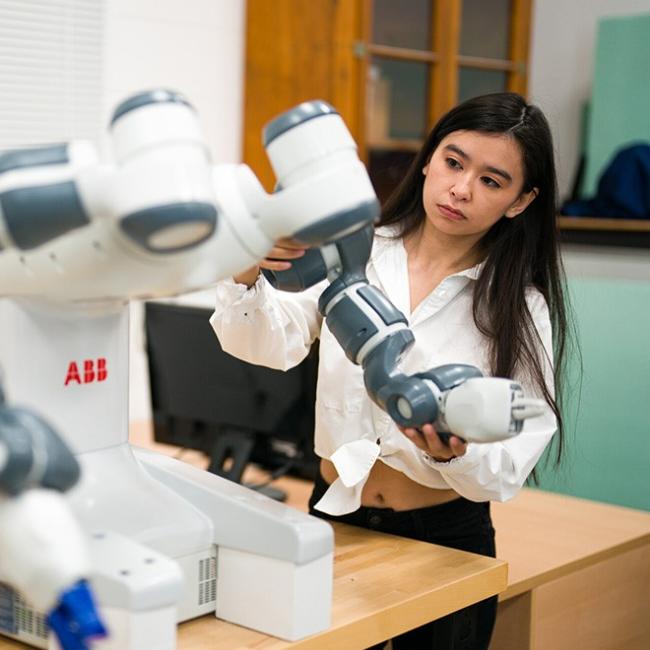
COmputer Science
The Computer Science minor at UNH offers foundational training in software design and computational thinking. Here you'll be able to develop programming skills and problem-solving techniques while accessing resources like the Interoperability Lab and student organizations.
Through hands-on experience with current technologies, you'll gain valuable expertise that enhances your major and expands your career opportunities across fields.
The only first-year research and innovation program of its type in the region!
The Innovation Scholars program, open to all CEPS majors, offers students an exceptional launch to their college experience. Through multiple interdisciplinary cohorts and hands-on research in world-class facilities, students build confidence, gain real experience, and open doors to paid research, internships, and future graduate study. It’s a proven program that helps students shape their future from day one.
Key Links
Contact Cards
Learn essential skills through specialized courses in programming and software development.
Our fundamentals-based programs equip students with the knowledge and skills needed for today’s rapidly evolving careers. Our graduates have achieved remarkable success as entrepreneurs, key contributors in startups, and corporate leaders. Our alumni can be found in virtually every major tech company and throughout fields as diverse as finance, insurance, and defense. Student learning is supported through the Programming Assistance Center for introductory classes and through peer support for advanced courses. The department provides opportunities for students to augment their studies by engaging in research through projects and independent studies. Students have access to the UNH Interoperability Lab, where they have opportunities to work alongside top tech companies, and the UNH ECenter, where they can receive assistance with entrepreneurial ventures. Many of UNH’s student organizations, such as the Cybersecurity Club, are a natural fit for our students.
The minor in computer science is designed for students in other majors who want to learn the fundamentals of designing and implementing computer software.
Students interested in the Computer Science minor should contact Arvind.Narayan@unh.edu for more information.
Academic policies related to Minors.
| Code | Title | Credits |
|---|---|---|
| Requirements | ||
| CS 415 | Introduction to Computer Science I | 4 |
| or CS 410C | Introduction to Scientific Programming/C | |
| or CS 410P | Introduction to Scientific Programming/Python | |
| CS 416 | Introduction to Computer Science II | 4 |
| or CS 417 | From Programs to Computer Science | |
| CS 420 | Foundations of Programming for Digital Systems | 4 |
| CS 515 | Data Structures and Introduction to Algorithms | 4 |
| Other Courses | ||
| Select one of the following: | 4 | |
CS 619 | Introduction to Object-Oriented Design and Development | |
CS 520 | Computer Organization and System-Level Programming | |
CS 620 | Operating System Fundamentals | |
CS 659 | Introduction to the Theory of Computation 1 | |
CS 761 | Programming Language Concepts and Features | |
An approved CS 700-level course | ||
CS 659 Introduction to the Theory of Computation has mathematics prerequisites: MATH 425 Calculus I, MATH 426 Calculus II, and MATH 531 Mathematical Proof.