




















| |
 |
UNH Exhibit Highlights Study
Abroad Experience
Contact: Erika Mantz
603-862-1567
UNH Media Relations
March 23, 2005

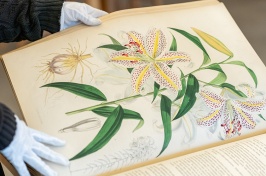
Editors: A photo is available for download
at http://www.unh.edu/news/img/DSC_2147.jpg
DURHAM, N.H. – Memorabilia from University
of New Hampshire students and professors who traveled abroad in
the early 20th century will be on display at the Museum of the Dimond
Library on the UNH campus beginning Thursday, March 31, 2005. An
exhibit opening and reception will begin at 5 p.m.
Organized in collaboration with UNH’s Department of Languages,
Literatures and Cultures, the exhibit will also feature memorabilia
from Mabel Ethelyn Spofford, who traveled to Spain in 1923 to study
at the Residencia de Estudiantes. The Residencia was a leading cultural
center and the first Spanish academic institution with a female
branch. Some of the most famous Spanish artists, poets and filmmakers
of the 20th century — Garcia Lorca, Salvador Dali and Luis
Buñuel, to name a few — studied there as well.
“This exhibit will provide the UNH community with the opportunity
to view a private cultural treasure and give us a chance to emphasize
the educational importance of traveling and studying abroad as a
way to promote international and inter-cultural contact and understanding,”
says Carmen Garcia-Rasilla, assistant professor of Languages, Literatures
and Cultures. The formal opening at 5 p.m. March 31 will include
an introductory talk as well as a poetry reading from poets connected
to the Residencia during Spofford’s stay, and music from Manuel
de Falla, interpreted by soprano Darby Tench and pianist Linda Chaston.
Refreshments will be served.
Spofford, a 1914 graduate of Wellesley College, went on to become
an English teacher, spending five years in the Dover, N.H., schools.
Items from her personal collection in the exhibit include a photo
album, letters she wrote to family members while in Spain, and copies
of speeches she gave about the trip when she returned.
“The year of Ethelyn’s trip was also a turning point
in the history of Spain,” Garcia-Rasilla says. “The
dictatorship of Primo de Rivera put an end to parliamentary rule
and paved the way for the Civil War. Some of her comments and photographs
make explicit references to social conditions that help us understand
the unstable political situation in Spain during that era.”
The exhibit is sponsored by the Center for the Humanities and UNH’s
Department of Languages, Literatures and Cultures. For more information
contact the Spanish program at 603-862-3121.
|