



















By Jody Record, Media Relations
It’s not yet known whether videoconferencing is the wave of the academic future but one thing’s for sure: the technology saved the day when a guest lecturer in England couldn’t make it across the ocean to speak at the UNH Institute on Disability’s annual conference on autism.
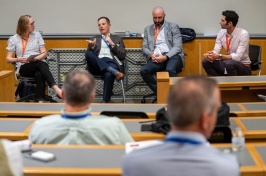
Essex native Ros Blackburn was one of the three keynote speakers scheduled for the Autism Summer Institute, held Aug. 14- 16 at Holloway Commons. Like the other two lecturers, Blackburn has autism.
Four days before the conference was to begin, she contacted IOD to say she couldn’t attend because her caregiver (although highly articulate, Blackburn requires constant assistance) did not want to fly.
That left folks at the IOD scrambling. One of the goals of the three-day conference was to present a real-world perspective of what life is like for people living with Autism Spectrum Disorder (ASD) and they wanted Blackburn’s input.
“She was the highlight of the conference. We really wanted her to participate,” says MaryAnn Allsop, information support assistant for IOD. “We were trying to think of what we could do when I thought of Mark.”
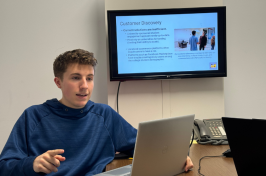
Mark Leonard is a technical specialist with Academic Technology. Allsop had met him during a distance learning class earlier this year.
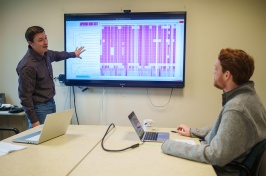
“I got a call saying, can we do a videoconference with someone in England?” Leonard says, adding such calls average about three a month. “I knew if we had a connection over there, we’d be all set. Right now, we’re going all over the planet.”
The pair had barely two days to pull the videoconference together. They had to find a university or college near Blackburn that could serve as the connection on the other end. Leonard put Allsop in touch with the University of Essex, which was able to do the job.
“It took a lot of back and forth phone calls,” Allsop says. “But it all worked out. I got goose bumps when I saw her on the screen. There she was, bigger than life. I couldn’t believe what we were doing.”
Videoconferencing provides near-television quality video and
audio signals in real time.
The sound is so good, Leonard says, if you turned your head,
you wouldn’t know the person wasn’t in the room.
“It allowed people to be very, very interactive,” he says. “It’s not like a telephone call at all. The audio was great.”
In fact, a hand-held microphone was passed around so the 100-plus attendees could ask questions of Blackburn.
“She could hear them perfectly,” Leonard says. “Videoconferencing is terrific technology when you want to be in two places at once.”
What’s more, Allsop says it’s “very inexpensive.” UNH charged IOD $310; the University of Essex, $235 pounds for two hours.
“If you consider the cost of flying someone over and paying
for their lodging, it would have been a lot more expensive,” Allsop
says. “For us, with little or no time to pull things together,
and being able to do so, it was a bargain. Mark was great. He
had to run back and forth between other conferences but it worked.
He really went above and beyond. He saved the day.”