

























| 
From
left: U.S. Senator Judd Gregg, NASA Associate Administrator for
Earth Sciences Ghassem Asrar, UNH President Ann Weaver Hart, and
Navy Vice Adm. Conrad C. Lautenbacher aboard the NOAA Research Vessel
Ronald H. Brown. (Sharon Keeler/Media Relations)
Atmospheric research lauded by Gregg
Midpoint of air quality study
marked
By
David Sims, EOS
Scientists and dignitaries involved in the largest air quality-climate
study ever conducted recently marked its midway point and announced
the successful maiden flight of a balloon mission that has ushered
in a new era of atmospheric research.
The multifaceted study, known as the International Consortium for
Atmospheric Research on Transport and Transformation or ICARTT,
began July 1 and will run through mid-August. Seacoast New Hampshire
is serving as the center of operations for the research in large
part because of the University of New Hampshire’s Atmospheric
Investigation, Regional Modeling, Analysis, and Prediction (AIRMAP)
program, which U.S. Senator Judd Gregg (R-NH) has been instrumental
in funding.
Scientists from UNH also developed a state-of-the-art, miniature
ozone-measuring instrument that flew on a 12-foot “Smart Balloon”
from Orient, New York, to Lincoln, Maine, at 1,500 feet on July
15. The flight marked the first time a small balloon has carried
an air quality instrument for an extended mission at low altitude.
Said UNH President Ann Weaver Hart, “This is truly a landmark
event and promises to change forever the way we study air pollution
in the atmosphere we breathe. We are no longer tied to ground-based
instruments and expensive airplane missions.”
The ozone instrument developed at UNH weighs only five ounces and
cost $1,000 to build. The balloon is one of many mobile and ground-based
platforms being deployed for this summer’s multifaceted, international
study.
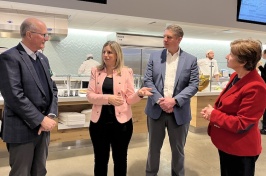
At a press briefing in the shadow of the National Oceanic and Atmospheric
Administration’s (NOAA) Research Vessel Ronald H. Brown, Sen.
Gregg said, “This gathering is a true demonstration of how
the University of New Hampshire has established itself as a leader
in the fields of atmospheric science. The fact that this study is
being done right here in New Hampshire is a testament to the outstanding
researchers and scientists and their dedication to studying the
world around us and finding ways to improve our quality of life.”
“The university and I have worked together for a number of
years on air quality studies, and to see the magnitude and scope
of this project, on both a national and international level, is
both amazing and exciting. I couldn’t think of a better place
for that to happen, and the work done here will highlight the need
for us to address this nationwide problem of air pollution,”
Gregg said.
In his capacity as chairman of the Senate Appropriations Subcommittee,
Sen. Gregg secured $5.75 million for the New England portion of
the project (the New England Air Quality Study) and $9 million for
efforts to improve air quality forecasting. NOAA is scheduled to
begin trial forecasting for New England this September.
“ It is through the foresight of Senator Gregg that this large-scale,
multi-agency air quality research is being done here in the seacoast
of New Hampshire,” Hart said. “The senator took the
initiative to fund the New England Air Quality Study each year,
starting in 2001, at a level that ensured a major study. That in
turn was enough to encourage others to join in what then became
the biggest air quality study ever.”
The air campaign involves six countries, a dozen airplanes, the
274-foot R/V Brown, balloons, satellites, and a network of state-of-the-art
ground-based observing stations. The study is led by NOAA’s
Aeronomy Laboratory in conjunction with AIRMAP - a NOAA/UNH cooperative
atmospheric observation network. NASA, the Department of Energy,
and a host of other institutions from around the country are also
involved in this summer’s project, as well as scientists from
Britain, France, Germany, and Canada.
“Data from this summer’s experiment, combined with insights
from work done in 2002, are providing new perspectives on long-standing
questions,”said retired Navy Vice Adm. Conrad C. Lautenbacher,
under secretary of commerce for oceans and atmosphere and NOAA administrator.
“By pulling out all the stops and collecting data on the ground,
in the air, and at sea, we will have some good information on which
to help guide our decisions in the future,” Lautenbacher said.
Added Berrien Moore III, director of the Institute for the Study
of Earth, Oceans, and Space, “We are honored to be working
so closely with NOAA on this ambitious and complex field campaign.
And we are ever grateful to Senator Gregg for his commitment to
getting the science needed to understand the dynamics of our region’s
variable air quality and, ultimately, protecting the air we breathe.”
|